Free Microsoft Dynamics MB-230 Actual Exam Questions
Dumps Box (DumpsBox) offers up-to-date practice exam questions for MB-230 certification exam which are developed and validated by Microsoft subject domain experts certified in Microsoft Dynamics MB-230 . These practice questions are update regularly as we keep an eye on any recent changes in MB-230 syllabus, and when there is update our team quickly adjusts the questions. This commitment to providing the best quality exam prep material to certification aspirants is what makes DumpsBox.com the best certification exam prep website. On top of that, our strong, yet strictly moderated, community based feedback keeps the content clean and current. Each question has helpful community discussion that provides it extra perspective and introduces helpful resources for better exam preparation. This also saves students from other outdated practice questions or illicit exam dumps that can have adverse affects on career. Browse through our Microsoft Dynamics MB-230 exam questions and pass your exam on first try.
HOTSPOT You need to configure each escalation scenario. Which configuration should you use for each scenario? To answer, select the appropriate options in the answer area. NOTE: Each correct selection is worth one point. 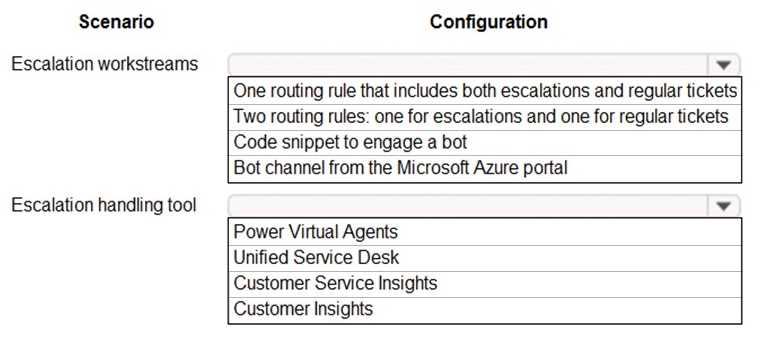
For scenario 1, option B fits since it shows a call escalation. Scenario 2’s alert icon lines up with option C for notifications. I’d rule out email since none of these icons really suggest that method here.
Looks like scenario 1 matches the call escalation icon, so option B fits there. Scenario 2 shows a notification alert, so option C seems right for that one. The icons are key to these choices.
DRAG DROP A Dynamics 365 Customer Service organization uses routing rules to escalate cases. Security roles have not been modified or created. You need to modify the routing rule set that is currently in use and enforce the principle of least privilege. Which five actions should you perform in sequence? To answer, move the appropriate actions from the list of actions to the answer area and arrange them in the correct order. 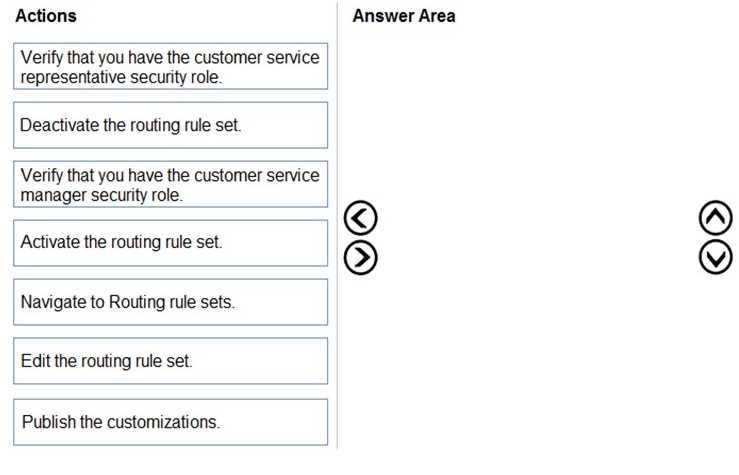
I think you should start by disabling the active routing rule set to prevent conflicts. Then update the rules as needed, modify security roles for least privilege, assign the updated roles, and finally activate the new routing rule set.
I’d kick off by updating the routing rule set first since that’s the core task. Then limit access by assigning the least privileged role that can still edit these rules, finally activating the new set after changes are locked down.
DRAG DROP You are customizing a Dynamics 365 for Customer Service implementation. The call center manager requires a visual representation that includes the number of resolved cases by month for each call center agent. The chart must be visible to all users within the service area. You need to create the chart. Which three actions should you perform in sequence? To answer, move the appropriate actions from the list of actions to the answer area and arrange them in the correct order. 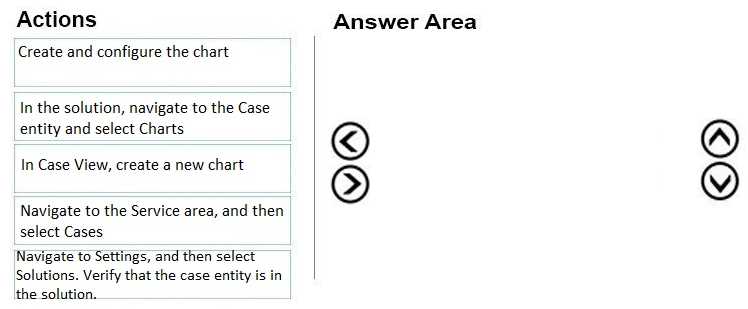
I think the key is creating the system chart first to make it available to everyone, as that’s a must. Then apply the filter for resolved cases so you’re only tracking ones that matter here. Last, grouping by agent and by month should give the clear visual breakdown the manager wants. If you don’t do it in this order, the data might not show correctly or be shareable across all users. Also, filtering before grouping helps keep the chart clean and focused on resolved cases only.
Start with system chart, filter by resolved cases, then group by agent and month.
HOTSPOT You view the interactive dashboard in the Microsoft Dynamics 365 Customer Service Hub. 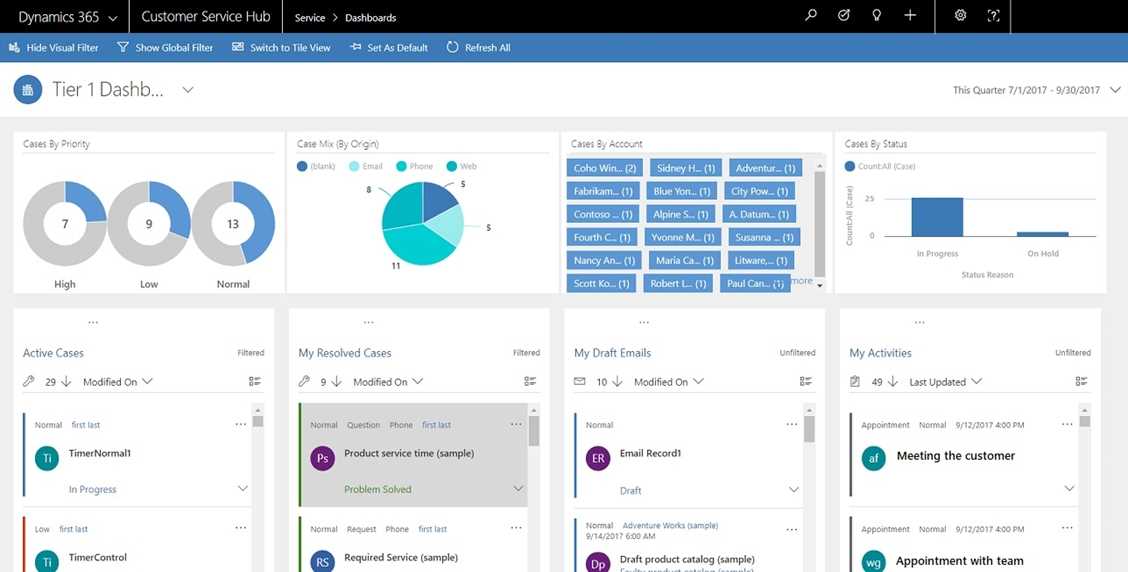 Use the drop-down menus to select the answer choice that answers each question based on the information presented in the graphic. NOTE: Each correct selection is worth one point.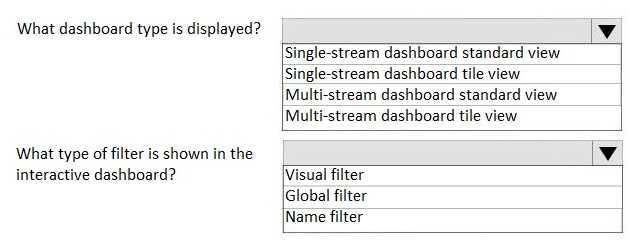
The top chart looks like a case type breakdown since it has categories like product issue and inquiry. For the time-based graph, I’d pick “Average Resolution Time” because it tracks duration trends, not just counts.
For the last dropdown, I think it shows "Average Resolution Time" because the graph has time on the Y-axis and dates on the X-axis, which matches tracking resolution trends over time rather than just case count.
What should you do?
B makes sense; routing rules handle notifications, not just monitoring sentiment.
This one feels like C to me. Turning on the Monitor real-time customer sentiment option seems like the first step to actually detect unhappy patients. Without that, you can’t really trigger any alerts or notifications effectively. B might route once something is flagged, but C sets the foundation.
HOTSPOT You use Dynamics 365 for Customer Service administrator. You plan to create Voice of the Customer surveys. You need to determine which survey question feature is needed to complete the design of the survey. Which survey features should you use? To answer, select the appropriate survey type in the dialog box in the answer area. NOTE: Each correct selection is worth one point. 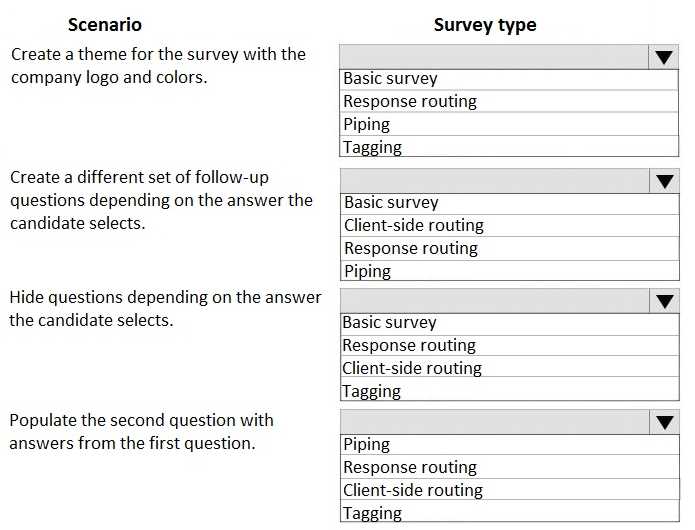
I think D makes more sense since it covers branching and logic, which are key for customizing question flow. B looks more like just rating scales without the advanced question controls needed here.
I think B is the right pick for question types since it mentions rating scales, which are common question features. D seems more about survey flow, so for question features, B nails it better.
Which two actions should you perform? Each correct answer presents part of the solution. NOTE:
Each correct selection is worth one point.
Couldn’t it be B and E? Adding the chatbot to the queue and setting context seems basic.
D imo, setting up separate queues is crucial for clear workflow, and E helps the chatbot understand context better, which improves its responses. Without context variables, the chatbot might miss important info.
HOTSPOT A company uses Omnichannel for Customer Service. The company has the following requirements for their agents' conversations with customers: Agents must verify a customer's information when a chat starts. Auto search must be enabled for knowledgebase articles based on case title. You need to enable agent scripts. Which action types should you use? To answer, select the appropriate options in the answer area. 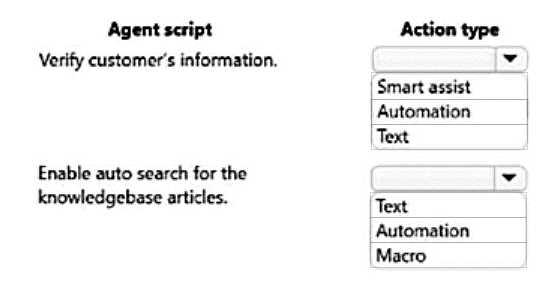 NOTE: Each correct selection is worth one point.
I’m thinking “Show Input” makes sense for verifying customer info since the agent needs to confirm details right at the start. For the auto search part, “Knowledge Article Search” fits because it triggers the system to pull relevant articles based on the case title automatically. The other options don’t seem to trigger the kind of interaction or automation needed here. So, I’d pick those two for the respective actions.
“Show Input” for verification and “Knowledge Article Search” for auto search.
case summary Copilot.
A user tests the Case summary feature of Copilot. The user observes that the case summary card
states, "There's not enough information to summarize." You need to recommend an action so an
administrator can configure the case summary correctly. Which action should you recommend?
I'm thinking option A might be worth considering. If the activity highlights summary is too limited or not expanded, there may not be enough content for Copilot to generate a summary. Expanding it could feed more info into the summary card. The case description alone might not be enough if the system relies on activity data to build a full picture. Has anyone seen if expanding activity highlights actually changes the summary result?
Maybe D makes the most sense here because without a description, Copilot has nothing to analyze or summarize. Even if you have activities or other notes, the description is usually the main source for a summary. I doubt just refreshing (E) or changing status (B) will help if the core info isn’t there. Expanding activity highlights (A) seems unrelated since the summary depends on case text. Feedback (C) is more of a long-term fix, not immediate. So making sure the case has a proper, detailed description is probably what will fix that “not enough information” message.
A customer service supervisor must create canvas apps. The environment uses a Microsoft Dataverse
database. The supervisor must be able to create new connections and Microsoft Power Automate
flows. The supervisor must not have data access privileges to data in the environment.
You need to assign a role to the supervisor by using the principle of least privilege.
Which security role should you grant to the supervisor?
It’s A—System Customizer and Admin roles definitely give too much data access.
B imo, because System Customizer lets you work on app customizations without broad data access, and might allow creating flows and connections too, without full admin rights. It’s less risky than giving Environment Admin or System Admin.
DRAG DROP A company uses Dynamics 365 Customer Service and Microsoft Teams. A project requires the creation of an automated tool to provide recommendations when addressing specific client needs. The tool must be interactive and allow agents to best serve their client base. All communications will be run through Teams chat You need to configure the smart assist chatbot In which order should you perform the actions? To answer, move all actions from the list of actions to the answer area and arrange them in the correct order. 
Looks pretty straightforward, I’d start with setting up the bot in Power Virtual Agents first.
You need to switch workspaces.
What should you do?
Maybe C, since switching usually means choosing from your saved workspaces.
It’s C for sure. You just go to My workspaces and pick the one you want. Options A and D don’t really fit how the interface works, and B sounds more about sharing than switching. Pretty straightforward question.
DRAG DROP A company implements Dynamics 365 Customer Service. You must create an external-facing website that allows customers to perform the following tasks:
• View the status of open support incidents.
• Search knowledge base articles.
• Access support discussion forums.
• Update customer profile information.
You need to create the portal. Which four actions should you perform in sequence? To answer, move the appropriate actions from the list of actions to the answer area and arrange them in the correct order. 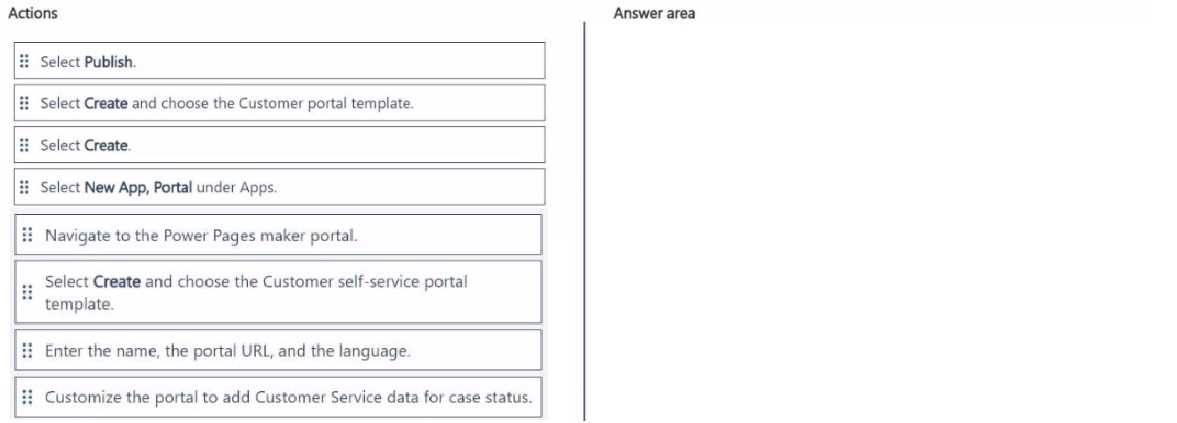
Start with portal creation, then add incident views before knowledge base and forums.
I’d start by creating the portal first to set the foundation, then enable authentication before adding incident views and knowledge base search since profile updates require logged-in users. Forums can come last as they’re less critical initially.
DRAG DROP You are setting up Omnichannel for Customer Service. You need to automate the following tasks to make it easier and quicker for representatives to assist customers: Establish a one-step process to send a predefined email to customers once a representative is done helping them. Ensure that representatives ask predefined questions to identify a customer before troubleshooting a case. Have chatbots available to help make recommendations in typed conversations. Which tools should you use? To answer, drag the appropriate tools to the correct requirements. Each tool may be used once, more than once, or not at all. You may need to drag the split bar between panes or scroll to view content. 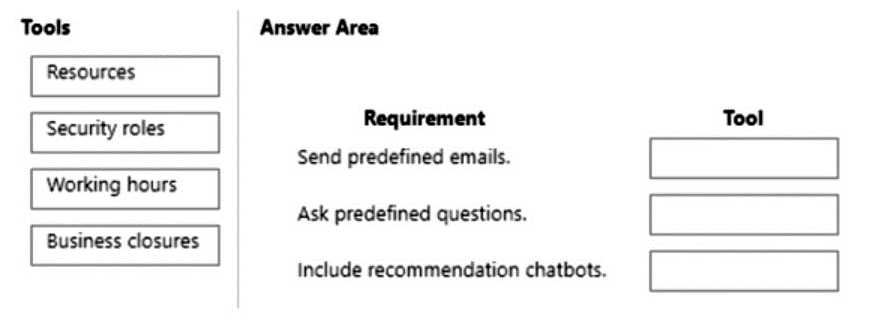
I agree the email part is definitely Power Automate flows, since it’s about sending something automatically once reps finish. For the customer ID questions, I’m thinking business rules because they can enforce required fields before moving on. Chatbots are an obvious fit for making recommendations during chats because they handle interactive conversations easily. Doesn’t seem like guided help fits here since it’s more about navigation assistance than enforcing questions or automating email. So, flows for email, business rules for questions, and chatbots for recommendations seems solid from a d
I’d say flows for the email, chatbots for recommendations, and business rules for mandatory questions.
HOTSPOT You need to configure the correct settings. Which settings should you configure? To answer, select the appropriate options in the answer area. NOTE: Each correct selection is worth one point. 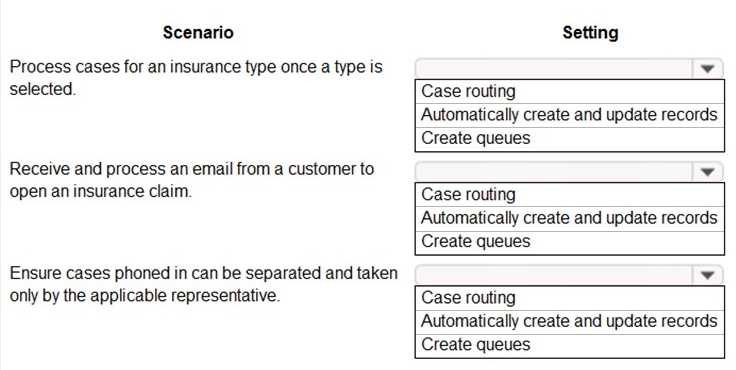
I’d pick B for subnet mask since it’s the standard class C range, which fits most setups. For IP range, A covers the necessary client scope without overlapping or wasting addresses.
I’d go with B for subnet mask since it defines the network size properly, and A for IP range as it fits the client pool best. C and D feel either too broad or off-topic here.