Free Cisco 350-701 Actual Exam Questions
Dumps Box (DumpsBox) offers up-to-date practice exam questions for 350-701 certification exam which are developed and validated by Cisco subject domain experts certified in Cisco 350-701 . These practice questions are update regularly as we keep an eye on any recent changes in 350-701 syllabus, and when there is update our team quickly adjusts the questions. This commitment to providing the best quality exam prep material to certification aspirants is what makes DumpsBox.com the best certification exam prep website. On top of that, our strong, yet strictly moderated, community based feedback keeps the content clean and current. Each question has helpful community discussion that provides it extra perspective and introduces helpful resources for better exam preparation. This also saves students from other outdated practice questions or illicit exam dumps that can have adverse affects on career. Browse through our Cisco 350-701 exam questions and pass your exam on first try.
What are two characteristics of the RESTful architecture used within Cisco DNA Center? (Choose
two.)
I agree that A and E look like the strongest choices here. REST APIs definitely rely on standard HTTP methods like GET, POST, PUT, and DELETE (so A fits). Plus, REST always uses HTTP as the transport protocol, which points to E. The other options seem off because REST isn’t tied to any specific OS or language (so B and C are out), and POST usually creates or modifies resources rather than outright replacing them like PUT does—so D doesn’t sound right. Could it be that the question is just testing basic REST principles without any Cisco-specific twists?
Option A and E seem spot on since REST mainly relies on those HTTP methods and communication.
DRAG DROP [Security Concepts] Drag and drop the common security threats from the left onto the definitions on the right. 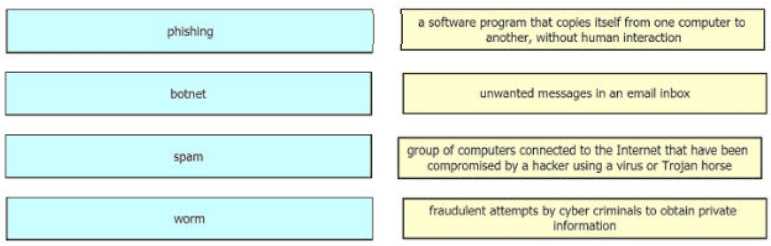
D looks better here since the definition talks about exploiting software flaws, which is what D usually covers in these questions. C seems more about tricking users, not technical exploits.
I’m thinking option D might be a better fit here because it talks about exploiting system vulnerabilities, which matches the description on the right better than C does. C seems more related to phishing or social engineering, but the definition looks more technical, so D feels like a stronger match. Also, the terms on the left seem to be pretty distinct, so eliminating ones that are clearly about human attack vectors helps narrow it down.
DRAG DROP [Security Concepts] Drag and drop the descriptions from the left onto the correct protocol versions on the right. 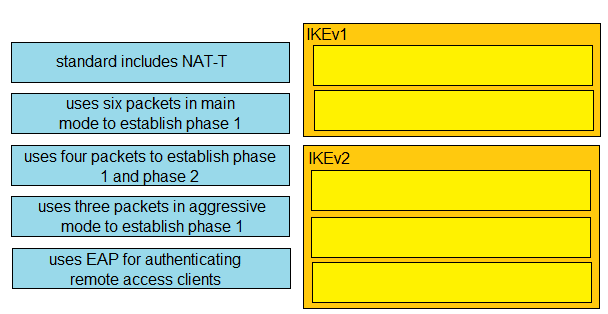
B fits NSEL as it highlights RSVP event export, which is specific.
I’d say C is not for NSEL since it talks about MPLS and complex metrics, which are more advanced than basic event filtering. It fits better with NetFlow v9 enhancements, so that leaves B clearly for NSEL.
Which two preventive measures are used to control cross-site scripting? (Choose two)
It’s B and D because output encoding and input sanitization actually stop XSS payloads.
B and D. Encoding output correctly (B) stops malicious scripts from executing, while sanitizing input (D) cleans any dangerous code before it gets processed. Options A and E don’t really prevent XSS, and C sounds unrelated since cookie inspection isn’t a direct XSS control. Overall, B and D cover both input and output sides, which is key in stopping these attacks.
DRAG DROP [Security Concepts] Drag and drop the features of Cisco ASA with Firepower from the left onto the benefits on the right. 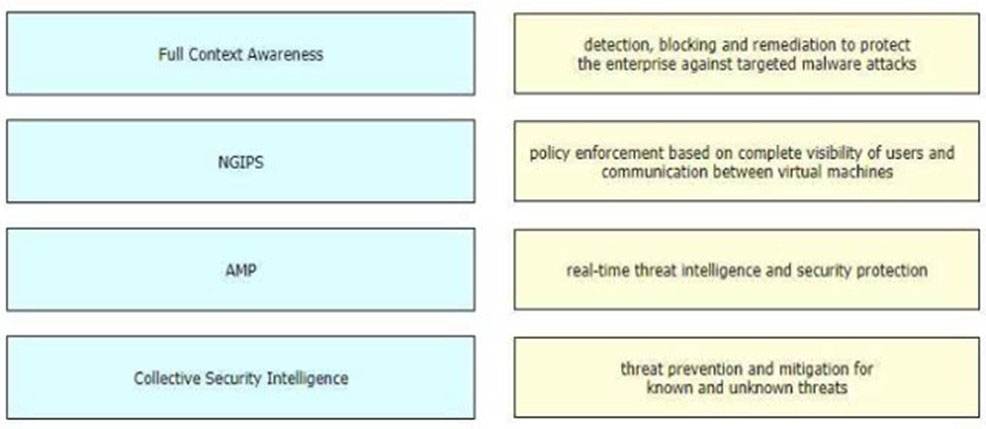
I’m thinking option A works because it highlights how ASA with Firepower simplifies management by uniting threat detection and firewall rules in one device, which is a big practical benefit.
I figured the key is that Cisco ASA with Firepower brings both firewall and intrusion prevention together, so matching those to benefits like enhanced security and threat visibility makes sense. The “combined defense” feature feels like a must-drop on the security boost.
Refer to the exhibit.
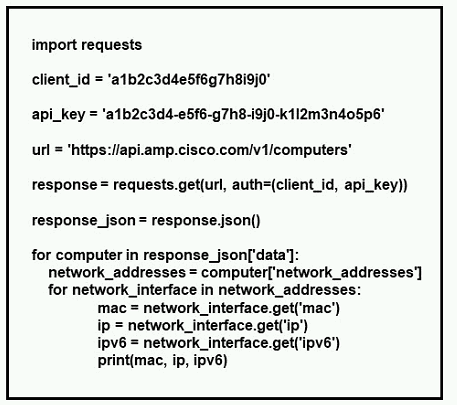
What does the API do when connected to a Cisco security appliance?
It’s D because gathering network interface info fits with what AMP sees on connected devices, not just process info or SNMP pulls. The API’s role here seems focused on endpoint interface details.
Option C makes sense since AMP focuses on endpoint telemetry data.
DRAG DROP [Secure Network Access, Visibility, and Enforcement] Refer to the exhibit. 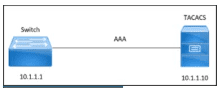 An engineer must configure a Cisco switch to perform PPP authentication via a TACACS server located at IP address 10.1.1.10. Authentication must fall back to the local database using the username LocalUser and password C1Sc0451069341l if the TACACS server is unreachable. Drag and drop the commands from the left onto the corresponding configuration steps on the right.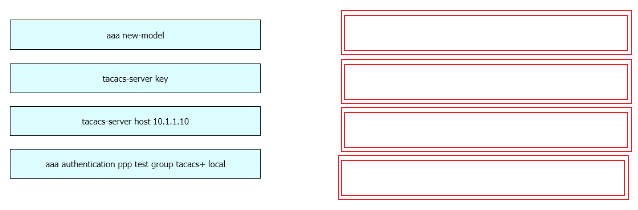
The local user config must match the exact username and password before AAA fallback.
I’m going with the commands that set up both AAA authentication and define the local user first. Without the local user configured, fallback wouldn’t actually work, so those steps have to be early in the process.
DRAG DROP [Security Operations] A network engineer is configuring NetFlow top talkers on a Cisco router Drag and drop the steps in the process from the left into the sequence on the right 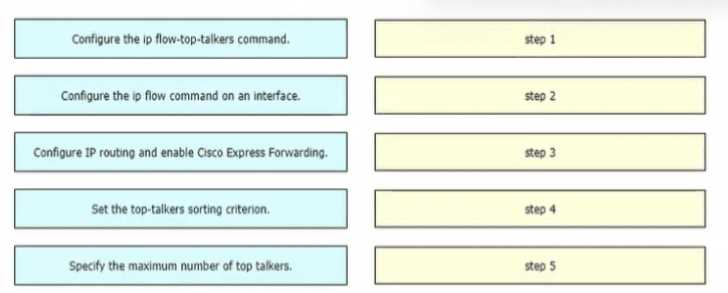
I think the order should start with B because you need to define where to send the data first. Then C comes in to specify what to capture, followed by A to create the monitor, and finally D applies it to the interface.
I see it differently. Since the flow record defines what traffic to capture, it should come before creating the monitor that references it. So it makes sense that step C (flow record) happens right after setting up the exporter in B. Then step A creates the flow monitor using that record and exporter, and finally D applies it. So the order B, C, A, D fits the logical setup better.
DRAG DROP [Security Operations] Drag and drop the NetFlow export formats from the left onto the descriptions on the right. 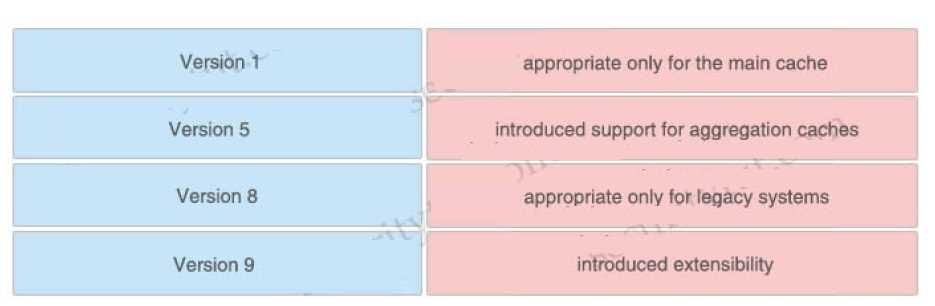
I think another good way to confirm is by remembering that NetFlow v5 is the oldest and most basic, so it’s definitely the one with fixed fields and IPv4-only support. v9 was introduced to add more flexibility and handle emerging network types but still isn’t as universal as IPFIX. IPFIX, being an IETF standard and designed as a successor, is meant for full extensibility like MPLS and IPv6 support. So matching them to their descriptions by how advanced and flexible they are makes sense here.
IPFIX matches the MPLS and IPv6 support description perfectly.
capabilities to administrators to allow them to view endpoint application usage?
It’s definitely B. Thinking about it, AMP Enabler (C) is mainly about malware protection and not really focused on app usage monitoring or integrating with Splunk for that kind of visibility. Network Visibility is built to track traffic and endpoint behavior which aligns more with what Splunk needs to provide admins with detailed insights. Plus, Umbrella Roaming Security (A) is mostly DNS-based security, so that wouldn’t cover app usage stats either. D also doesn’t fit since ISE Posture is about compliance checks, not monitoring apps on endpoints.
I’m with B here. Umbrella Roaming Security (A) is more about DNS-layer protection, so it’s unlikely to provide detailed app usage data for Splunk monitoring. B it is.
What are two advantages of using Cisco Any connect over DMVPN? (Choose two)
Option C and E since AnyConnect’s user focus beats DMVPN’s site-to-site model.
C and E, since AnyConnect focuses on user access and identity-based policies.
What is the result of running the crypto isakmp key ciscXXXXXXXX address 172.16.0.0 command?
B imo since it mentions a single IP, not a subnet, so it’s for that specific peer.
C imo since the crypto isakmp key command is used for IKEv1, it’s definitely about authenticating the peer’s IP, but it usually matches a single IP rather than a range. So C fits better than A or B.
Which Cisco DNA Center RESTful PNP API adds and claims a device into a workflow?
I think it’s D because the workflow API is designed to handle the whole process, not just import. Since adding and claiming is usually a combined step in PNP workflows, the api/v1/onboarding/workflow endpoint fits better than just importing or adding the device alone. B seems like just an import without claiming.
Option C adds the device but doesn’t claim it, so not that one.
DRAG DROP An engineer must configure AsyncOS for Cisco Secure Web Appliance to push log files to a syslog server using the SCP retrieval method. Drag and drop the steps from the left into the sequence on the right to complete the configuration. 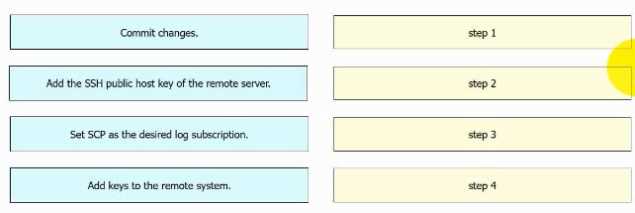
I think step 1 should be creating the SCP user account because without that, you can’t authenticate to the syslog server. After that, setting up the folder for the logs makes sense so the server knows where to place or get files. If you try to create the folder first without user permissions, it might cause errors or access issues. So, the sequence probably starts with user creation, then folder setup, then enabling SCP, and finally configuring the log push settings. This order avoids permission problems later on.
Creating the SCP user first makes sense since permissions are needed before folder setup.
DRAG DROP [Network Security] Drag and drop the cryptographic algorithms for IPsec from the left onto the cryptographic processes on the right. 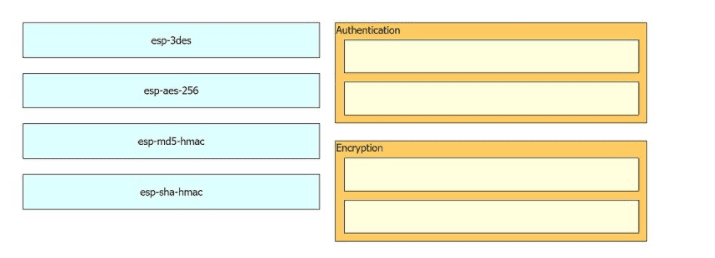
AES is definitely the encryption pick, so that’s a safe drag.
I think AES fits encryption best, so drop it there for sure.