Free Cisco 350-701 Actual Exam Questions - Question 8 Discussion
DRAG DROP [Security Operations] A network engineer is configuring NetFlow top talkers on a Cisco router Drag and drop the steps in the process from the left into the sequence on the right 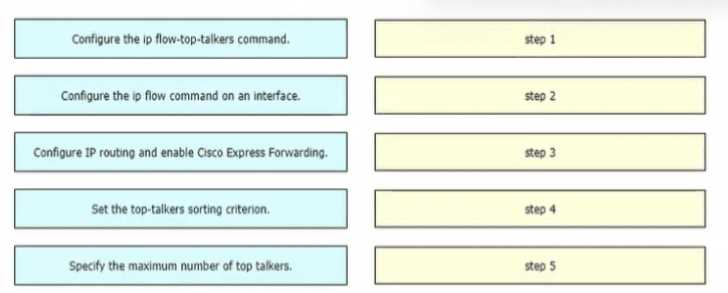
I think the order should start with B because you need to define where to send the data first. Then C comes in to specify what to capture, followed by A to create the monitor, and finally D applies it to the interface.
I see it differently. Since the flow record defines what traffic to capture, it should come before creating the monitor that references it. So it makes sense that step C (flow record) happens right after setting up the exporter in B. Then step A creates the flow monitor using that record and exporter, and finally D applies it. So the order B, C, A, D fits the logical setup better.
B sets exporter first, then C for flow record, A creates monitor, D applies it.
The key is remembering the flow. Step B sets up the exporter first, which sends data out. Step C creates the flow record or sampler to define what to capture. Then A makes the flow monitor combining record and exporter. Finally, D applies the monitor on the interface to start collecting stats. So the sequence goes B, C, A, D. Skipping or mixing up these would mess up data collection.
I think step A is about creating the flow monitor, which should come after setting up the exporter in B. So the order is B, A, then C, and finally D to apply it on the interface.
D looks like applying the flow monitor to the interface, which should be last.
I figured step B has to come first since you need to define the flow exporter before actually applying it. Without that, the router wouldn’t know where to send the NetFlow data. So setting up the export destination and format seems like the logical starting point before moving on to enable it on an interface or creating the flow monitor. That method makes the whole setup smoother and avoids errors later.
D