Free Cisco 300-410 ENARSI Actual Exam Questions
Dumps Box (DumpsBox) offers up-to-date practice exam questions for 300-410 certification exam which are developed and validated by Cisco subject domain experts certified in Cisco 300-410 ENARSI . These practice questions are update regularly as we keep an eye on any recent changes in 300-410 syllabus, and when there is update our team quickly adjusts the questions. This commitment to providing the best quality exam prep material to certification aspirants is what makes DumpsBox.com the best certification exam prep website. On top of that, our strong, yet strictly moderated, community based feedback keeps the content clean and current. Each question has helpful community discussion that provides it extra perspective and introduces helpful resources for better exam preparation. This also saves students from other outdated practice questions or illicit exam dumps that can have adverse affects on career. Browse through our Cisco 300-410 ENARSI exam questions and pass your exam on first try.
sites. The existing configuration allows NHRP to add spoke routers automatically to the multicast
NHRP mappings. The customer is migrated the network from IPv4 to the IPv6 addressing scheme for
those spokes’ routers that support IPv6 and can run DMVPN tunnel over the IPv6 network. Which
configuration must be applied to support IPv4 and IPv6 DMVPN tunnel on spoke routers?
Maybe D makes sense here because 6rd is specifically designed for IPv6 deployment over IPv4 infrastructure, which fits a transition scenario like this. Auto-tunnel (C) does support dual stack, but it’s more generic and might not handle the IPv4-to-IPv6 migration as smoothly in some cases. Since the question mentions migration and coexistence, 6rd could be the better fit for encapsulating IPv6 over an IPv4 DMVPN core. Also, 6to4 (A) and isatap (B) are more legacy or specialized, so less likely for a full dual-stack DMVPN setup.
C/D? I think C fits because auto-tunnel handles both IPv4 and IPv6, but if the network uses 6rd for IPv6 over IPv4, D might work too. The question’s a bit vague on the exact IPv6 tunneling method.
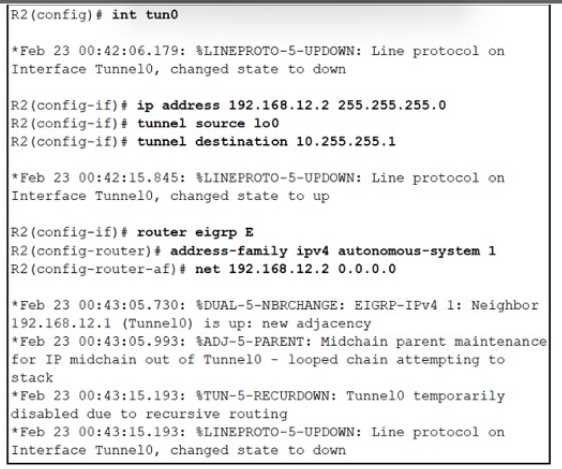
An administrator is configuring a GRE tunnel to establish an EIGRP neighbor to a remote router. The
other tunnel endpoint is already configured. After applying the configuration as shown, the tunnel
started flapping. Which action resolves the issue?
A imo, the tunnel keeps flapping because the tunnel destination IP is getting routed inside the tunnel itself. Stopping that route from being advertised should fix the loop and stabilize the tunnel.
Makes sense that the tunnel flaps because the tunnel source or destination IP is within the tunnel subnet, causing a routing loop. So, option A looks right — stop sending a route matching the tunnel destination across the tunnel. That usually avoids the source/destination confusion and stabilizes the tunnel. D might help in some cases, but if the problem is routing the tunnel endpoint IP inside the tunnel itself, removing that route should fix it quicker.
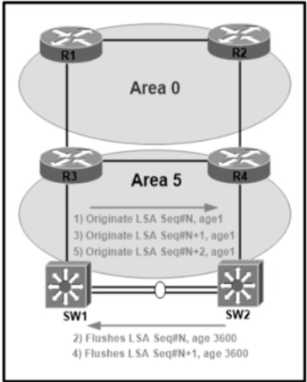
An error message "an OSPF-4-FLOOD_WAR” is received on SW2 from SW1. SW2 is repeatedly
receiving its own link-state advertisement and flushes it from the network. Which action resolves the
issue?
Probably B, since a mask mismatch often causes LSA loops like this.
This seems like a Layer 3 problem, but no mention of multiple links is given, so B makes more sense—fixing the subnet mask mismatch on the link should prevent LSAs from bouncing back. B
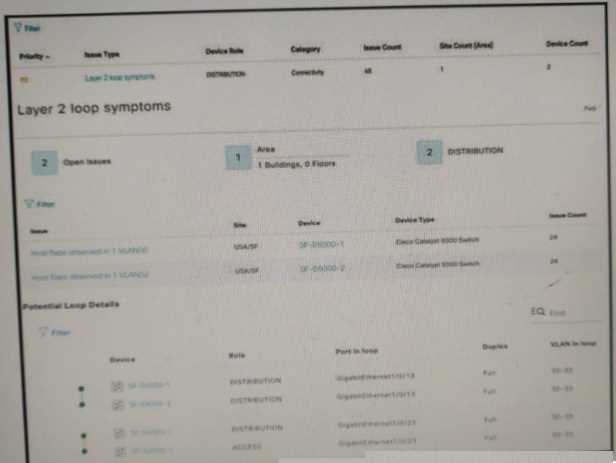
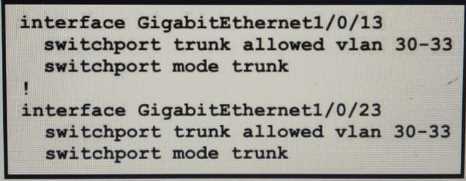
An engineer identifier a Layer 2 loop using DNAC. Which command fixes the problem in the SF-
D9300-1 switch?
It’s B because loopguard helps prevent loops from nondesignated ports failing silently.
Is the loop on trunk ports? That would rule out D for sure.
DRAG DROP Drag and drop the descriptions from the left onto the IPv6 first hop security features on the right. Not all options are used. 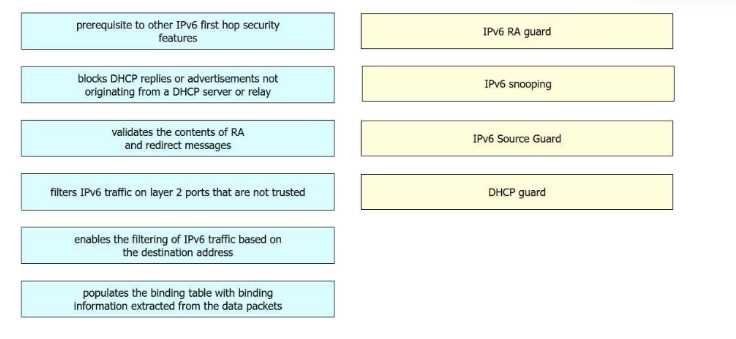
B and C are likely the main features since they deal with RA Guard and DHCPv6 Snooping, which directly protect against rogue devices on the local link. The others seem less relevant for first hop IPv6 security.
I’d add that DHCPv6 Guard should be considered too, since it prevents rogue DHCPv6 servers, which is crucial for first hop security. Also, Device Tracking is often used to tie IP addresses to MACs on the port, helping identify devices on the network and preventing spoofing. So anything mentioning IP-MAC binding or device tracking likely matches a first hop security feature as well. The options about blocking DHCPv4 or general IPv4 stuff can be ruled out here since this is specifically IPv6 focused.
DRAG DROP Drag and drop the MPLS concepts from the left onto the descriptions on the right. 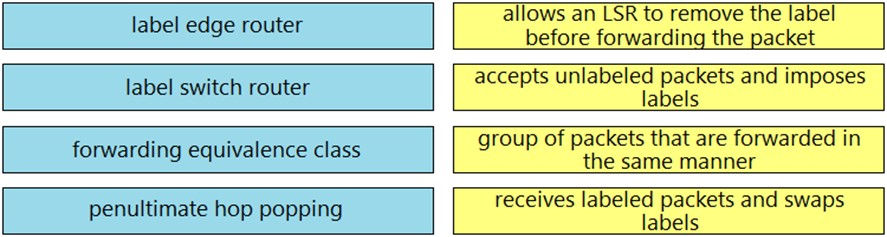
I think D fits label retention because it’s about keeping labels assigned on interfaces, not just forwarding or sharing. That part definitely isn’t about switching or distribution.
I’d put label distribution at C because it deals with sharing labels between routers. Label retention sounds like D since it’s about keeping labels stored after assignment, while label switching fits B for actual packet forwarding.
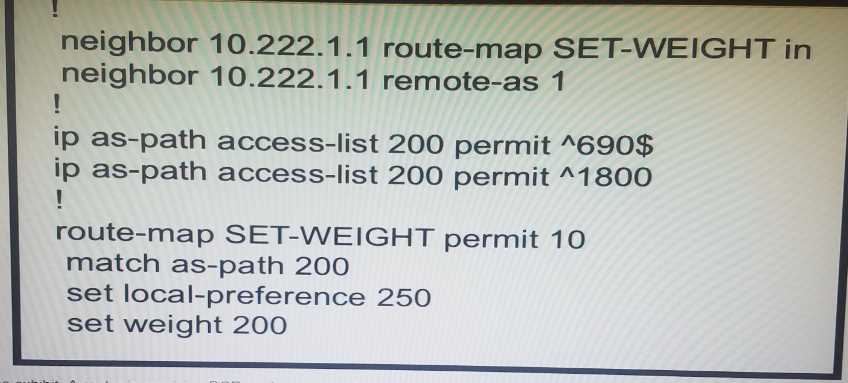
A router receiving BGP routing updates from multiple neighbors for routers in AS 690. What is the
reason that the router still sends traffic that is destined to AS 690 to a neighbor other than
10.222.1.1?
D imo, because weight is a Cisco-specific attribute and it’s the first step in BGP path selection. So if another neighbor has a higher weight than 200, the router will prefer that path regardless of local preference values. The config probably just shows the local preference but doesn’t highlight weight differences explicitly, which might be why traffic isn’t going to 10.222.1.1. That means even if local preference is set at 250 here, a higher weight elsewhere can override it and make the router send traffic to a different neighbor.
D The weight attribute is Cisco-specific and is considered before local preference when selecting the best path on a router. If another neighbor has a weight higher than 200, the router will prefer that path regardless of the local preference set on other neighbors. So even if local preference values are set, a higher weight can still influence outgoing traffic choice. This makes D a valid reason why traffic might go to a different neighbor despite local preference settings.
Maybe D, since MPLS tags packets just after the MAC header but before the IP header, which fits between Data Link and Network layers. That’s the common understanding for where MPLS lives in OSI.
D, because MPLS operates below the network layer, not above it.
DRAG DROP Drag and drop the LDP features from the left onto the descriptions on the right 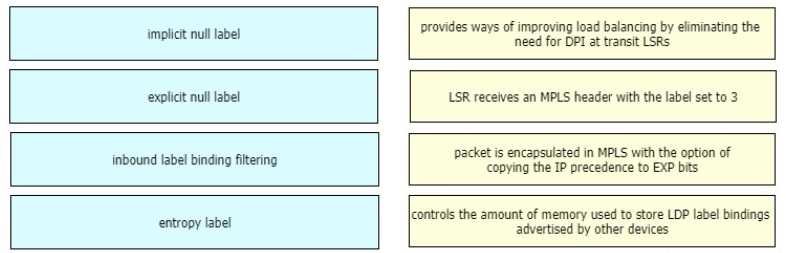
Session establishment should be separate from neighbor discovery because it involves setting up the control channel, not just finding the peer. Label distribution definitely fits with mapping since it’s about exchanging label info after the session is up.
I’d put the session establishment under the discovery phase too, since without session there’s no label exchange. Label mapping seems more like the actual label info transfer after discovery.
SIMULATION A DMVPN network is preconfigured with tunnel 0 IP address 192.168.1.254 on the HUB, IP connectivity, crypto policies, profiles, and EIGRP AS 100. The NHRP password is ccnp123, and the network ID and tunnel key is EIGRP ASN Do not introduce a static route. Configure DMVPN connectivity between routers BR1 and BR2 to the HUB router using physical interface as the tunnel source to achieve these goals: 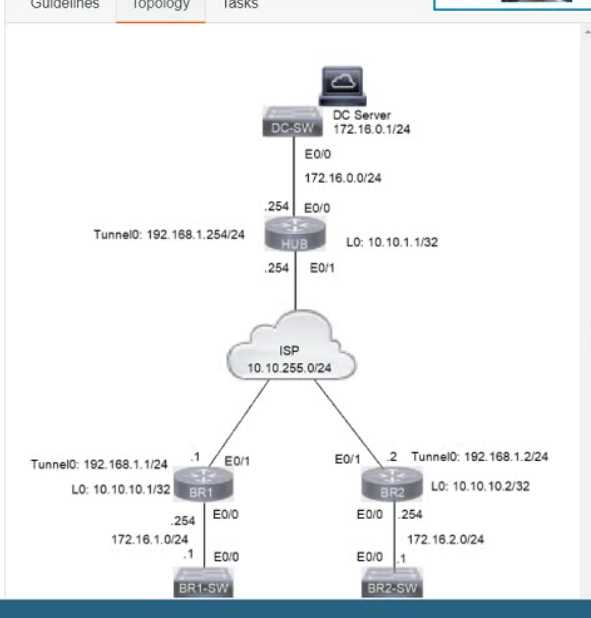
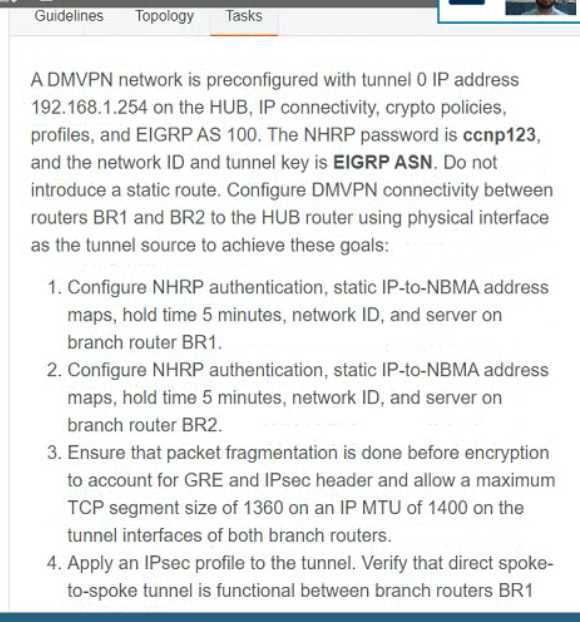
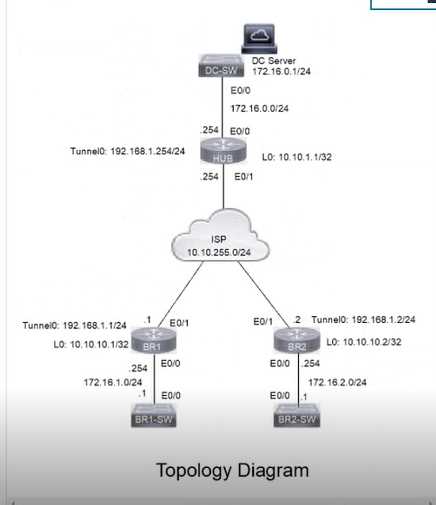
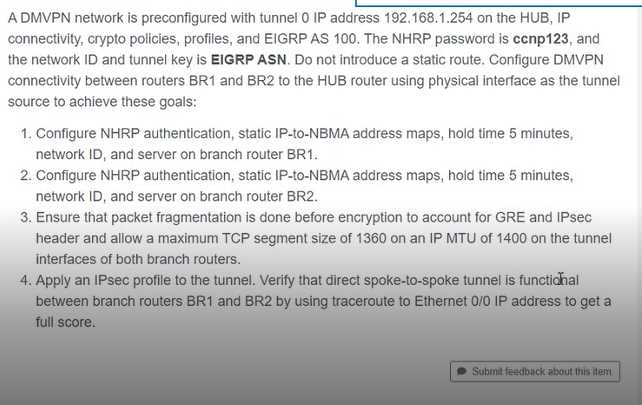
I think another angle here is that using the physical interface as the tunnel source also simplifies troubleshooting. If you chose a loopback or some other interface without direct physical connectivity, it would complicate verifying NHRP registrations and crypto associations. Plus, since the HUB’s tunnel IP is configured on tunnel0, the spokes must use their actual physical interfaces to establish proper IP reachability, which EIGRP relies on to exchange routes dynamically. This avoids any need for static routes while keeping the DMVPN mesh stable. So it's not just about reachability but also
Agreed, the physical interface as tunnel source ensures proper NHRP and crypto operation.
DRAG DROP Drag and drop the OSPF adjacency states from the left onto the correct descriptions on the right. 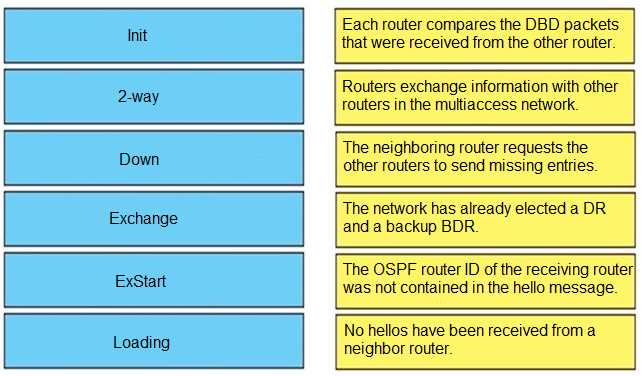
I think D is Loading since it shows more packet exchange, while C fits Exchange better with database descriptions. A for Down still makes sense as no adjacency started, and B matches ExStart due to negotiation signs.
I’d put A as Down since it shows no adjacencies yet, and B definitely fits ExStart because of the master/slave dialogue. C works well for Exchange—it’s all about DB description exchange. Then D is Loading with the actual link-state info being requested and received. E looks like Full because the neighbors have synchronized completely. This sequence follows the OSPF process logically from no connection to full adjacency. It’s not just about the packet content but also the order and what each state means for neighbor relationships.
It’s B because ND inspection matches IPv6 addresses to MACs, which are Layer 2 identifiers, and it mainly deals with stateless autoconfig addresses. So securing those bindings fits Layer 2 neighbor tables better than Layer 3.
It’s A because ND inspection mainly focuses on stateless addresses from SLAAC and secures their Layer 3 bindings, not stateful or Layer 2 ones. That fits the function better than the others.
DRAG DROP An engineer must establish a connection between two CE routers for two customers with overlapping IP addresses Customer_a is connected to interfaces Gig0/0, and Customer_b is connected to interfaces Gig0/1. Routers CE1 and CE2 are configured as follows: 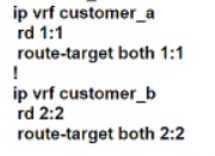 Drag and drop the code snippets from the right onto the boxes in the configuration to establish the needed connection. Snippets may be used more than once.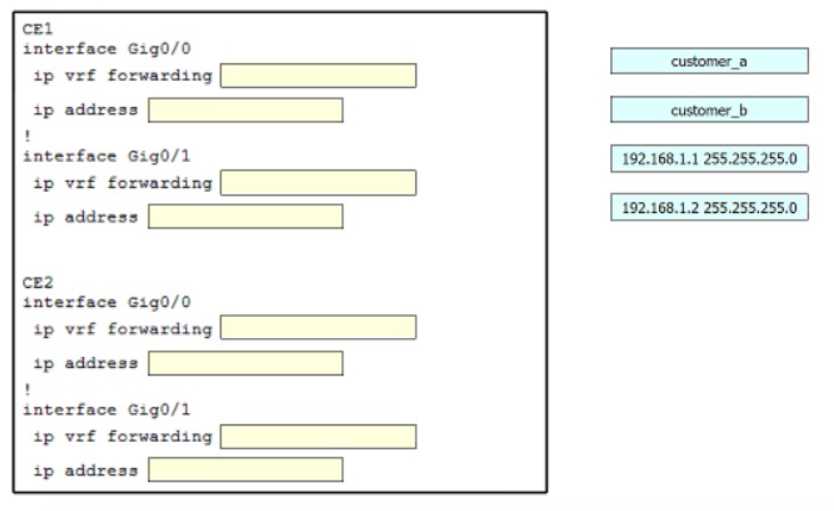
C fits better for route-target import/export since it’s symmetric on both sides.
I see why B and D are picked for the VRF setup and interface assignments. For the remaining two, I’d go with C in one slot because it has the route-target commands needed to import/export routes between VRFs, which is critical to get the customers talking despite overlapping IPs. Snippet A seems more basic without the route-targets, so C fits better for route leaking. So overall, B and D for VRFs/interfaces and C for route-targets/import-export makes sense here.
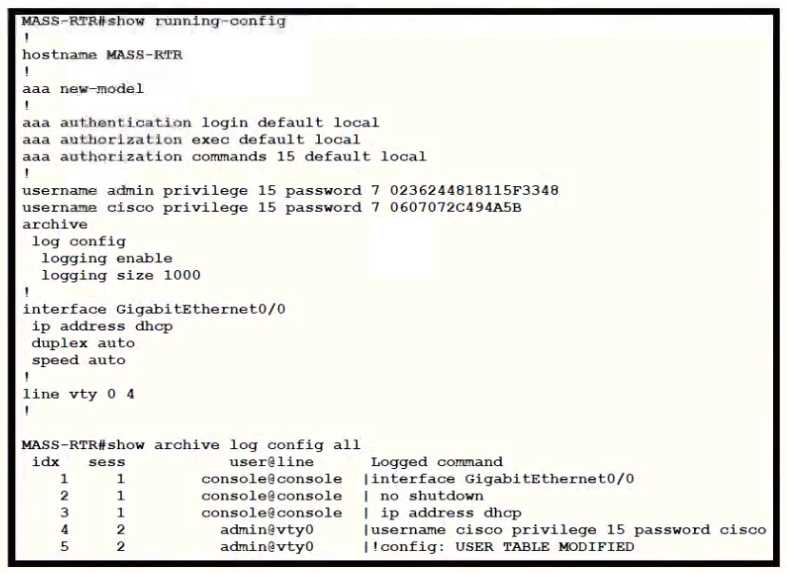
A client is concerned that passwords are visible when running this show archive log config all.
Which router configuration is needed to resolve this issue?
It’s C because service password-encryption applies globally and will at least scramble passwords so they’re not in clear text anywhere, not just in archive logs. That’s a safer bet than just hiding keys.
A/D? Option A encrypts the passwords specifically, which means they won’t show in plain text at all, while D just hides them from display but might not encrypt. Depends if you want encryption or just hiding.
DRAG DROP Drag and drop the MPLS terms from the left onto the correct definitions on the right. 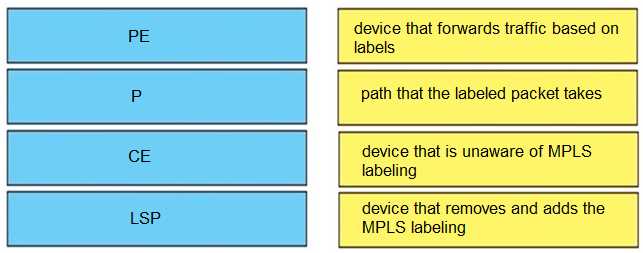
For A, I think it’s the Label because it represents the actual identifier attached to packets for forwarding. That fits since the others are more about devices or paths, not the tag itself.
I’m confident B is the Label Switched Path since it’s about the established route through the MPLS network. D has to be the Label Edge Router because it’s where labels get pushed or popped at the boundaries. C fits well as the Label Switched Router handling packets mid-path with label switching. That leaves A, which must be the actual label attached to packets to guide them through, not the packet itself or the path. So, A = Label, B = LSP, C = LSR, and D = LER makes the most logical sense here.