Free Cisco 300-410 ENARSI Actual Exam Questions - Question 3 Discussion
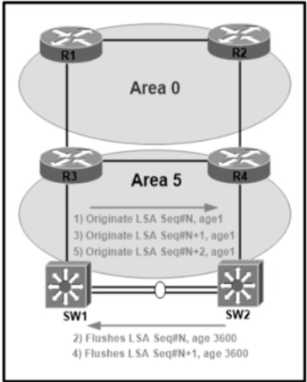
An error message "an OSPF-4-FLOOD_WAR” is received on SW2 from SW1. SW2 is repeatedly
receiving its own link-state advertisement and flushes it from the network. Which action resolves the
issue?
Probably B, since a mask mismatch often causes LSA loops like this.
This seems like a Layer 3 problem, but no mention of multiple links is given, so B makes more sense—fixing the subnet mask mismatch on the link should prevent LSAs from bouncing back. B
The repeated LSAs suggest the issue is link-related, so fixing subnet mask mismatches (B) might help since OSPF needs matching masks on point-to-point links. This could stop the LSA from looping back.
C The issue likely comes from multiple physical links causing OSPF confusion. Setting up a Layer 3 port channel would combine those links and stop the LSA flood loop.
C. If multiple physical links connect SW1 and SW2, bundling them as a Layer 3 port channel helps OSPF treat them as one, stopping LSAs from looping back and causing those flood warnings.
Option C seems solid too; bundling links into a Layer 3 port channel prevents OSPF from confusing multiple physical paths as separate routes, which can trigger that LSA flooding issue.
Maybe C makes sense here. If SW1 and SW2 are connected over multiple links, not bundling them into a Layer 3 port channel can cause OSPF to see duplicate LSAs because the same LSA gets flooded over different physical paths. Setting up a Layer 3 port channel would present a single logical link to OSPF, preventing these loops. Options A and D don’t seem to directly address the flooding issue; area type or IP conflicts would have other symptoms. B could matter if there was a subnet mismatch, but without explicit mention of that, C feels like a solid fix for repeated LSA floods in a multi-link set
I’d go with B because subnet mismatches often cause OSPF LSAs to bounce back unexpectedly.