Free Cisco 300-410 ENARSI Actual Exam Questions - Question 7 Discussion
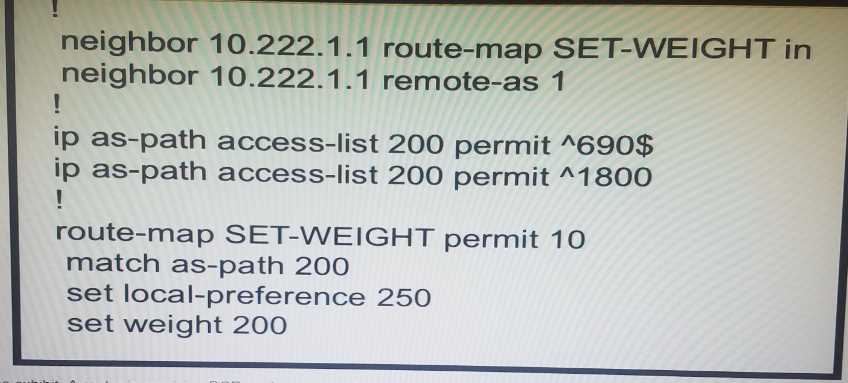
A router receiving BGP routing updates from multiple neighbors for routers in AS 690. What is the
reason that the router still sends traffic that is destined to AS 690 to a neighbor other than
10.222.1.1?
D imo, because weight is a Cisco-specific attribute and it’s the first step in BGP path selection. So if another neighbor has a higher weight than 200, the router will prefer that path regardless of local preference values. The config probably just shows the local preference but doesn’t highlight weight differences explicitly, which might be why traffic isn’t going to 10.222.1.1. That means even if local preference is set at 250 here, a higher weight elsewhere can override it and make the router send traffic to a different neighbor.
D The weight attribute is Cisco-specific and is considered before local preference when selecting the best path on a router. If another neighbor has a weight higher than 200, the router will prefer that path regardless of the local preference set on other neighbors. So even if local preference values are set, a higher weight can still influence outgoing traffic choice. This makes D a valid reason why traffic might go to a different neighbor despite local preference settings.
A Local preference always beats weight in BGP path choice.
A local preference definitely overrides weight in BGP path selection here, so A.
A. Local preference always beats weight when choosing outbound paths in BGP, so if another neighbor has a local preference above 250, it makes sense traffic won’t go to 10.222.1.1.
A. Since local preference is a key BGP attribute used to select outbound traffic paths within an AS, if another neighbor has a higher local preference than 250, the router will choose that path over 10.222.1.1. Weight is only locally significant on the router itself and doesn’t get advertised, so option D is less likely. Also, while route map direction can affect route acceptance, it wouldn’t explain why traffic prefers a different neighbor if local preference differs. So, a higher local preference on another neighbor seems to be the primary reason here.
Are we sure the route map is applied outbound or inbound correctly? Sometimes that direction changes which neighbor gets preferred for traffic.