Free Cisco 300-410 ENARSI Actual Exam Questions - Question 13 Discussion
DRAG DROP An engineer must establish a connection between two CE routers for two customers with overlapping IP addresses Customer_a is connected to interfaces Gig0/0, and Customer_b is connected to interfaces Gig0/1. Routers CE1 and CE2 are configured as follows: 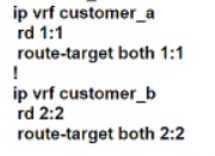 Drag and drop the code snippets from the right onto the boxes in the configuration to establish the needed connection. Snippets may be used more than once.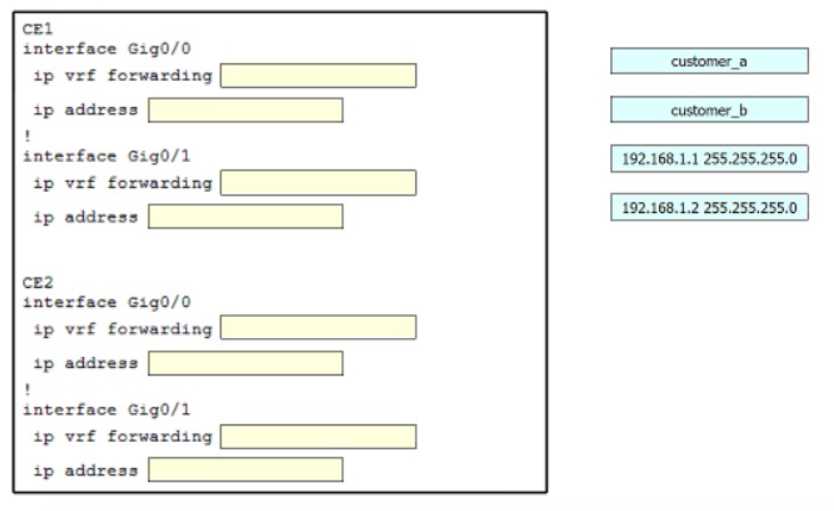
C fits better for route-target import/export since it’s symmetric on both sides.
I see why B and D are picked for the VRF setup and interface assignments. For the remaining two, I’d go with C in one slot because it has the route-target commands needed to import/export routes between VRFs, which is critical to get the customers talking despite overlapping IPs. Snippet A seems more basic without the route-targets, so C fits better for route leaking. So overall, B and D for VRFs/interfaces and C for route-targets/import-export makes sense here.
I agree B and D are essential for creating VRFs and binding interfaces. For the other two slots, I’d pick A over C because snippet A includes the route-target import/export commands needed to allow route leaking between VRFs on both routers. Without that, the two sides wouldn’t know about each other’s routes even if VRFs are set up. Snippet C is more about generic interface config without VRF specifics, so it seems less relevant here.
I think snippet B for creating VRFs fits since you need separate routing tables for overlapping IPs. Also, snippet D makes sense because it assigns interfaces to the right VRFs, isolating customer traffic. This way, each customer’s traffic won’t mix despite overlapping addresses. Snippets that don’t mention VRFs or route-maps probably won’t handle the overlap correctly, so I’d avoid those.
Looks like route-maps and VRFs are key here, probably snippets B and D.