Free Cisco 300-715 SISE Actual Exam Questions
Dumps Box (DumpsBox) offers up-to-date practice exam questions for 300-715 SISE certification exam which are developed and validated by Cisco subject domain experts certified in Cisco 300-715 SISE . These practice questions are update regularly as we keep an eye on any recent changes in 300-715 SISE syllabus, and when there is update our team quickly adjusts the questions. This commitment to providing the best quality exam prep material to certification aspirants is what makes DumpsBox.com the best certification exam prep website. On top of that, our strong, yet strictly moderated, community based feedback keeps the content clean and current. Each question has helpful community discussion that provides it extra perspective and introduces helpful resources for better exam preparation. This also saves students from other outdated practice questions or illicit exam dumps that can have adverse affects on career. Browse through our Cisco 300-715 SISE exam questions and pass your exam on first try.
C/D? C definitely stands out because TACACS+ is designed to provide command accounting, letting you track user actions in detail, which RADIUS doesn't do as well. D seems less likely since TACACS+ doesn't rely on SSL certificates specifically; it uses TCP with its own encryption method. Also, option A's latency point feels less relevant to report reviewing in Cisco ISE. So, I’d pick C for the added insight in reports through command accounting, even if it might need some setup to see all details.
C/D? While C highlights command accounting as a TACACS+ advantage, D’s mention of SSL certificates feels off since TACACS+ typically uses TCP with encryption but not specifically SSL certs. So C seems more accurate here.
module to automatically download and install on endpoints Which action accomplishes this task for
VPN users?
Maybe A makes sense since it involves AnyConnect config and client provisioning, which fits VPN users better than just the posture policy itself. B might not cover auto-install for remote VPN endpoints.
I think D can be ruled out because a compound posture condition mainly checks status, it doesn't really automate the download or install. B seems more direct for automatic deployment. D
must ensure that an agent pop-up is presented to the client when attempting to connect to the
network Which configuration item needs to be added to allow for this'?
D imo, an API connection seems necessary for triggering real-time client pop-ups.
Probably B on this one. If the goal is to get an actual pop-up on the client machine, having a temporary agent installed makes the most sense because it runs locally and can directly trigger UI elements. The URL in A might just redirect or kick off a process but wouldn’t guarantee a pop-up. C and D seem more about backend handling or communication rather than creating a client-side prompt. So B fits best if the pop-up has to appear immediately and interactively on the client device.
need to send special attributes in the Access-Accept response to ensure that the users are given the
appropriate access. What must be configured to accomplish this'?
A imo. dACLs are designed to enforce access policies by defining which traffic or resources users can access, so they fit well when you need to send specific attributes to control user access on non-Cisco devices. Command sets (D) mainly control command authorization on Cisco gear, so they might not cover the attribute needs here. Shell profiles (C) seem Cisco-specific, and custom access conditions (B) are more about defining roles rather than passing attributes in Access-Accept responses.
B tbh, because custom access conditions let you define roles flexibly without being tied to Cisco-specific setups, which fits sending special attributes for non-Cisco devices better.
speakers that require access to the intercom system. This traffic needs to be identified if the ToS bit is
set to 5 and the destination IP address is the intercom system. What must be configured to
accomplish this goal?
It’s A, NMAP actively probes and can detect ToS bits and IP destinations for profiling.
A imo—NMAP can actively scan and profile devices based on specific traffic attributes like ToS bits and destination IP, which might help identify those IP speakers for correct authorization.
configured with the Administration. Policy Service, and Monitoring personas to protect from a
complete node failure?
Option B seems right because dispersed mode is designed so every node handles all personas, ensuring full redundancy if one fails. Distributed splits roles, so it won’t give that kind of protection.
B/D? Distributed definitely doesn’t fit since it separates roles, so no full redundancy on each node. Two-node feels limited in scale and might not have the full persona set on both nodes. Hybrid mixes personas, so it’s not every node with all roles either. That leaves dispersed, which is designed exactly for full persona redundancy on every node to avoid single points of failure. Makes sense to pick B here for true full redundancy across nodes.
maximum of two devices. There are other guest services in production that rely on the default guest
types. How should this configuration change be made without disrupting the other guest services
currently offering three or more guest devices per user?
B imo. Creating a new guest type to set device limits keeps existing guest types untouched, so other services stay unaffected. This seems cleaner than messing with identity or sponsor groups.
Option A keeps other guest types intact by limiting devices via an identity group.
and have been reported as stolen in the Cisco ISE My Devices Portal. Which condition must be used
when configuring an authorization policy that sets DenyAccess permission?
C/D? The key here is the device being reported stolen, which aligns with Lost. But I wonder if Reinstate could be involved if they later want to allow access again. Since the question focuses on blocking access, Lost makes more sense as the BYOD state to target in the policy. The Blocklist part definitely fits for denying access. So, C seems like the better match based on stolen device status and being on the blocklist.
Maybe C, since Lost clearly means stolen devices need blocking.
agent that supports using service conditions as conditions for the assessment. The agent should be
run as a background process to avoid user interruption but when it is run. the user can see it. What is
the problem?
It’s A. The question says the agent supports service conditions and runs as a background process but is still visible to the user, which matches the behavior of the regular AnyConnect posture agent. The Stealth AnyConnect posture agent is designed to run in the background without showing up, so if the user can see it, they probably didn’t switch to the Stealth version. The other options don’t directly address the visibility issue like this one does.
Probably A since the regular agent shows up, only the Stealth agent runs hidden as a background process.
to the network. The RADIUS test fails after the administrator configures all of the settings in Cisco ISE
and adds the proper configurations to the switch. What is the issue"?
C/D? A wrong shared secret is an easy miss that immediately kills RADIUS. But if the switch is using a self-signed cert and ISE expects a CA cert, that could also cause a failure in mutual trust checks.
It’s C, shared secret mismatches stop the RADIUS test dead.
does not support native supplicant provisioning provided by Cisco ISE. Which portal must the
employee use to provision to the device?
A. This is about a mobile device without native supplicant support, so BYOD portal fits since it’s designed for manual provisioning on personal devices lacking native support.
D, client provisioning handles devices without native supplicant support directly.
passwords. The network administrator wants the existing Cisco ISE deployment to utilize an external
identity source to alleviate this issue. Which two requirements must be met to implement this
change? (Choose two.)
E imo, secure LDAP is a must to protect credentials in transit. C also fits since Global Catalog servers are essential for AD lookups. The others don’t seem as directly relevant here.
C/E? Access to a Global Catalog server is often needed for AD queries, and secure LDAP is definitely required for safe communication. NAT config might help but isn’t always mandatory.
An engineer is configuring Cisco ISE and needs to dynamically identify the network endpoints and ensure that endpoint access is protected. Which service should be used to accomplish this task?
It’s A since profiling is the key service for dynamically identifying endpoints, which is the first step before any protection like posture enforcement happens. Without accurate profiling, posture can’t work effectively.
It’s D because posture goes beyond just identifying devices; it checks their security status and enforces policies, which fits the need for both dynamic ID and protected access.
What should be considered when configuring certificates for BYOD?
Option A seems off because ISE BYOD doesn’t always require an endpoint certificate; it depends on your deployment. Also, the CN field being the device hostname (C) feels less likely since user identity usually takes priority in certs for BYOD to tie it back to the user, not just the device. D is interesting, but SAN can hold different info, not just the username, so it’s not guaranteed either. The enrollment protocol difference in B is a solid clue since Android’s EST support is distinct, making B a strong candidate here.
It’s B. Android devices use EST for certificate enrollment mainly because it supports the newer protocols and security features that Android favors, while other OSes typically stick with SCEP. This difference is pretty consistent across Cisco ISE setups and helps streamline the process for different platforms. So, the protocol variance is definitely something to keep in mind when configuring BYOD certs. Options A, C, and D seem more about specifics that can vary depending on the deployment or certificate template, but B highlights a clear protocol distinction tied to the device type itself.
DRAG DROP Select and Place 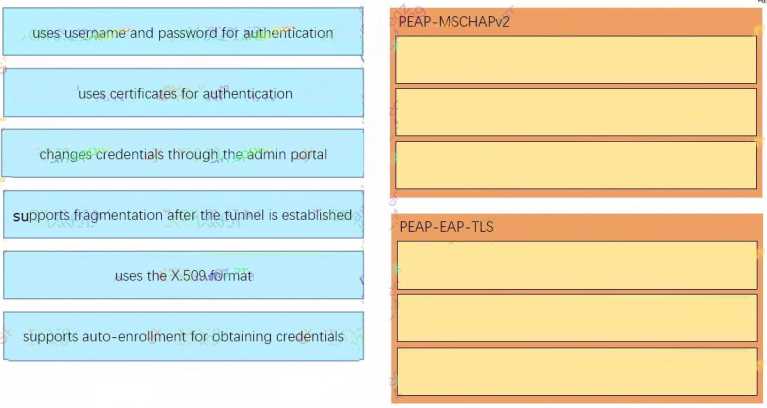
I’d say B can’t come right after D since it feels like B’s response depends on something from C. So maybe D starts, then C, then B, and A closes it out. That way the flow follows a challenge-response logic.
D starts the exchange, but I think C should confirm before A wraps it.