Free Cisco SPRI 300-510 Actual Exam Questions
Dumps Box (DumpsBox) offers up-to-date practice exam questions for SPRI 300-510 certification exam which are developed and validated by Cisco subject domain experts certified in Cisco SPRI 300-510 . These practice questions are update regularly as we keep an eye on any recent changes in SPRI 300-510 syllabus, and when there is update our team quickly adjusts the questions. This commitment to providing the best quality exam prep material to certification aspirants is what makes DumpsBox.com the best certification exam prep website. On top of that, our strong, yet strictly moderated, community based feedback keeps the content clean and current. Each question has helpful community discussion that provides it extra perspective and introduces helpful resources for better exam preparation. This also saves students from other outdated practice questions or illicit exam dumps that can have adverse affects on career. Browse through our Cisco SPRI 300-510 exam questions and pass your exam on first try.
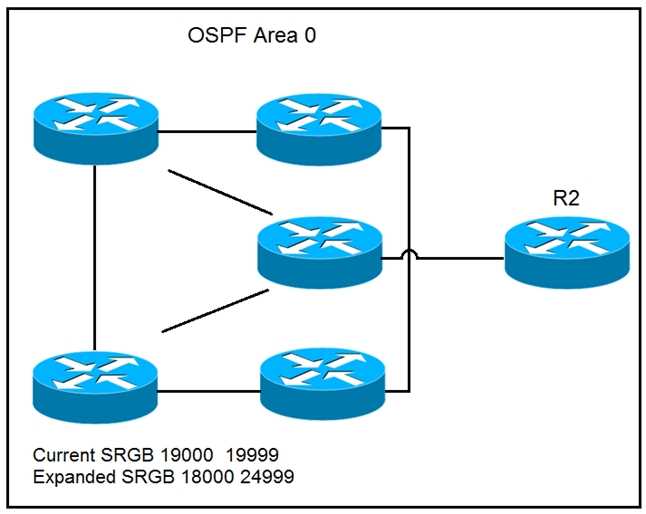
A network operator wants to expand the segment routing global block in upcoming
maintenance. The operator must ensure that the changes to the segment routing global block have
no adverse impacts on the prefix-sid associated with the loopback0 interface used within the OSPF
domain.
Which command can the operator use to enforce R2 to have a strict prefix-sid assignment to
loopback0?
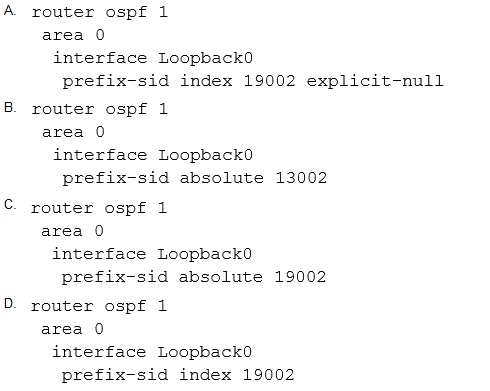
It’s B, since it explicitly locks prefix-SID to loopback0 avoiding any global block conflicts.
Good point about B locking the SID explicitly under loopback0. Also, A’s use of "strict" at the interface level might not be supported in all IOS versions, so B seems safer here. B
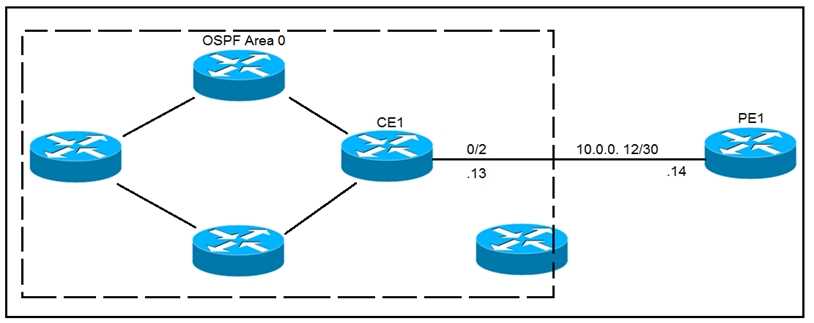
CE1 is the gateway router into the provider network via PE1. A network operator must
inject a default route into OSPF area 0. All devices inside area 0 must be able to reach PE1. Which
configuration achieves this goal?
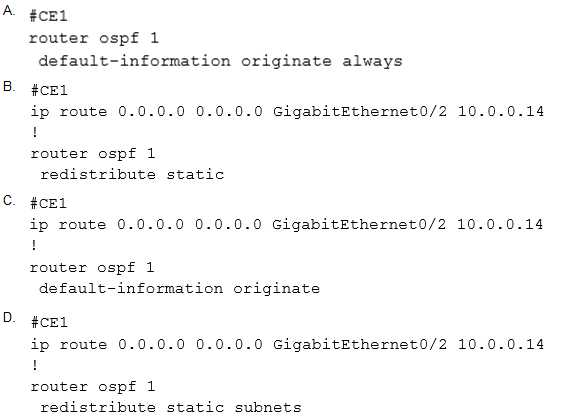
A imo doesn’t force default route injection, so if CE1 lacks the default route, area 0 won’t learn it. D is better for guaranteed reachability.
B. Option B looks promising because it uses the default-information originate command without the always keyword, which means it will only inject the default route if CE1 actually knows it. If CE1 is acting as the gateway router to the provider network, it likely has the default route already. This avoids unnecessary route injection if the default route wasn’t present, making it a cleaner choice. D forces the default route always, but that might not be needed and could cause routing inconsistencies if the default route isn’t really there. So B seems like a solid middle ground here.
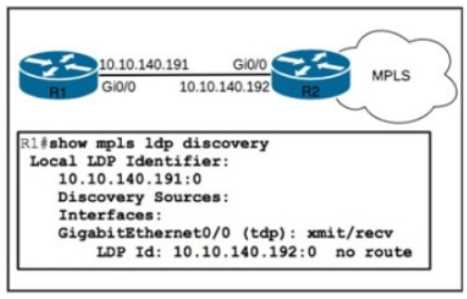
Routers R1 and R2 are RFC 5036-based MPLS-enabled core routers MPLS IP is enabled globally on
both routers OSPF with area 0 configuration is used as an interior routing protocol between the
routers After new services were enabled on the MPLS network, LDP connectivity failed on R1
TCP/UDP port 711 is confirmed to be open Which two actions must the engineer take to correct the
problem? (Choose two.)
A/D? The issue seems to be with OSPF not advertising the right subnet on R2, so adding the full /24 network is key. Plus, enabling MPLS IP on Gi0/0 on R1 is necessary for LDP to work.
Is the exact subnet mask and area number for the OSPF network on R2 confirmed? The options mention different masks and area 0, but clarity would help pinpoint the missing OSPF config.
A. The egress node terminating SRv6 packets makes sense since it processes the SRH with locator info, which fits control plane roles better than ingress adding or swapping headers.
B/D? B fits since ingress adds the SRv6 header, but D about egress adding an outer header doesn’t sound right. Egress usually removes or processes headers, not adds new ones.
make the conversion?
Maybe C, since only 23 bits from the IP are mapped, not 24.
C, since it’s the low order 23 bits used after the fixed MAC prefix.
communication problems between the two instances. Which description of the possible cause of
issues in the routing domain is true?
Option C makes sense too—if the NSEL values don’t match, neighbors won’t come up, so communication between instances fails even if everything else looks fine.
Maybe B. Different IS-IS instances act like separate routing domains, so they don’t talk to each other unless there’s some special configuration. That would explain communication problems between the two. A seems less likely because usually interfaces can be configured for more than one IS-IS instance if needed, and D sounds like a Cisco-specific command that wouldn’t broadly cause this kind of problem. C is possible but the question points more to the fact that these are two distinct instances not forming routes.
C, because IOS XR needs a proper route back to the IOS router for BFD sessions.
B/D? BFD usually works across both platforms, so D feels off. B could be true if multihop for IPv4 isn’t supported in all IOS XR versions, but without version info, hard to say.
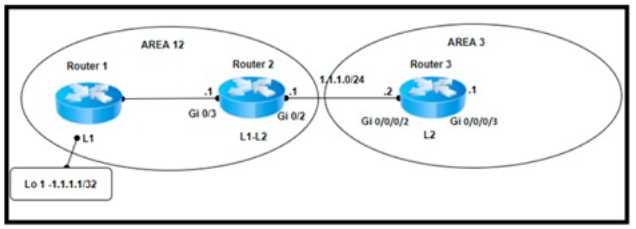
Refer to the exhibit. A network engineer configured three new PE routers to expand the network.
The new routers run in the IS-IS routing protocol and reside in the data center in the same exchange
as the existing routers. However, the network is now experiencing suboptimal routing. The Layer 2
configuration and VLANs are configured correctly to provide segregation between networks, but the
Level 1 routes are not being converted to Level 2 routes. Which action resolves the issue?
Maybe D. Summarizing on Router 2 could help because if Router 2 acts as a Level 1-2 router, summarization there might enable proper route leveling and fix the suboptimal routing.
D imo, summarizing on Router 2 might help push Level 1 routes into Level 2.
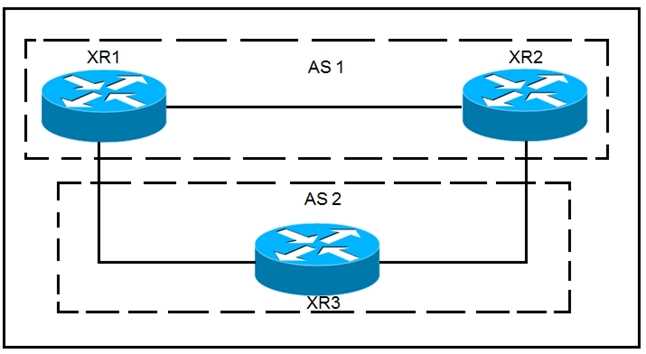
XR1 and XR2 are sending the prefix 10.11.11.0/24 to XR3. A configured policy on XR1 is
incorrectly prepending AS path 11 11 12 12 onto this prefix. A network operator wants to add a policy
onto XR3 that will not allow the falsely prepending prefix from being installed. Which policy
configuration applied to the XR3 neighbor configuration for XR1 can accomplish this requirement
without impact to other or future
received routes?
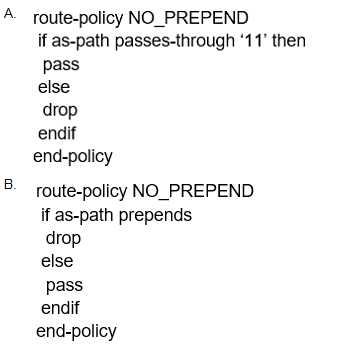
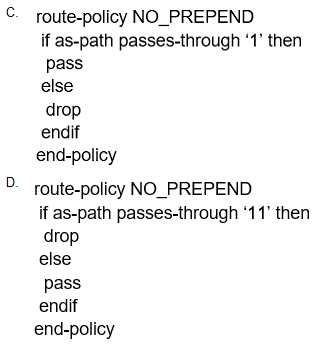
Makes sense that D is the best pick since it targets both the AS path and specific prefix, so no other routes get wrongly blocked. Definitely the safest bet here. D
D, it blocks the exact bad AS path and prefix combo, no collateral damage.
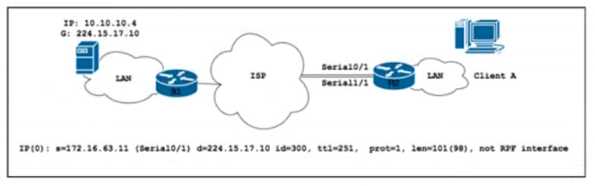
Refer to the exhibit. Mid-sized company Z connected two branch offices via a multicast-enabled ISP
using the BGP routing protocol. PIM was implemented to support multicast streaming between the
branches via MSDP Client A cannot connect to the multicast stream source of company Z. The
network engineer ran a debug on the edge of the network as shown. Which action resolves the
issue?
Looks to me like option B makes sense since the serial link probably needs PIM enabled for multicast to work between branches. Also, Auto-RP would help with RP discovery. So B.
Maybe A. Since BGP is used between branches, enabling MBGP with the multicast address family on R2 is crucial for transporting multicast routes properly. Without MBGP, multicast routing info won’t be shared over BGP, which could explain why Client A can’t reach the stream. Options B and C focus on PIM and RP discovery, but if BGP isn’t carrying multicast routes correctly, that won’t matter. D looks unrelated since 10.10.10.0/24 is just unicast and doesn’t solve multicast routing issues directly. So getting MBGP running seems like the key step here.
Drag and drop the characteristics from the left onto the corresponding routing protocols on the right.
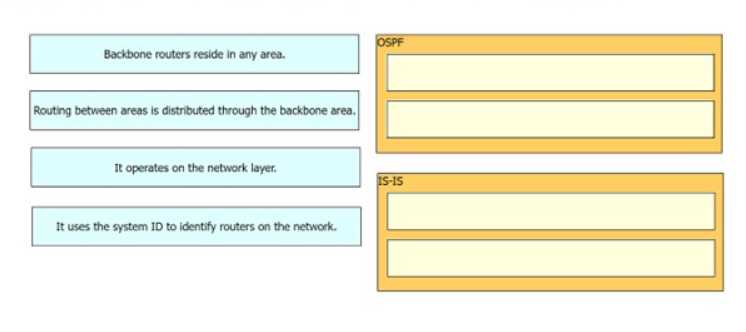
I ruled out anything about areas or LSAs for EIGRP since those are classic OSPF traits. Also, things like the use of DUAL definitely point to EIGRP, so that helped me match the right features quickly.
One quick way to separate these is by focusing on protocol type: EIGRP is a hybrid/proprietary protocol with features like DUAL and fast convergence, while OSPF is a pure link-state protocol that uses LSAs and areas for routing info. Also, OSPF (both v2 and v3) relies on cost as its metric based on bandwidth, whereas EIGRP uses a composite metric including bandwidth and delay. So anything mentioning LSAs or areas belongs to OSPF, and anything pointing to rapid topology changes with DUAL is definitely EIGRP. That should help confirm which characteristics go where.
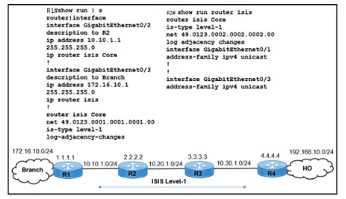
Refer to the exhibit. Users at the branch office on R1 reported issue with an application at the home
office on R4. While troubleshooting the issue, a network engineer determined that
The branch-office users can connect to the home office.
The IS-IS adjacencies between R1 and R2 and R1 and the branch office are up.
Traffic from R1 to the R2 10.20.1.0/24 network is moving normally.
The application at the home office is experiencing packet drops on the connection to the Branch, and
R3 cannot reach the R1 172.16.10.0/24 network.
Which action resolves the issues?
If R3 can’t reach R1’s 172.16.10.0/24 but traffic from R1 to R2 is fine, maybe the problem is R1 not advertising that network in IS-IS. Could redistribution (A) fix that instead of messing with interfaces?
Maybe B, since missing IS-IS on Gig0/3 stops proper route sharing.
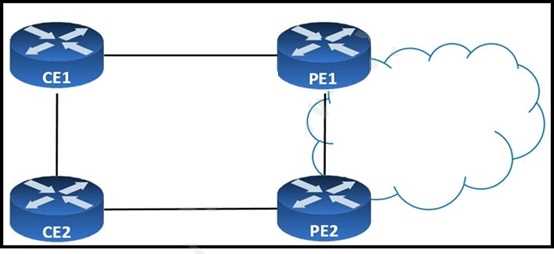
CE1 and CE2 are iBGP neighbors in AS 65516. All traffic that exits AS 65516 must use the link from
CE1 to PE1. CE1 is advertising a higher local preference to CE2, but traffic from CE2 still prefers the
PE2 link. Which action corrects the problem?
The problem sounds like next-hop issues, so D makes sense here.
B tbh, the local preference should usually dictate the best path inside the AS, but if CE2 is ignoring it and still picking the PE2 link, it might be because MED is influencing its decision. Configuring CE1 to send a higher MED to CE2 could make CE2 see the PE1 path as more preferred. Lowering local preference on PE2 (A) doesn’t feel right since CE2 is receiving routes from PE1 and PE2; next-hop self (D) is more about next-hop reachability, and weight (C) is Cisco-specific and not propagated. So tweaking MED seems like the way to go here.
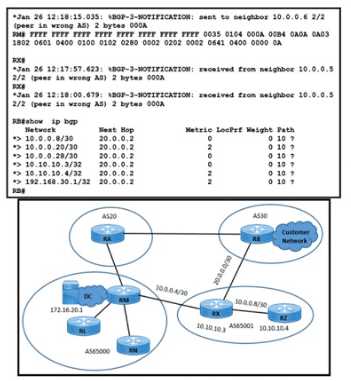
Refer to the exhibit. An engineer working for a private telecommunication company with an
employee id: 4233:46:364 notices that the customer network going through AS30-AS65001-AS65000
is experiencing packet drops when it accesses an application at 172.16.20.1/32 In the DC cloud. The
BGP link between AS20 and AS30 is inaccessible because of a fiber cut. Routers RL, RN, and RZ are
configured with confederation identifier 10. Which action resolves this Issue?
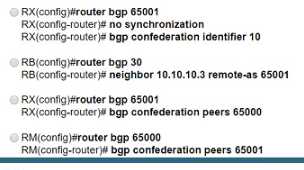
Option C, because fixing internal confederation routing can prevent drops despite external link failure.
It’s B, because rerouting around the fiber cut is key here, not just internal tweaks.
Which step did you forget to complete?
Maybe D, because if you don’t save the config, the change might not persist after a reload, even though it applies temporarily. Still, committing is needed to activate the change now.
A. You gotta commit the config for it to take effect.