Free Cisco SPRI 300-510 Actual Exam Questions - Question 12 Discussion
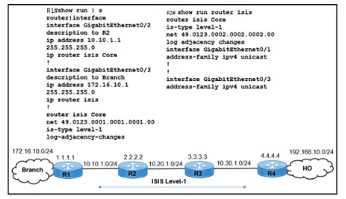
Refer to the exhibit. Users at the branch office on R1 reported issue with an application at the home
office on R4. While troubleshooting the issue, a network engineer determined that
The branch-office users can connect to the home office.
The IS-IS adjacencies between R1 and R2 and R1 and the branch office are up.
Traffic from R1 to the R2 10.20.1.0/24 network is moving normally.
The application at the home office is experiencing packet drops on the connection to the Branch, and
R3 cannot reach the R1 172.16.10.0/24 network.
Which action resolves the issues?
If R3 can’t reach R1’s 172.16.10.0/24 but traffic from R1 to R2 is fine, maybe the problem is R1 not advertising that network in IS-IS. Could redistribution (A) fix that instead of messing with interfaces?
Maybe B, since missing IS-IS on Gig0/3 stops proper route sharing.
B seems right since R1’s interface missing from IS-IS core would block route propagation.
D imo, configuring the IS-IS core instance on R2’s Gig0/1 (D) could fix this since R2 is the key link between R1 and R3/R4. If that interface isn’t in the core area, routes won’t propagate properly, causing drops and reachability issues. Simply adding routes on R1 might not help if the adjacency or area boundaries aren’t set correctly. R2 acting as a transit needs proper IS-IS config to ensure full route visibility and connectivity across the network.
If R3 can’t reach 172.16.10.0/24, that network might not be advertised beyond R1. So redistributing connected routes on R1 (A) or making sure interfaces are in IS-IS (B) both fit. But what if the problem is on the core side, like R2’s interface missing IS-IS?
A. The packet drops and reachability issues suggest routes for 172.16.10.0/24 might not be advertised from R1 properly, so redistributing connected and static routes there makes sense.
Makes sense if R1’s interface isn’t in IS-IS yet, so B.
Option B, seems like R1’s Gig0/3 might need core IS-IS config.