Free Cisco SPRI 300-510 Actual Exam Questions - Question 10 Discussion
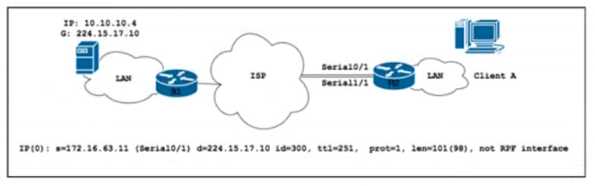
Refer to the exhibit. Mid-sized company Z connected two branch offices via a multicast-enabled ISP
using the BGP routing protocol. PIM was implemented to support multicast streaming between the
branches via MSDP Client A cannot connect to the multicast stream source of company Z. The
network engineer ran a debug on the edge of the network as shown. Which action resolves the
issue?
Looks to me like option B makes sense since the serial link probably needs PIM enabled for multicast to work between branches. Also, Auto-RP would help with RP discovery. So B.
Maybe A. Since BGP is used between branches, enabling MBGP with the multicast address family on R2 is crucial for transporting multicast routes properly. Without MBGP, multicast routing info won’t be shared over BGP, which could explain why Client A can’t reach the stream. Options B and C focus on PIM and RP discovery, but if BGP isn’t carrying multicast routes correctly, that won’t matter. D looks unrelated since 10.10.10.0/24 is just unicast and doesn’t solve multicast routing issues directly. So getting MBGP running seems like the key step here.
It’s B because the serial link likely doesn’t have PIM enabled, so multicast traffic can’t flow between branches. Auto-RP helps with RP discovery, so enabling both fixes the core problem.
Option B seems off because serial interfaces usually need PIM for multicast, so not having PIM there could block the stream. The debug output hints at multicast routing issues, so enabling PIM on Serial 1/1 makes sense.