Free Cisco 300-425 ENWLSD Actual Exam Questions
Dumps Box (DumpsBox) offers up-to-date practice exam questions for 300-425 certification exam which are developed and validated by Cisco subject domain experts certified in Cisco 300-425 ENWLSD . These practice questions are update regularly as we keep an eye on any recent changes in 300-425 syllabus, and when there is update our team quickly adjusts the questions. This commitment to providing the best quality exam prep material to certification aspirants is what makes DumpsBox.com the best certification exam prep website. On top of that, our strong, yet strictly moderated, community based feedback keeps the content clean and current. Each question has helpful community discussion that provides it extra perspective and introduces helpful resources for better exam preparation. This also saves students from other outdated practice questions or illicit exam dumps that can have adverse affects on career. Browse through our Cisco 300-425 ENWLSD exam questions and pass your exam on first try.
Drag and drop the characteristics from the left onto the correct functionalities on the right.
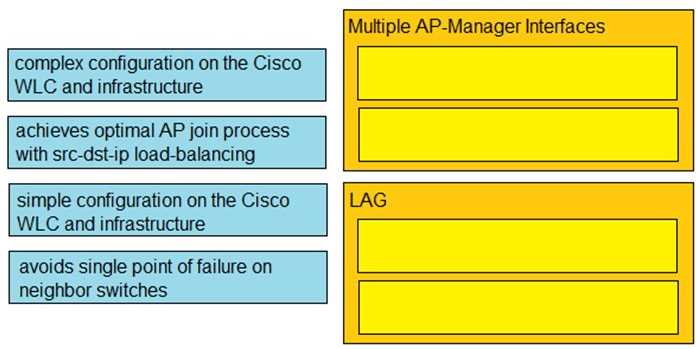
I dropped anything mentioning caching or speed under performance since those usually boost how fast things run, not the logic. That helped me separate those from security or data handling features.
For me, I ruled out any characteristics that mentioned user interface or experience since the functions seemed more backend-focused. That narrowed down the options quickly without overthinking it.
controllers are running software version 6.0.4539:44024. The customer is using OEAP and wants to
keep this functionality. Which licenses should the consultant propose with the latest controller
software version?
I’m thinking A is too basic to cover OEAP fully with new software, so probably not that.
It’s B since Premium licenses usually cover OEAP and fit well when upgrading from AireOS without needing the full Advanced suite, keeping costs reasonable.
will not be ready before the move. The new building has a non-Cisco WLAN to which they can
connect. The engineer has a 12-port switch and one Cisco autonomous AP and must connect
multiple wired devices. Which additional device is needed to get all clients connected over the
workgroup bridge?
C Definitely need something to split that single AP port to multiple wired devices.
C seems right since you need to connect multiple wired devices to one AP port.
the 5 GHz band set to 40 MHz. Co-channel interference must be reduced. Which two actions must be
taken? (Choose two.)
D/E? Dropping to 20 MHz channels in 5 GHz definitely shrinks the interference footprint, and lowering AP power helps limit overlapping coverage areas, which cuts down co-channel issues. Increasing SSIDs or changing 2.4 GHz settings feels unrelated since the question focuses on 5 GHz and interference reduction specifically. Disabling band steering doesn't really help with co-channel interference either. So D and E make the most sense based on the given details.
Maybe E and D. Lowering AP power limits overlap zones, and 20 MHz channels in 5 GHz reduce co-channel interference without cramming too many networks in the same spectrum. Increasing SSIDs or 2.4 GHz settings doesn’t help here.
• RF coverage
• better than -67 dBm in the 5 GHz spectrum
• RRM be used for DCA and TPC in the 2.4 GHz band
• RRM be used for DCA and TPC in the 5 GHz band
After deployment, why do many of the legacy 802.11b/g devices have difficulty maintaining
connectivity?
D
• two Cisco Catalyst 9800 Series wireless controllers that are configured in a high-availability SSO
cluster to manage the APs in a local office network
• 100 APs in local mode that are registered to the high-availability cluster
• one Catalyst 9800 Series wireless controller that is deployed as an anchor in a DMZ
• a CAPWAP tunnel in UP state between the high-availability cluster and the anchor WLC
The customer wants the anchored traffic to remain up if a single WLC in the high-availability cluster
fails. How must this requirement be incorporated into the design?
A. Setting the APs to use the HA cluster as primary makes sure they stick with the cluster during failover, preventing dropped anchored traffic if one WLC goes down. Without that, failover won’t be seamless.
It’s A too. If APs aren’t set to use the HA cluster as primary, they might drop anchored traffic when one WLC fails, messing up the seamless failover the customer wants.
9800, a stack of two Catalyst 9300X-
48HX switches, and 9166 APs. Each AP must be named using the Floor-439412509-01X sting where X
is the area number. The engineer wants
to connect the APs to the switch stack using POE. How many APs must the engineer connect to the
stack so the APs run using full functionalities?
B/C? If the APs need full PoE, one switch might not cut it, but using all ports on both seems overkill. Maybe just one switch fully loaded is enough before stacking adds more power.
D imo, spreading the APs across half the ports on each switch sounds like a better power management strategy. Using all ports might waste power if the budget per port is limited. Plus, connecting half the ports per switch should still provide enough POE to keep all APs fully functional without overloading a single switch.
company’s building still run on the legacy WLC. The new WLC is not located at the same site as the
legacy WLC. The company requires seamless client inter-controller roaming between the new WLC
and the legacy WLC, with no disruptions. Both WLCs are separated by firewalls. Which
troubleshooting command validates that
the mobility control packets between the WLCs can be
sent and received?
Option A makes sense since it directly tests if the mobility control packets can reach the other WLC, which is key when firewalls might block them. Debug commands just show what’s happening but don’t confirm connectivity.
Maybe A makes more sense here since the question emphasizes validating if mobility control packets can be sent and received. Debug commands show traffic but don’t necessarily confirm baseline connectivity, which A’s mapping command checks.
• Provide coverage in a single contiguous space.
• Support dual-band wireless coverage.
• Use nine APs for full coverage in a 5 GHz band.
What must the engineer do to mitigate co-channel interference and maintain coverage in 2.4 GHz?
Option C makes sense-turning off 2.4 GHz on some APs helps reduce overlap and interference.
controllers. The implementation should facilitate inter-controller roaming for users in their new
campus. After the configuration, the mobility tunnel is not operational for the data path in the
network. Which two validations should be performed? (Choose two.)
Maybe A and E. The tunnel needs both the specific port and protocol allowed through firewalls to pass data correctly. The other choices don’t fit the context or seem wrong.
Not C, since C looks like a typo. Double-checking firewall rules for port 16666 and protocol 97 is key to ensure the mobility tunnel can operate correctly.
amount of time. Which tool or equipment is used when performing the site survey?
Probably B, since sniffer mode can quickly detect all signals without extra hardware.
I agree that relying on access points (A and C) would slow down a big outdoor survey. Between B and D, I think D is better because a dedicated GPS module is designed for outdoor location tracking, making the process faster and more accurate. Using sniffer mode alone (B) might help with signal detection, but it won’t speed up mapping the whole area. So definitely D – a site survey tool with GPS is the way to go here for the quickest and most efficient survey.
issues and the primary controller lost
connectivity. Immediately all APs went to discovery and joined the secondary controller. After
recovering from the issue, the primary controller is online, but no APs return to it. All APs remain in
the secondary controller. Which setting advises the APs to return to their primary
controller?
A/D? I’m pretty sure it’s A because AP fallback is all about whether APs switch back after a failover. D, broadcast forwarding, seems unrelated since that’s more about how traffic is handled between switches and controllers. The main issue is the APs sticking to the secondary controller even when the primary is back online, which matches the AP fallback setting’s purpose. So it sounds like enabling or confirming AP fallback is needed to get the APs to rejoin the primary controller.
Guessing A, since the APs need a specific setting to switch back to the primary controller.
buildings with access points that must provide seamless wireless coverage and client roaming. The
customer data center must have two WLCs and the core switches for the network. Which type of
wireless architecture must be used?
Actually, D fits better since distributed architecture supports seamless roaming across buildings.
It’s B, because two WLCs point to centralized control, not autonomous or cloud.
Guests at headquarters need wireless access for presentations, demonstrations, and sharing of
information. The engineer must provide external users with secure guest access by
connecting to anchor controllers on the DMZ. Auto-Anchor Mobility has been selected in the
mobility group to accomplish it. Both anchors are configured as part of the mobility group for HQ.
Which design approach ensures that clients connect to the primary controller first and are
pushed to the secondary if the primary fails?
Actually, option B might cause the secondary to be preferred first, which is not what we want.
Option A sounds right since in most networking setups, a lower priority number means higher preference. So setting the primary controller's anchor priority to 1 should make clients try it first, and only failover to the secondary if needed. Option B would just flip that logic, which doesn’t make sense if you want the primary preferred initially. The ECMP options (C and D) feel more complex and less likely to control strict failover order like priority settings do.
authentication SSIDs configured. After fail over, all APs are broadcasting all SSIDs, but the clients are
assigned IP addresses from a different subnet. The WLANs on both WLCs are configured with the
same dynamic interfaces. Which feature must be incorporated in the wireless design of the second
controller?
Makes sense that VLAN Select (C) is the key here. Since both controllers use the same dynamic interfaces, without VLAN Select on the backup, the VLAN-to-SSID mapping won’t adjust after failover, causing clients to land in the wrong subnet. AP Groups (B) wouldn’t fix this since all APs already broadcast all SSIDs, so it’s not about which APs send which SSIDs. It’s a VLAN assignment issue, so adding VLAN Select on the second controller is needed to keep the VLAN mappings consistent and ensure clients get correct IPs after failover.
It’s C because VLAN Select handles VLAN mapping per SSID, fixing subnet issues after failover.