Free Microsoft Dynamics MB-330 Actual Exam Questions
Dumps Box (DumpsBox) offers up-to-date practice exam questions for MB-330 certification exam which are developed and validated by Microsoft subject domain experts certified in Microsoft Dynamics MB-330 . These practice questions are update regularly as we keep an eye on any recent changes in MB-330 syllabus, and when there is update our team quickly adjusts the questions. This commitment to providing the best quality exam prep material to certification aspirants is what makes DumpsBox.com the best certification exam prep website. On top of that, our strong, yet strictly moderated, community based feedback keeps the content clean and current. Each question has helpful community discussion that provides it extra perspective and introduces helpful resources for better exam preparation. This also saves students from other outdated practice questions or illicit exam dumps that can have adverse affects on career. Browse through our Microsoft Dynamics MB-330 exam questions and pass your exam on first try.
A company manufactures and sells surround-sound audio systems. A third-party company manufactures the stereo receivers as part of the Bill of materials (BOM) for complete sound systems. You need to automatically create a purchase order for the stereo receiver from the production order for a sound system. Which three actions should you perform? Each correct answer presents part of the solution.
I think B, E, and D make the most sense here. Setting the BOM line type to Vendor and attaching the service item are obvious, and linking the vendor on the costing sheet seems necessary for the PO to know who to order from.
B/E for sure since you need the BOM line as vendor type and attach the service item. I’d say D also makes sense because linking the service item to the vendor on the costing sheet ensures the system knows who to order from. A might be redundant if D is done, so probably B, D, and E is another valid combo. C doesn’t fit since pegged supply is more for internal supply, not purchase orders.
What should you do first?
A/D? Setting up the product first (A) is key to lay the groundwork, but storage dimensions (D) might be crucial for handling pottery safely and efficiently in inventory. Without proper storage setup, things could get messy.
C seems like a solid choice too. Creating a product master with predefined variants means you’re ready to handle different types of pottery right away, which could be more efficient before adding tracking or storage details.
What should you do first?
A vs E? Setting up product master and serial tracking seems more foundational than categories.
Probably C. Setting up storage dimensions first seems practical because you need to know how the product will be stored before defining configurations or procurement categories. Without that, other steps might be off. Plus, perfumes usually need careful handling and specific storage space, so getting that sorted early feels right.
requirements to and from the warehouse.
Which feature should you use?
I’m thinking C could be the way to go since quarantine zones hold products that fail checks. That seems like a direct method to stop nonconforming products moving through the warehouse. Does anyone see a downside?
D makes sense here since quality tests are the actual checks run on products to verify they meet requirements. Without these tests, you can’t automatically enforce anything inbound or outbound. Quarantine zones (C) just hold products, but don’t enforce requirements on their own. Quality orders (B) are for managing the test process, but the enforcement really comes from the tests themselves.
overall labor must be added to a costing sheet for each item.
The company also requires that the labor and overhead costs be calculated independently and then
rolled up to a total amount.
Which three actions should you perform to meet the requirements?
Select all answers that apply.
Guessing B, C, and E here too. Breaking down overhead and labor with subnodes (B) fits the need to keep them separate, plus defining rates on cost groups (E) matches how percentages are usually set.
Maybe B, C, and E—rates usually sit on cost groups, not nodes.
You need to provide the information for the costing manager. What should you do first?
C Checking if cancellations are closed and adjusted first could prevent errors in costing info later. If cancellations aren’t handled, the data might be misleading for the costing manager.
I get why B is popular, but I’d say D makes more sense here. You want to make sure all settlements are properly closed before handing over any costing info, otherwise the data could be incomplete or outdated. Checking that first helps avoid errors down the line.
A company uses Dynamics 365 Supply Chain Management to manage procurement operations. A purchasing manager creates a procurement request of the main product line from an offshore vendor. The vendor informs the purchasing manager that the items will be delivered in two phases due to raw material shortages. The purchasing manager wants to maintain this information by keeping the procurement request intact for tracking. You need to configure the procurement requirements before the goods are shipped. What are two possible ways to achieve this goal? Each correct answer presents a complete solution.
D imo, purchase order updates handle delivery splits best; folio seems just for notes.
B/D – You want to keep the original procurement request untouched for tracking but still manage the phased delivery info. Updating the folio (B) lets you add notes about the split deliveries without changing the request itself. And updating the purchase order (D) reflects the actual delivery phases so you can track shipments properly. Vessel and voyage (A/C) seem more tied to shipping logistics rather than procurement tracking, so they don’t really fit here.
the series contains a unique solution that might meet the stated goals.
A company uses Dynamics 365 Supply Chain Management to item returns.
You need to ensure that the original quantity and price from a sales order is used for return orders.
Solution: Create a Sales Order that uses the returned order sales type.
Does the solution meet the goal?
C imo, you usually have to process returns through a specific return order linked to the original sales order. Just creating a new sales order with a different type won’t keep the original pricing automatically.
It’s B. Just creating a sales order with the returned order sales type doesn’t automatically pull in the original quantity and price details. You’d need a way to link the return directly to the initial sales order so the system knows what to match. Otherwise, it might default to standard pricing or quantities that don’t reflect the original transaction.
You need to configure the system to support the inventory costing requirement. Which two actions should you perform? Each answer represents a complete solution.
Makes sense to pick C since you likely need both FIFO and Standard item model groups to handle different costing methods properly. A single item group (A) wouldn't cover varied costing needs well. C
B, C. I think having separate item groups for different product types (B) is important since perfume and ceramicware could have very different costing needs. Then pairing that with multiple item model groups for FIFO and Standard methods (C) lets you assign the right costing method per group. Just using one FIFO group or one default group seems too limiting given the variety in inventory. This way you get flexibility in tracking costs accurately across item categories.
A distribution company is implementing Dynamics 365 Supply Chain Management. The company plans to expand into providing trucking services for its primary distribution center. The company may expand into other locations later. All vehicle maintenance will be performed at standardized intervals to meet trucking regulations. The vehicles must be established on the maintenance schedule at the distribution center. The fleet manager requires all vehicles to be grouped together by location for the distribution center and by sublocations for any hubs. The company requires the following implementation:
• Sublocations must inherit the maintenance schedule.
• Non-vehicle assets must not inherit the maintenance schedule.
You need to configure the system to meet the requirements. What should you configure?
Maybe B, since functional location types manage grouping and schedule inheritance well.
I also think B fits best here. Functional location types help organize assets logically by location and sublocation, which matches the grouping requirement. The inheritance of maintenance schedules can be set up at this level. Plus, since non-vehicle assets shouldn't inherit the schedule, using functional location types allows you to assign maintenance rules specifically to vehicle categories and exclude others. The other options don’t really address grouping and inheritance like B does.
You need to meet the requirements for CustomerD. Which two parameters should you configure? Each answer presents part of the solution.
D I’m going with D and B here. Wave templates (D) help organize and control order processing, which can be crucial for meeting specific customer requirements, while sellable days (B) set the freshness window. Together, they cover both the scheduling and product validity sides without overcomplicating with expiration logic if that’s not explicitly needed. Seems like a practical pair if the focus is on operational flow along with product availability.
B and E seem like a solid pair to manage both freshness and value.
new products and learn that CompanyA plans to use Warehouse management (WMS) but CompanyB
will not.
Each storage, tracking and production dimension name and configuration must be identical in each
company.
You need to set up the dimensions that affect WMS for the new products.
Which two actions should you perform? Each correct answer presents a complete solution
C imo, product master locks dimensions; D too for setting storage group upfront per company.
It’s definitely C because the product master makes sure all dimension names and configs stay the same between companies. Also, D makes sense here—assigning the storage group before release and then adjusting it per company fits the need to keep things aligned but still allow for company-specific WMS use. A and B feel off since changing tracking or leaving storage blank can cause inconsistencies or missing setup in one company. So, C and D together cover both consistency and company-specific adjustments properly.
HOTSPOT A company uses Dynamics 365 Supply Chain Management for master planning in manufacturing processes. Master planning runs have increased in processing time over the past month. You need to identify the impact of configuration changes on performance from a single location. Which objects should you use? To answer, select the appropriate options in the answer area.
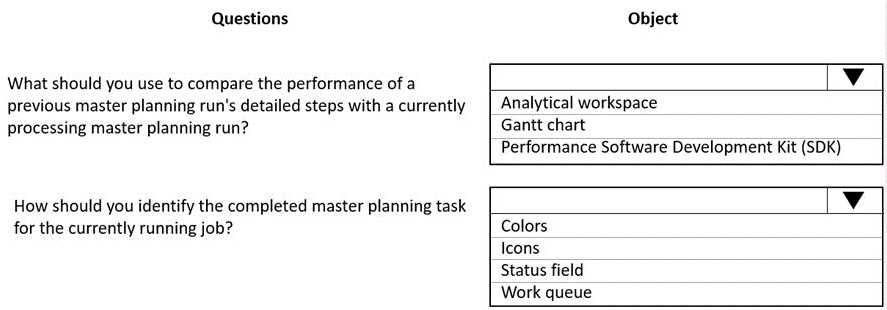
Besides what’s been said, I’d say focusing on system administration logs and batch job history still makes the most sense because they give you a clear timeline of what changed and when the master planning runtimes spiked. Performance analyzer is great for deep dives, but if you want to start with a single point of truth about config changes affecting performance, those two are your best bet. Database tables might hold data but won’t directly link changes to performance hits without extra work. Keeping it simple helps pinpoint the root cause faster.
I’d add that performance analyzer is key to pinpoint which config changes caused slowdowns, since it breaks down run-time stats. So system admin logs plus batch job history and performance analyzer covers all angles.
HOTSPOT A company uses Dynamics 365 Supply Chain Management with advanced warehouse capabilities. Warehouse workers use mobile devices. High value stocked items are classified as A items and are stocked in different locations in the warehouse. The accounting department requires that all A items be counted weekly. If there are any inconsistencies, the A items must be counted a second time prior to posting the counts. You need to configure the system to meet the requirements What should you configure for each requirement? To answer, select the appropriate options in the answer area.
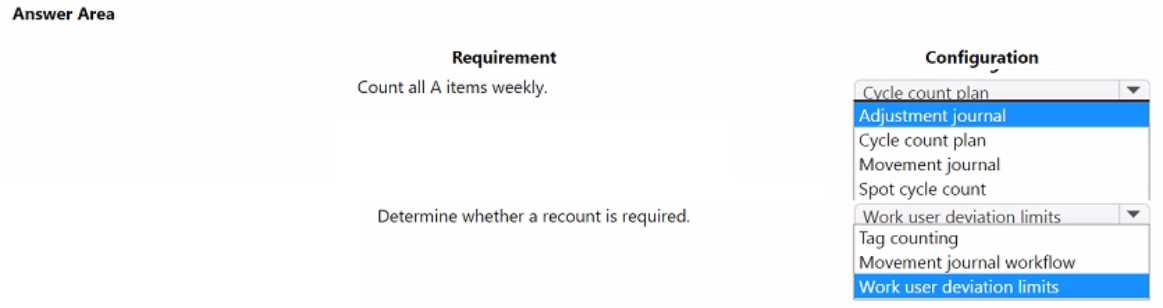
Another angle is to focus on using a dedicated cycle count journal specifically for A items. You can set the frequency to weekly and configure the system to automatically block posting if discrepancies occur, forcing a recount before any posting. This aligns with the need for a second count on inconsistencies and keeps the process controlled. Plus, splitting counts by cycle groups ensures only A items get this strict treatment without slowing down the rest of the inventory.
Also, configuring separate cycle count groups for A items could help manage locations better and ensure only those specific items get the weekly counts and recounts if needed. This keeps it organized and targeted.
An engineering department designs a bill of materials (BOM) for a new finished good. The finished good must be sold with a 30 percent markup of the BOM cost. You need to define the sales price for the finished good. What should you set up on the cost group? Select only one
It’s B because the cost group behavior determines how costs are treated and how the markup gets applied. Just setting a profit percentage (A) won’t work properly unless the system knows how to handle the group, like if it’s direct or indirect costs. Options C, D, and E focus on categorizing the costs but don’t directly set up the markup or pricing logic. So defining the cost group behavior is more fundamental to setting the sales price based on BOM costs.
It’s A because setting the profit percentage directly controls the markup.