Free Microsoft AZ-305 Actual Exam Questions
Dumps Box (DumpsBox) offers up-to-date practice exam questions for AZ-305 certification exam which are developed and validated by Microsoft subject domain experts certified in Microsoft AZ-305 . These practice questions are update regularly as we keep an eye on any recent changes in AZ-305 syllabus, and when there is update our team quickly adjusts the questions. This commitment to providing the best quality exam prep material to certification aspirants is what makes DumpsBox.com the best certification exam prep website. On top of that, our strong, yet strictly moderated, community based feedback keeps the content clean and current. Each question has helpful community discussion that provides it extra perspective and introduces helpful resources for better exam preparation. This also saves students from other outdated practice questions or illicit exam dumps that can have adverse affects on career. Browse through our Microsoft AZ-305 exam questions and pass your exam on first try.
HOTSPOT You plan to deploy an Azure web app named Appl that will use Azure Active Directory (Azure AD) authentication. App1 will be accessed from the internet by the users at your company. All the users have computers that run Windows 10 and are joined to Azure AD. You need to recommend a solution to ensure that the users can connect to App1 without being prompted for authentication and can access App1 only from company-owned computers. What should you recommend for each requirement? To answer, select the appropriate options in the answer area. NOTE: Each correct selection is worth one point. 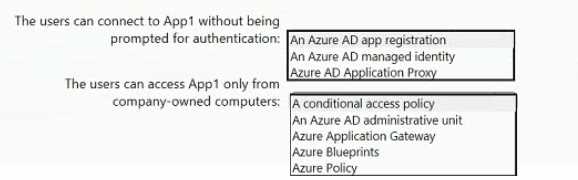
Azure AD Join ensures seamless SSO, and Conditional Access with device compliance restricts access properly.
Azure AD Join plus Conditional Access with device compliance should do it.
HOTSPOT You plan to create an Azure environment that will contain a root management group and 10 child management groups. Each child management group will contain five Azure subscriptions. You plan to have between 10 and 30 resource groups in each subscription. You need to design an Azure governance solution. The solution must meet the following requirements: • Use Azure Blueprints to control governance across all the subscriptions and resource groups. • Ensure that Blueprints-based configurations are consistent across all the subscriptions and resource groups. • Minimize the number of blueprint definitions and assignments. What should you include in the solution? To answer, select the appropriate options in the answer are a. NOTE: Each correct selection is worth one point. 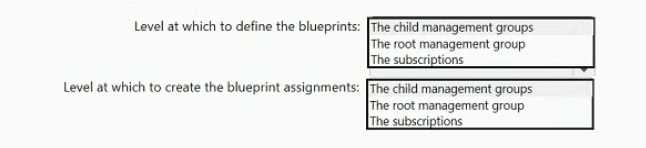
I’d go with assigning one blueprint definition at the root management group (D) because it covers all child management groups and subscriptions automatically, keeping configs consistent. Then, assign the blueprint once at the root (B) to minimize the number of assignments. Creating multiple definitions for each child mgmt group or subscription would just complicate things and increase maintenance. This setup leverages inheritance and meets the requirement for consistency without unnecessary duplication.
Assigning a single blueprint definition at the root management group level makes sense to keep things consistent and minimize assignments, since everything under it inherits the policies. That covers all subscriptions and resource groups efficiently.
in size and have various utilization levels.
You plan to move all the virtual machines to Azure.
You need to recommend how many and what size Azure virtual machines will be required to move
the current workloads to Azure. The solution must minimize administrative effort.
What should you use to make the recommendation?
B/D? Azure Pricing Calculator (B) helps estimate costs but doesn’t analyze actual workloads or recommend sizes. Azure Advisor (D) mainly gives best practice recommendations after resources are deployed, not for initial sizing. Since the question wants to minimize admin effort and get sizing recommendations, C seems best, but if you don’t have VM usage data yet, then C’s assessment might be limited. Still, among these, only C offers a built-in tool for migration assessment and sizing. So I’d rule out A/B/D pretty quickly.
None but C offers automated right-sizing based on actual workload data.
The App Service instances will be deployed at the same time as the Azure SQL
databases.
The company has a regulatory requirement to deploy the App Service instances only to specific Azure
regions. The resources for the App Service instances must reside in the same region.
You need to recommend a solution to meet the regulatory requirement.
Solution: You recommend using an Azure policy to enforce the location of resource groups.
Does this meet the goal?
B imo, because resource group location doesn’t limit where App Services actually run.
It’s B because resource groups can contain resources in different regions. Just enforcing the resource group location doesn’t stop App Services from being deployed elsewhere. You need a policy that targets the App Service resource type directly.
DRAG DROP You plan to import data from your on-premises environment to Azure. The data Is shown in the following table.  What should you recommend using to migrate the data? To answer, drag the appropriate tools to the correct data sources-Each tool may be used once, more than once, or not at all. You may need to drag the split bar between panes or scroll to view content. NOTE: Each correct selection is worth one point.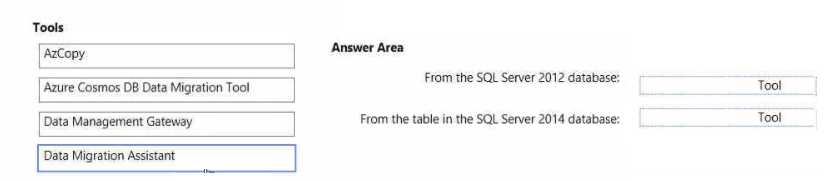
This drag and drop feels kinda confusing without the images. Anyone else struggling to match the right tools to each data source? I’m not sure which tool suits each scenario best here.
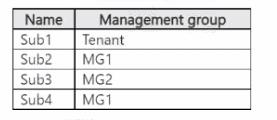
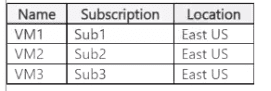
HOTSPOT You have the Azure management groups shown in the following table. 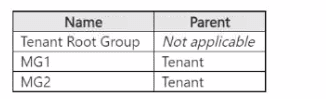 You have the Azure subscriptions shown in the following table.
  You have the virtual machines shown in the following table.
  You have the resource groups shown in the following table.
 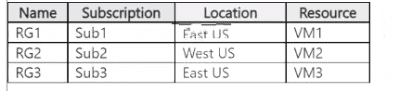 You have the Azure policies shown in the following table. You perform the following actions: • Assign PA1 to MG1. • Modify PA2 and configure the resource selector to include only Microsoft.Compute/virtualMachines in the East US Azure region. • Modify PA3 and add an exclusion for Sub1. For each of the following statements, select Yes if the statement is true. Otherwise, select No. NOTE: Each correct selection is worth one point.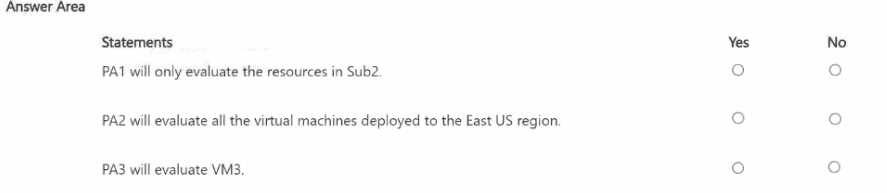
PA1 definitely covers both subscriptions since it's assigned to MG1. For PA2, the resource selector limits it to East US VMs, so VM3 in West US doesn’t get it. PA3 excludes Sub1, so nothing under Sub1 is affected.
PA1 applies to both Sub1 and Sub2 since they’re under MG1, but PA2 only targets VMs in East US, so VM3 in West US is excluded. PA3 excludes Sub1, so policies won’t affect its VMs.
HOTSPOT You need to ensure that users managing the production environment are registered for Azure MFA and must authenticate by using Azure MFA when they sign in to the Azure portal. The solution must meet the authentication and authorization requirements. What should you do? To answer, select the appropriate options in the answer area. NOTE: Each correct selection is worth one point. 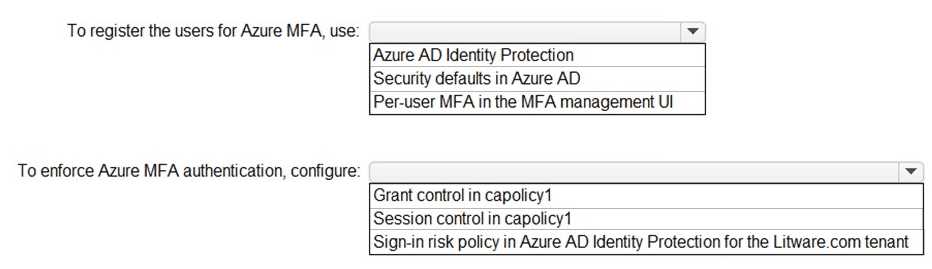
D is the standout for registration since it enforces completing MFA setup. Then A ensures MFA is actually required every time they log in, covering both registration and enforcement properly.
I’d pick D for registration since it forces users to register MFA before accessing, and then A to ensure MFA is required on every sign-in. B and C don’t really cover mandatory MFA registration well.
DRAG DROP You have an on-premises named App 1. Customers App1 to manage digital images. You plan to migrate App1 to Azure. You need to recommend a data storage solution for Appl. The solution must meet the following image storage requirements: Encrypt images at rest. Allow files up to 50M 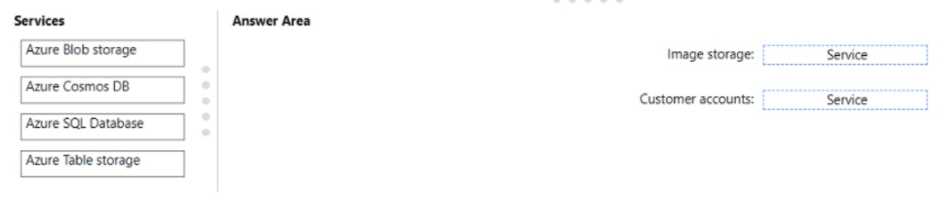
I’m thinking option B makes the most sense here because Azure Blob Storage supports encryption at rest by default and handles files way larger than 50MB easily. Since the app deals with digital images, storing them as blobs is pretty straightforward. Plus, Blob Storage offers different access tiers if you need to optimize cost later on. Options like Azure Files might be overkill unless the app specifically needs SMB protocol support, which wasn’t mentioned. So, Blob Storage seems like the simplest and most fitting choice for encrypted, large file storage.
Option B fits since it supports encryption and files over 50MB.
HOTSPOT You plan to migrate on-premises Microsoft SQL Server databases to Azure. You need to recommend a deployment and resiliency solution that meets the following requirements: Supports user-initiated backups Supports multiple automatically replicated instances across Azure regions Minimizes administrative effort to implement and maintain business continuity What should you recommendation? To answer, select the appropriate options in the answer area. NOTE: Each correct selection is worth one point. 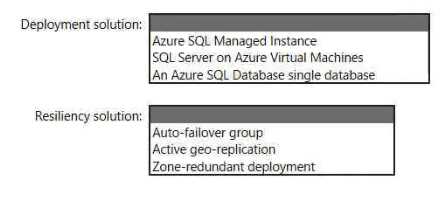
Option B fits better for auto replication, while C handles user backups easier.
B and C make the most sense for auto replication and backup control.
processing application. When a transaction in App1 requires shipping, a message is added to an
Azure Storage account queue, and then App2 listens to the queue for relevant transactions.
In the future, additional applications will be added that will process some of the shipping requests
based on the specific details of the transactions.
You need to recommend a replacement for the storage account queue to ensure that each additional
application will be able to read the relevant transactions.
What should you recommend?
It’s B. Topics let multiple apps subscribe separately and get filtered messages, which suits adding more processors better than a single queue or multiple queues. Data Factory isn’t designed for real-time messaging here.
Agree with the choice of B here. Unlike a single queue, a Service Bus topic lets multiple apps subscribe independently and get only the messages they care about using filters. That’s perfect for scaling out and adding more processors without duplicating logic or losing messages. Also, storage queues are pretty basic and don’t support multiple subscribers well, so D is out. The pipeline option C doesn’t really fit event messaging scenarios. So B seems like the best fit to enable flexible, multi-app processing of shipping requests.
HOTSPOT You have the Azure resources shown in the following table. 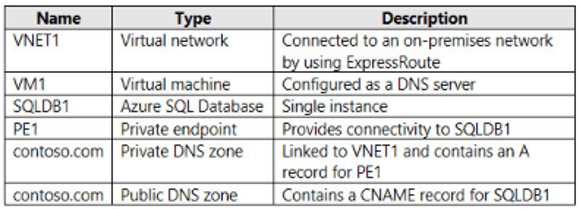 You need to design a solution that provides on-premises network connectivity to SQLDB1 through PE1. How should you configure name resolution? To answer, select the appropriate options in the answer area.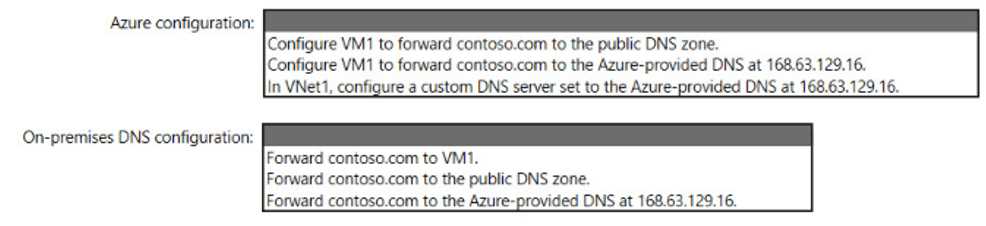
Option B makes sense since on-prem DNS needs conditional forwarding to Azure Private DNS.
They probably want conditional forwarding to Azure Private DNS from on-prem DNS.
You need to recommend a database solution for the application. The solution must meet the
following requirements:
Support SQL commands.
Support multi-master writes.
Guarantee low latency read operations.
What should you include in the recommendation?
Not B because active geo-replication in Azure SQL Database doesn’t support multi-master writes, only readable secondaries. A fits better for multi-master and SQL support.
This one’s tricky but gotta go with A. Cosmos DB SQL API since it supports SQL, multi-master writes, and low latency reads.
DRAG DROP Your on-premises network contains a server named Server1 that runs an ASP.NET application named App1. You have a hybrid deployment of Azure Active Directory (Azure AD). You need to recommend a solution to ensure that users sign in by using their Azure AD account and Azure Multi-Factor Authentication (MFA) when they connect to App1 from the internet. Which three Azure services should you recommend be deployed and configured in sequence? To answer, move the appropriate services from the list of services to the answer area and arrange them in the correct order. 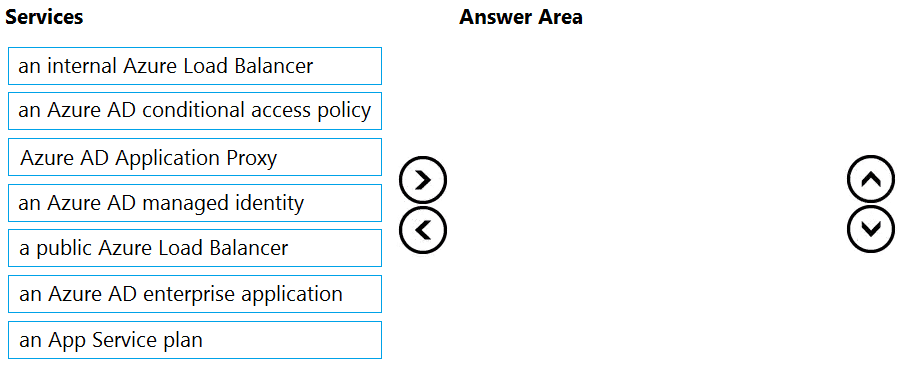
I’d pick Azure AD Application Proxy first to securely publish App1, then Azure AD to handle user authentication, and finally Azure MFA to add the extra verification step for internet users. That order fits the hybrid setup best.
I think starting with Azure AD Application Proxy makes sense to expose App1 securely, then Azure AD for sign-in, and lastly enforce MFA. Without the proxy, you can't easily apply Azure AD authentication from outside your network.
HOTSPOT You plan to deploy Azure Databricks to support a machine learning application. Data engineers will mount an Azure Data Lake Storage account to the Databricks file system. Permissions to folders are granted directly to the data engineers. You need to recommend a design for the planned Databrick deployment. The solution must meet the following requirements: Ensure that the data engineers can only access folders to which they have permissions. Minimize development effort. Minimize costs. What should you include in the recommendation? To answer, select the appropriate options in the answer area. NOTE: Each correct selection is worth one point. 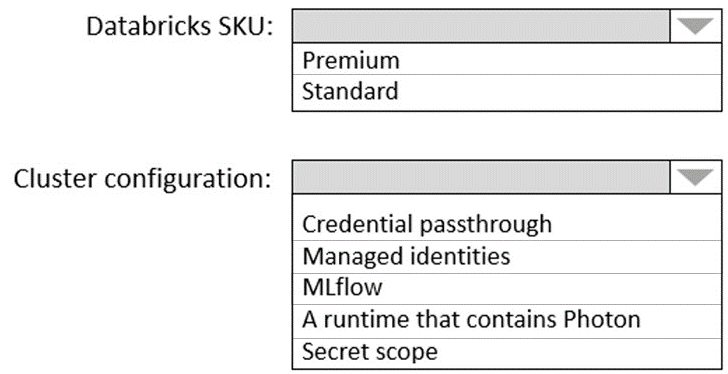
I think choosing Azure Data Lake Storage Gen2 ACLs is key since it handles folder-level permissions natively. Also, mounting the ADLS Gen2 storage directly in Databricks keeps costs and dev work low compared to custom access controls.
Using ACLs on ADLS Gen2 folders is smart here since it directly controls access without extra coding. Also, mounting the storage in Databricks as DBFS doesn’t add cost or complexity, so that fits the requirements well.
compliance requirement
What should you do?
C imo. Resource locks prevent accidental deletion or modification, which is a key part of maintaining compliance and protecting data integrity. Just setting RBAC (D) controls access but doesn’t stop someone with permissions from deleting resources by mistake. Locks add an extra layer of protection specifically for compliance scenarios where data must not be altered or removed without strict oversight. This feels like a better fit when the question focuses on securing data storage itself beyond just access rights.
B vs D? Changing access level (B) seems too blunt; RBAC (D) offers detailed control needed for compliance.