Free Juniper JN0-683 Actual Exam Questions
Dumps Box (DumpsBox) offers up-to-date practice exam questions for JN0-683 certification exam which are developed and validated by JUNIPER subject domain experts certified in Juniper JN0-683 . These practice questions are update regularly as we keep an eye on any recent changes in JN0-683 syllabus, and when there is update our team quickly adjusts the questions. This commitment to providing the best quality exam prep material to certification aspirants is what makes DumpsBox.com the best certification exam prep website. On top of that, our strong, yet strictly moderated, community based feedback keeps the content clean and current. Each question has helpful community discussion that provides it extra perspective and introduces helpful resources for better exam preparation. This also saves students from other outdated practice questions or illicit exam dumps that can have adverse affects on career. Browse through our Juniper JN0-683 exam questions and pass your exam on first try.
Probably B and C here. eBGP in an underlay fabric often uses loopbacks for peering, so you don’t always need an IGP running just for adjacency—making B plausible. Also, the standard leaf-spine design means each leaf peers with every spine (C), not leaf-to-leaf, so D doesn’t fit. A seems off because the whole point of underlay fabrics is to simplify and avoid extra protocols if possible.
A imo, because eBGP normally needs some IGP or static routes for adjacency since it’s between different ASes and routers need to know how to reach each other. D doesn’t fit since leaf-to-leaf peering isn’t typical in underlay fabrics. C might be true but less of a given than A for sure. So A and D are less likely, making B and C the better picks, but I’d say A is definitely a factor to consider in an E8GP setup.
statements are correct in this scenario? (Choose two.)
Maybe B, since OTT with VNI translation directly handles mapping VNIs across isolated domains.
I think C fits best since VXLAN stitching is designed specifically to connect isolated VXLAN segments and handle VNI translation naturally. So, C seems like the right pick.
scenario? (Choose two.)
This one’s tricky, but I’m going with C. Locally connected hosts usually don’t have an active source IP because they’re directly attached, so the field would be blank. That seems cleaner than B, since an ARP failure typically wouldn’t leave the MAC known without any IP info at all—it’d probably just not show the entry. Plus, multicast EVPN routes usually have different markers, so D feels less likely here.
B/D? The blank active source could mean the system knows the MAC but can’t find the IP, which fits B. But if this were a multicast EVPN route, that might also explain why no IP shows up since multicast entries sometimes don’t have an associated source IP. I’m not sure if the exhibit clarifies whether this is a multicast or unicast route though, which makes it tough to rule out D. So it’s either a failed ARP or multicast-related missing IP info.
multiple unique VRF instances. You want to determine the routing information that belongs in each
routing instance's routing table.
In this scenario, which property is used for this purpose?
A The VRF target community controls route import/export between VRFs, so it directly determines what routing info ends up in each instance’s table. That’s the key property for separating tenant routes.
I’m thinking B might be worth considering since the routing instance type defines how the routing table behaves and what kind of routes it accepts. Could that be the key to determining which routes belong where, rather than just tagging or distinguishing them?
attached. The statistics need to be reported every five seconds. Using the Junos default settings,
which telemetry method would accomplish this request?
Maybe C and D. Symmetric routing usually handles bigger scale better, which fits the scenario. Plus, asymmetric routing is known to do the routing on the egress switch, so D makes sense too.
Noticed some debate on scaling and IRB use. I think C and D work best here. Symmetric routing is generally better for scaling large numbers of VLANs, which fits the scenario’s future growth. And D matches how asymmetric routing offloads routing to the egress switch, keeping it simpler on the ingress side. A feels off because symmetric routing doesn’t necessarily need an extra VLAN for each VRF, just IRBs configured properly. So, C and D seem like the stronger picks from what I understand.
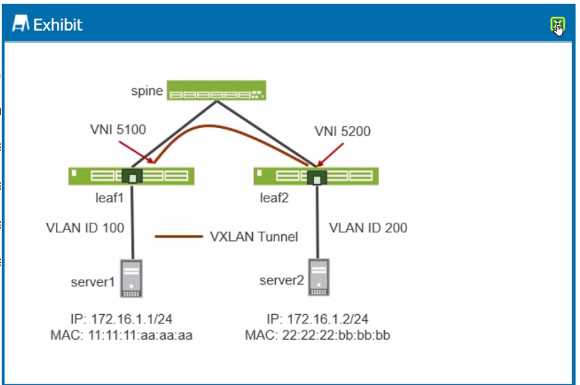
A VXLAN tunnel has been created between leaf1 and Ieaf2 in your data center. Referring to the
exhibit, which statement is correct?
Makes sense to me that host-facing interfaces need service-provider style for overlapping VLANs, so A fits. Also, spine-facing interfaces typically use enterprise-style, so C seems right too.
It’s A and C for me. Overlapping VLANs need service-provider style on host-facing interfaces, so A fits. Spine-facing usually stick with enterprise-style, which matches C. D doesn’t make sense since mac-vrf isn’t VLAN-based.
B imo, since CRB centralizes routing on spines, matching the question directly.
Makes sense that CRB (B) is the answer since it centralizes routing on the spines, which matches the question’s need. ERB (A) usually handles routing on the leaves, so that doesn’t fit here. The bridged overlay (C) is more about Layer 2 bridging than routing. Distributed symmetric routing (D) spreads routing across leaves and spines, so it’s not strictly spine-only routing. So, B stands out as the best match for routing on spines only.
receiving all the routes. However, the routes are not installed in the routing table and are marked as
hidden.
Which two statements describe how to solve the issue? (Choose two.)
It’s A because the border spine devices are designed for stitching VLANs like Blue across DCs in ERB. The Red and Green VLANs usually get routed, so stitching them isn’t necessary here.
It’s D because adding a lean super spine makes sense when stretching all VLANs and stitching is needed across DCs, covering both inter-VLAN routing and VLAN extension in one place.
configuration. In this scenario, what are two components that you would configure on the DHCP
server? (Choose two.)
A/C for me. The inner packet fields usually aren’t part of the hash calculation because VXLAN load balancing typically relies on outer headers, especially the source UDP port which changes per flow. The destination port is fixed (usually 4789), so B is definitely out. D could be true in some cases, but without explicit mention of special config or software version, it’s safer to go with A and C.
Makes sense that destination port won’t help since it’s fixed, so B is out. The source port (C) is likely used for hashing, and inner packet fields aren’t included, so A fits as well. A and C.
for VNI 100. You have already configured an IRB interface. In this scenario, which command would
you use to accomplish this task?
I’m not sure about B because if the fabric is collapsed, wouldn't having multiple vendors complicate the uniform VXLAN encapsulation? Also, A feels off since collapsed fabrics usually avoid complex spine meshing.
B. The question mentions a collapsed fabric EVPN-VXLAN setup, which typically means using identical devices for simplification. Saying it supports multiple vendors as long as the spines are all Juniper L2 VTEPs sounds off because mixing vendors usually complicates the fabric consistency and interoperability. So, B feels less likely. Also, fully meshed spine links (A) aren’t strictly needed if the fabric is collapsed and simplified. Virtual Chassis at leaf (C) is about resiliency but not a defining feature of collapsed EVPN-VXLAN fabrics. D fits best with standard border leaf duties.
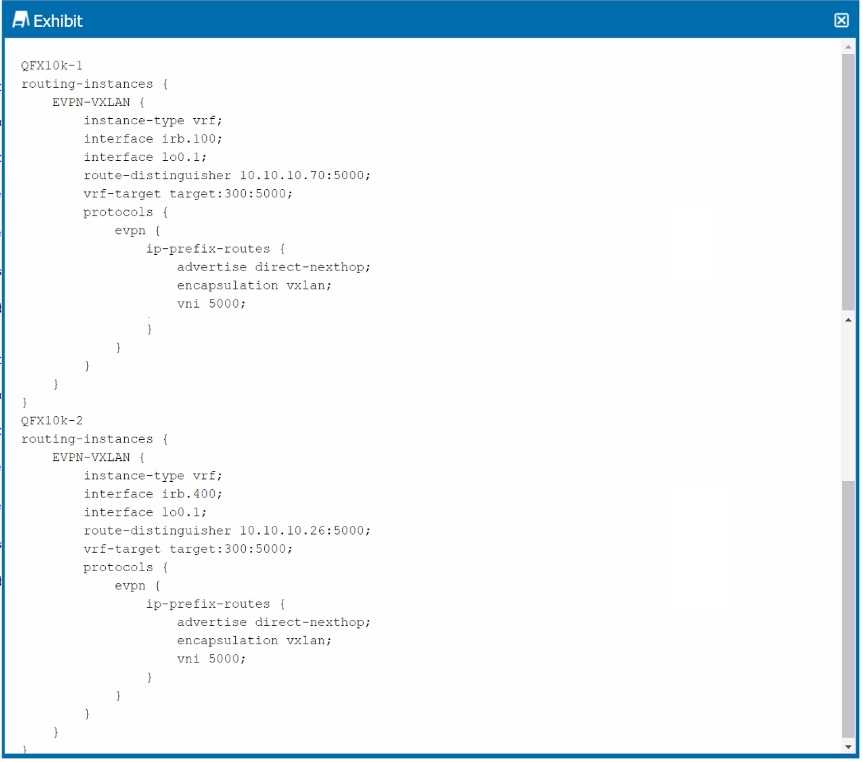
You have a sample configuration for connecting two sites through EVPN-VXLAN by exchanging IP
prefix routes.
Referring to the exhibit, which two statements regarding the configuration are true? {Choose two.)
Probably A and C since adding leaves adds capacity, reducing oversubscription.
It’s A and C since adding leaves boosts bandwidth, lowering oversubscription, and removing leaves does the opposite.
Ethernet in this scenario, which statement is correct about congestion management?
Maybe B, deleting advertise-external could stop the UNDERLAY group from leaking incorrect routes that might block the BGP session with Border-Leaf-2. It’s worth trying if the external routes cause confusion.
It’s D, removing accept-remote-nexthop usually fixes sessions blocked by unrecognized next-hops.
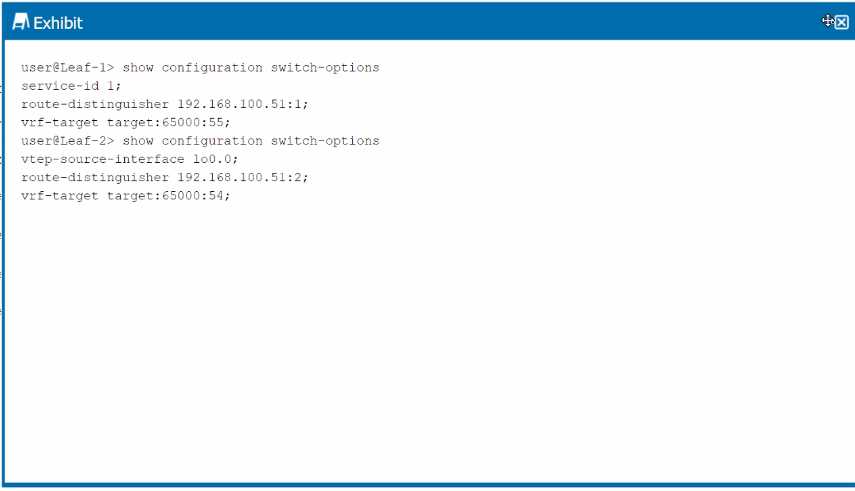
Connections between hosts connected to Leaf-1 and Leaf-2 are not working correctly.
Referring to the exhibit, which two configuration changes are required to solve the problem?
(Choose two.)
Maybe B and D. Since each data center has unique IP space and no bridging, peering all leaf nodes (D) could ensure full reachability inside DCs, while B covers border leaf peering for inter-DC communication.
It’s C and B since Type 5 handles unique IP prefixes, and peering at border leafs makes sense.
signalling?
Maybe C and D make the most sense here. IRB interfaces are usually on the leaf switches to bridge between VXLAN and VLAN, so C fits. Also, traffic going directly over the VXLAN tunnel between leaf1 and Ieaf2 (D) sounds right since that’s how EVPN-VXLAN typically forwards East-West traffic in the fabric without involving spines in the data path. The spines usually handle control-plane or routing, not VXLAN termination, so options involving IRBs on spines (A) or VXLAN tunnels transiting spines (B) seem less likely.
Looks like the answer involves IRB interfaces on leafs, so C and D.
In this scenario, which two statements are correct? (Choose two.)
Adeel T. imo, option B is key since border leaf nodes handle the EVPN route exchange between data centers. Then options A and D cover Layer 2 and Layer 3 respectively with Type 2 and Type 5 EVPN routes. The full mesh in C and E feels like overkill here—especially since the question points to just linking two data centers over an IP backbone, not a huge multi-site fabric. So I’d drop C and E for simplicity and stick with A, B, D to cover both layers efficiently without unnecessary complexity.
B (border leaf EVPN exchange) plus A and D for Type 2/5 routes covers both layers well.