Free Juniper JN0-683 Actual Exam Questions - Question 6 Discussion
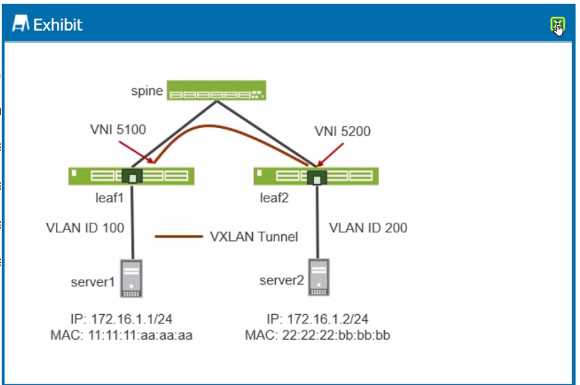
A VXLAN tunnel has been created between leaf1 and Ieaf2 in your data center. Referring to the
exhibit, which statement is correct?
Makes sense to me that host-facing interfaces need service-provider style for overlapping VLANs, so A fits. Also, spine-facing interfaces typically use enterprise-style, so C seems right too.
It’s A and C for me. Overlapping VLANs need service-provider style on host-facing interfaces, so A fits. Spine-facing usually stick with enterprise-style, which matches C. D doesn’t make sense since mac-vrf isn’t VLAN-based.
A, C. Since mac-vrf supports overlapping VLANs, host-facing interfaces usually require service-provider style config to properly handle those VLAN tags, making A sensible. Spine-facing interfaces often use enterprise-style configs because they don’t deal with overlapping VLANs directly, so C fits well. B is less likely since enterprise-style on host interfaces wouldn't handle overlapping VLAN IDs properly, and D doesn’t sound right because mac-vrf isn’t VLAN-based routing-instance type.
I’m pretty sure A is right because service-provider style configs are used on host-facing interfaces when you want to handle overlapping VLAN IDs. That leaves C, since spine-facing interfaces usually get enterprise-style to handle VXLAN encapsulation properly. So, A and C make the most sense here.
Option B for host interfaces, since mac-vrf needs enterprise-style VLAN tagging.
B/C? Host-facing interfaces usually get enterprise-style configs since they deal with customer VLANs, while spine-facing might differ. D doesn’t fit because mac-vrf isn’t VLAN-based; it’s MAC-based routing.
I think the key is allowing Type 5 routes, which are about IP prefixes. So, option A makes sense to move vrf-target to EVPN to export/import those routes. Options B and C seem unrelated to Type 5 routes.