Free Cisco 350-601 Actual Exam Questions
Dumps Box (DumpsBox) offers up-to-date practice exam questions for 350-601 certification exam which are developed and validated by Cisco subject domain experts certified in Cisco 350-601 . These practice questions are update regularly as we keep an eye on any recent changes in 350-601 syllabus, and when there is update our team quickly adjusts the questions. This commitment to providing the best quality exam prep material to certification aspirants is what makes DumpsBox.com the best certification exam prep website. On top of that, our strong, yet strictly moderated, community based feedback keeps the content clean and current. Each question has helpful community discussion that provides it extra perspective and introduces helpful resources for better exam preparation. This also saves students from other outdated practice questions or illicit exam dumps that can have adverse affects on career. Browse through our Cisco 350-601 exam questions and pass your exam on first try.
manage or control the underlying cloud infrastructure. It also wants to maintain control over the
deployment of its applications and configuration settings of the application-hosting environment.
Which cloud service model meets these requirements?
It’s A. The question says they don’t want to manage infrastructure but want control over app deployment and config settings. IaaS (C) would mean managing VMs and OS, which they want to avoid. SaaS (D) wouldn’t let them control deployment or environment settings. Function as a Service (B) is too limited since it’s just running functions without broader app environment control. So PaaS fits best because it handles the infrastructure but still gives control over how the app runs and is set up.
A/D? Since they don’t want to manage infrastructure but want control over deployment, SaaS (D) is too limited. PaaS (A) gives more control than SaaS without the infrastructure hassle, so A still feels right.
Drag and drop the keywords onto the URL request to collect all the subnets configured under tenant Production using
a REST API. Not all options are used.
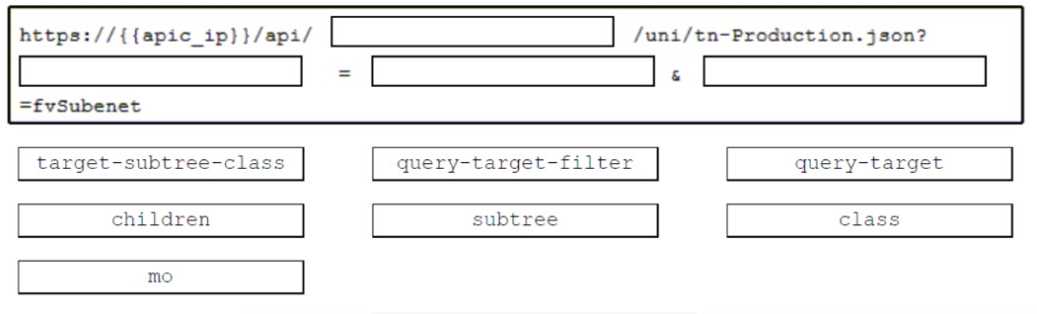
I agree that D targets the tenant specifically, but I’m thinking about C too since it mentions subnets explicitly. Maybe the best approach is combining both to ensure the API call filters on tenant Production and pulls only subnets. If the API requires both tenant and resource type filtering, just using D might return more than subnets. So, dropping C and D makes sense to narrow down the request exactly to subnets under Production.
D seems right since it specifically targets subnets under tenant Production.
Makes sense that it’s D since dynamically managing space avoids downtime. D
I don’t think it’s A because aborting updates due to pending commits would cause disruptions, which goes against the whole point of a nondisruptive update. B feels shaky too, since merging zone servers is a sensitive operation and usually wouldn’t be left running uninterrupted during an update. D makes the most sense since dynamically allocating space lets the switch load new images without downtime, which aligns with the nondisruptive goal. C seems off because BIOS updates are typically separate and more invasive. So, I’m with D on this one.
vPCs are deployed as follows:
vPC 1 encompasses ports Eth 1 /1 on leaf A and B and connects to server 1.
vPC 2 encompasses port Eth1/2 on leaf A and B and connects to server 2.
A leaf switch profile listing leaves A and B is already configured Which ACI object must be created to meet these
requirements?
A vs C? The question mentions creating two vPCs, which means two separate PortChannels logically, but the policies controlling interface behavior are defined in interface policy groups. So it’s likely you need two vPC interface policy groups (A) to properly apply different settings per vPC. C refers more to the PortChannel group itself, which might not be an ACI object in this context.
C imo, since each vPC needs a PortChannel group for correct aggregation. Interface policy groups handle settings like speed but don’t create the actual channel bundles needed here.
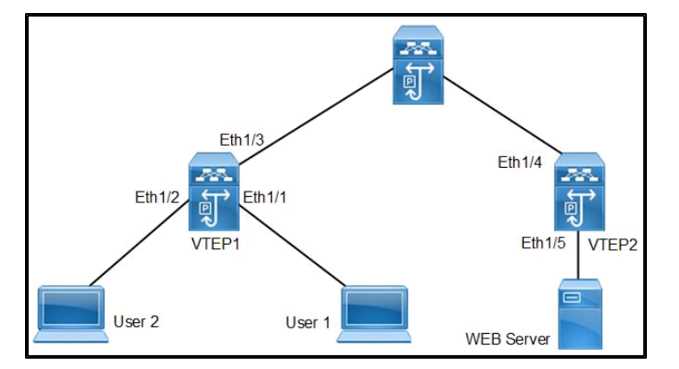
Refer to the exhibit. User1 and User2 are connected to VTEP1 switch. The users can reach the WEB server. The
P-10
monitoring tool shows degrading network performance and excessive traffic is sent from User2 to reach the WEB
server. Which storm control percentage levels must be used to suppress traffic from User2 and allow all traffic types
from User1?
Maybe C, because setting 0 on Eth1/2 could block User2’s excess traffic.
C/D? If Eth1/2 is User2’s port, setting 0 there blocks their excess traffic, while 100 on Eth1/1 leaves User1 unaffected. Without clear port mapping, this seems the best guess.
P-37
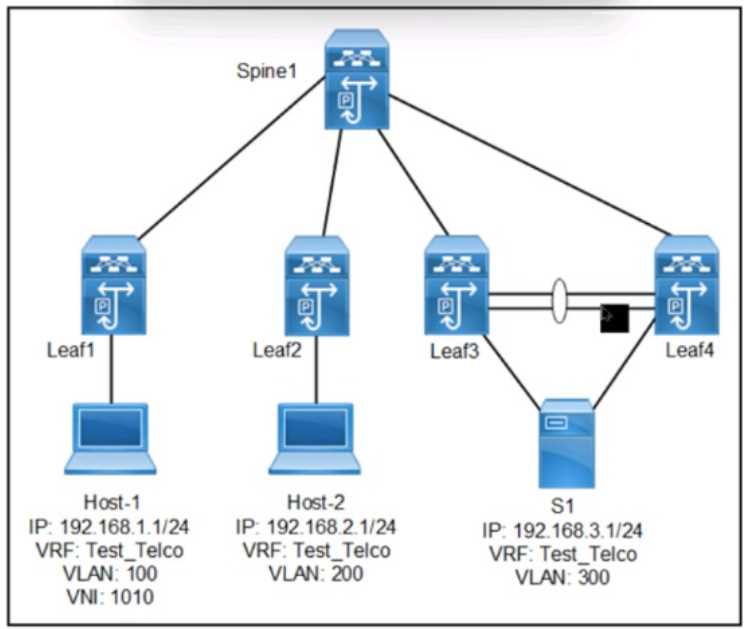
Refer to the exhibit A VXLAN data center fabric has three hosts mapped to three different VLANs. Ingress and egress
VTEPs perform Layer 2 and Layer 3 lookups VLAN 100 is mapped to VNI 1010 on Lead. Which set of actions allow
communication between Host-1 and Host-2?
B, suppressing ARP and using anycast gateway is standard for VXLAN L3 VNI setups.
It’s D here. Attaching the VRF to the Layer 3 VNI lets the hosts communicate across VLANs within the same routing domain. Suppressing ARP on the Layer 3 VNI interface avoids unnecessary broadcast traffic in VXLAN, which fits the data center fabric design. The other options either miss suppressing ARP or don’t tie the VRF correctly to the L3 VNI, which is critical for routing between hosts in different VLANs mapped to VXLAN.
Refer to exhibit. P-8 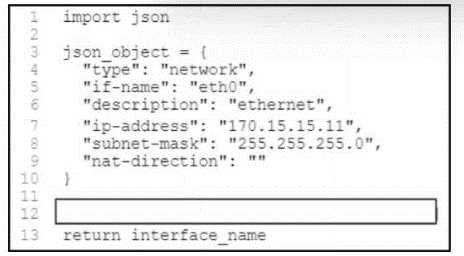 Refer to the exhibit. A network engineer must retrieve the network interface name from a JSON object. The engineer loads the JSON into a Python dictionary named json_object. Which code snippet completes the Python script?
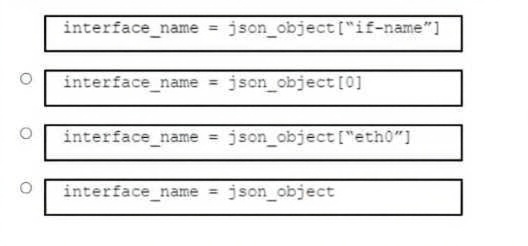
Good point, but I think B works better since it uses dictionary keys directly. B
A/B? If "interfaces" is a list, then option A’s use of an index makes sense. But if it’s a dict, B fits better. Without knowing the exact JSON structure, both could be plausible.
consistency. The solution must be easy to configure and manage and must support Python and YAML. Which
configuration management tool meets these requirements?
Option D is best since it uses simple YAML and Python modules, no agents needed.
Not A, since Puppet doesn’t natively use YAML and tends to have a steeper learning curve. B seems solid too, but Ansible’s agentless setup and straightforward YAML playbooks make it way simpler overall.
vHBAs, vNICs, and server port types.
Which role should be assigned to allow the engineer to complete this task?
C, since vNICs and vHBAs are server profile components, not network fabric settings.
I thought it was C because vHBAs and vNICs are linked to server profiles, which falls under server-compute. But I’m wondering if "server port types" might mean physical ports that network admins handle more often. If that’s the case, A could be right. Is there a clear definition of "server port types" in UCS that points more to one role? That would help decide between the two.
P-20
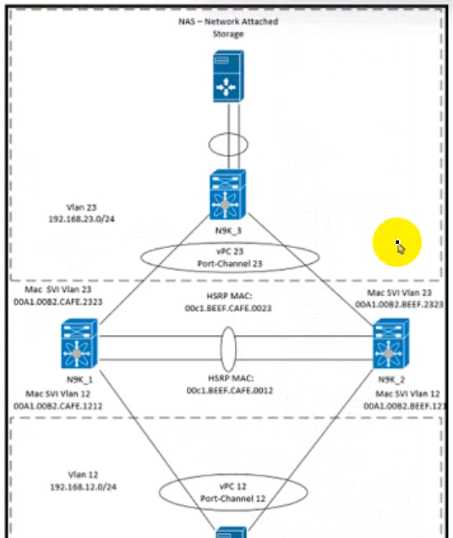
Refer to the exhibit. A Cisco data center environment is implemented with vPC. The web server replies using the SVI
MAC address as the Layer 2 header instead of the HSRP MAC address on VLAN 23. This behavior causes packet drops
on the Cisco Nexus 9000 Series Switches due to the vPC loop prevention mechanism The requirement is for the vPC
feature to allow N9K_1 and N9K_2 to forward traffic between the NAS server and the web server, even if the HSRP's
MAC address is not used on Layer 2 headers for VLAN 23. Which feature must be used to accomplish this goal?
Maybe D doesn’t really fit since object tracking is more about failover and interface state monitoring, not MAC address handling in vPC. C also seems off because L3 Peer Router is for routing redundancy, not fixing Layer 2 MAC issues causing drops. Between A and B, Peer Gateway (A) is designed to let both vPC peers forward traffic using their own MACs, which directly tackles the loop prevention problem caused by the SVI MAC being different from HSRP. So yeah, A definitely makes the most sense here.
Option A makes the most sense here because Peer Gateway lets each vPC peer forward traffic using the MAC address of the local switch, even if it’s different from the HSRP MAC. That prevents the loop prevention mechanism from dropping packets when the SVI MAC is used, which is exactly what’s happening. ARP Sync (B) is more about syncing ARP tables, so it wouldn’t directly fix the MAC mismatch issue causing drops. Object Tracking (D) and L3 Peer Router (C) don’t really address this problem either. So Peer Gateway is the feature designed to handle this specific scenario.
supervisors. The script is located on a built-in container that runs as part of the Cisco NX-OS system.
The requirement is to automate the periodic transfer of the Python script to a redundant supervisor.
In addition, the script must be transferred to an external server using encryption and authentication.
Which configuration set meets these requirements?
D/B? D seems solid since guest shell sync is designed for syncing scripts between supervisors, and SCP meets the secure transfer requirement. But B uses a scheduler too, which might be simpler for periodic tasks, though TFTP lacks encryption. Since encryption is mandatory, B doesn’t fit well. So, between secure transfer and the right sync method, D seems to cover all bases better.
D imo, guest shell sync handles redundancy and SCP covers secure transfer well.
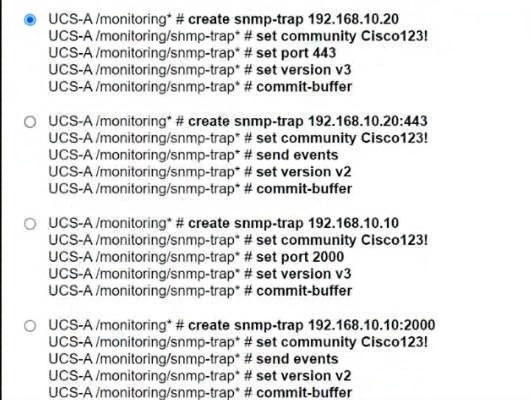
Refer to the exhibit. 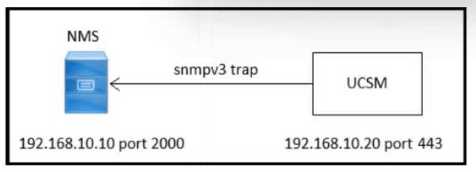 Refer to the exhibit. The network management system that is located at 192.168.10.10 and port 2000 must receive traps from the Cisco UCS Manager called UCSM. The community name is Cisco123! and the SNMP version must be the most secure. These two commands have already been configured on Cisco UCSM. UCS-A# scope monitoring UCS-A/monitoring # enable snmp Which command set completes the SNMP configure
 .
.
Option B looks strong too since it sets the SNMPv3 user with authentication and privacy, plus it specifies the community name. That covers both security and community requirements clearly.
D imo, since it specifies the SNMP version 3 with both auth and privacy settings, matching the “most secure” requirement better than just setting version or community alone.
storage array and set the zoning type to single initiator multiple targets. The engineer must also configure interrupt
handling and queues of the vHBA interface. Which two Cisco UCS policies should be used to configure the settings?
(Choose two.)
A/E? SAN connectivity policy is designed for WWPN and zoning types, while vHBA policy manages interface settings like interrupts and queues. Storage connection policy feels more general, not as specific.
Maybe D and E. Storage connection policy sounds like it covers zoning and WWPN stuff, while vHBA policy would handle the vHBA-specific settings like interrupts and queues. Feels like a good split to me.
DRAG DROP Refer to the exhibit.  Refer to the exhibit. Drag and drop the code snippets from the bottom onto the blanks in the code to complete the JSON request that implements the ACL presented. Not all code snippets are used. P-50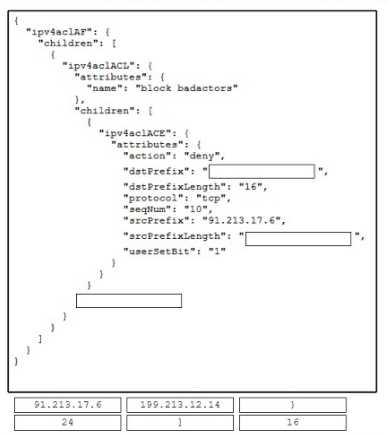
I noticed that the ACL uses “permit” and “deny” explicitly, but the JSON keys are case-sensitive, so those should be lowercase. Also, since the ACL specifies conditions for certain IPs and protocols, the JSON needs to include those fields exactly as shown. Some snippets like “ipv4” and “permit” have to be placed carefully to match the ACL hierarchy. The unused snippets probably don't fit logically into the structure, so it’s about fitting the actual rules rather than using all parts given.
I think the code needs "permit" in lowercase as shown on the ACL diagram.
DRAG DROP 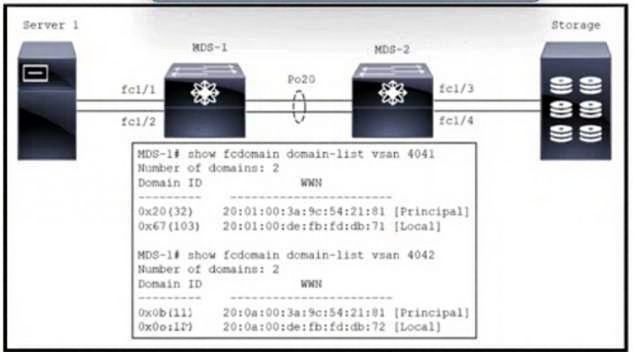 Refer to the exhibit The VSAN 4041 and 4042 are exchanged between two Cisco MDS 9000 Series Switches called MDS-1 and MDS-2 The objective is to deploy a security mechanism on MDS-1 to allow MDS-2 to join the fabric exclusively Drag and drop the code snippets from the bottom onto the boxes in the code to complete the MDS-1 configuration Not all code snippets are used.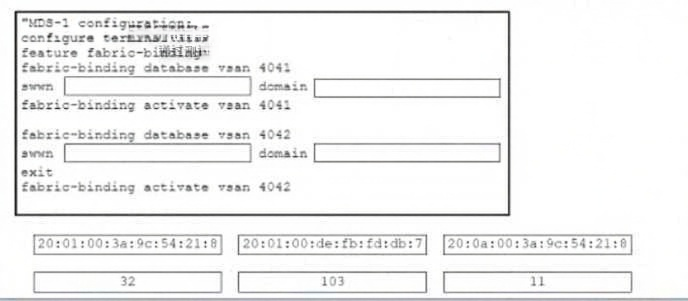
I think it’s crucial to not just set the switch names and enable VSAN security but also to explicitly deny unknown switches from joining. So any snippet related to “switchname MDS-2” and “vsan security enable” should be there, plus something like “deny unknown switch” or similar. That way, you prevent any other switches from sneaking in. Without that, you might allow undesired devices to join the fabric. The question probably wants a tight control mechanism, not just basic naming and enabling.
I’d say disabling unknown switch joining is important too, so besides naming MDS-2, the config should include a command to block any other switches from joining the VSANs. That’s a good extra layer of security.