Free Cisco 350-601 Actual Exam Questions - Question 10 Discussion
P-20
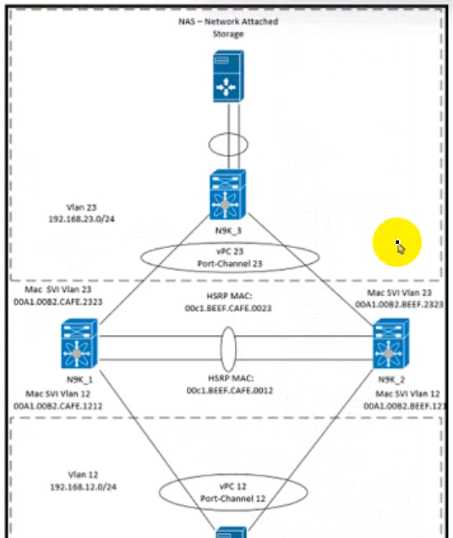
Refer to the exhibit. A Cisco data center environment is implemented with vPC. The web server replies using the SVI
MAC address as the Layer 2 header instead of the HSRP MAC address on VLAN 23. This behavior causes packet drops
on the Cisco Nexus 9000 Series Switches due to the vPC loop prevention mechanism The requirement is for the vPC
feature to allow N9K_1 and N9K_2 to forward traffic between the NAS server and the web server, even if the HSRP's
MAC address is not used on Layer 2 headers for VLAN 23. Which feature must be used to accomplish this goal?
Maybe D doesn’t really fit since object tracking is more about failover and interface state monitoring, not MAC address handling in vPC. C also seems off because L3 Peer Router is for routing redundancy, not fixing Layer 2 MAC issues causing drops. Between A and B, Peer Gateway (A) is designed to let both vPC peers forward traffic using their own MACs, which directly tackles the loop prevention problem caused by the SVI MAC being different from HSRP. So yeah, A definitely makes the most sense here.
Option A makes the most sense here because Peer Gateway lets each vPC peer forward traffic using the MAC address of the local switch, even if it’s different from the HSRP MAC. That prevents the loop prevention mechanism from dropping packets when the SVI MAC is used, which is exactly what’s happening. ARP Sync (B) is more about syncing ARP tables, so it wouldn’t directly fix the MAC mismatch issue causing drops. Object Tracking (D) and L3 Peer Router (C) don’t really address this problem either. So Peer Gateway is the feature designed to handle this specific scenario.
Not B, ARP Sync focuses on ARP table consistency, not MAC-based loop prevention.
Peer Gateway (A) lets both switches forward traffic despite MAC differences, right?
B imo, ARP Sync helps keep ARP tables consistent between peers, which can also prevent traffic drops caused by MAC mismatches in vPC environments. Could be a solid backup to Peer Gateway here.
A imo, Peer Gateway is made for handling MAC mismatches in vPC setups.
A Peer Gateway fits here because it lets each vPC peer forward traffic even when the MAC address on the packet isn’t the HSRP one, avoiding those loops and drops. The others don’t handle this Layer 2 forwarding issue directly.
Option A, Peer Gateway, prevents drops when MACs differ in vPC setups.
Maybe D isn’t right since Object Tracking usually helps with route failover, not MAC forwarding issues. B (ARP Sync) sounds like it’d keep ARP tables consistent, but that doesn’t directly fix the MAC address mismatch here. A (Peer Gateway) seems fit because it lets vPC peers accept frames with the non-HSRP MAC, avoiding drops due to loop prevention. C (L3 Peer Router) is more about routing redundancy, so less relevant. So, probably A is the way to go for this specific vPC MAC handling problem.
Is there any info on the NX-OS version? That might affect feature availability.