Free Cisco 300-420 Actual Exam Questions
Dumps Box (DumpsBox) offers up-to-date practice exam questions for 300-420 certification exam which are developed and validated by Cisco subject domain experts certified in Cisco 300-420 . These practice questions are update regularly as we keep an eye on any recent changes in 300-420 syllabus, and when there is update our team quickly adjusts the questions. This commitment to providing the best quality exam prep material to certification aspirants is what makes DumpsBox.com the best certification exam prep website. On top of that, our strong, yet strictly moderated, community based feedback keeps the content clean and current. Each question has helpful community discussion that provides it extra perspective and introduces helpful resources for better exam preparation. This also saves students from other outdated practice questions or illicit exam dumps that can have adverse affects on career. Browse through our Cisco 300-420 exam questions and pass your exam on first try.
Drag and drop the characteristics from the left onto the Yang model they describe on the right.
Select and Place:
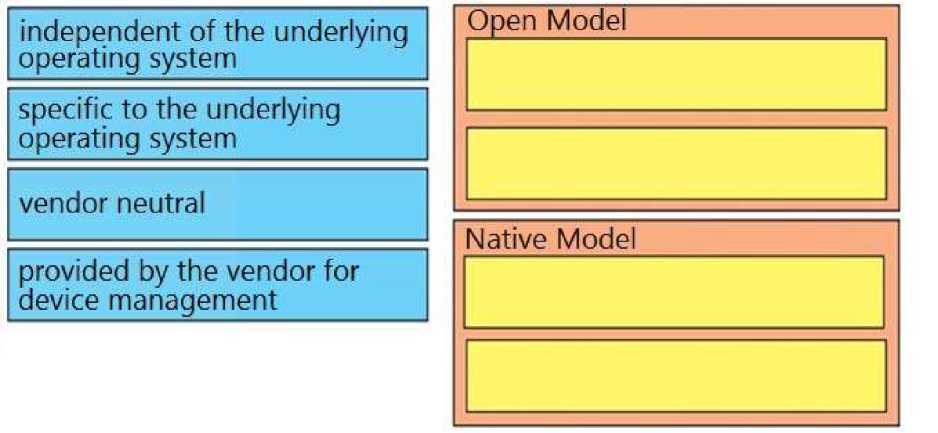
I thought about this one a bit differently. The model with traits like innovation and agility fits better with B since it’s clearly more dynamic, while the one focused on consistency and stability goes with D. Even if the version isn’t specified, those core ideas haven’t shifted much, so matching B to the flexible model and D to the control one seems solid. Plus, the visual cues in the colors and layout kind of push me towards that setup without needing extra context.
If the question doesn't specify the version, I’d trust the one with more emphasis on adaptability for innovation, so B fits better there. D feels more stable and control-oriented, so matches the control model well.
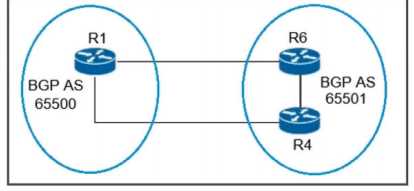
Refer to the exhibit. An architect must design a solution to connect the two ASs. To optimize
bandwidth, the design will implement load sharing between router R6 and router R4. Which solution
should the design include?
D vs B? Maximum-paths (D) fits for load sharing, but B mentions next-hop-self, which can help with route advertisement consistency between ASes. Still, D seems more directly about load balancing.
Option D makes sense since maximum-paths lets the router install multiple equal-cost BGP paths, which helps with load sharing between R4 and R6. The other choices don't directly address load sharing—like A is about loopback source for BGP sessions, B is more about next-hop behavior, and C is just for eBGP multihop reachability. So D fits best for optimizing bandwidth with load sharing.
DHCP services must be available.
Clients BIOS settings must be set for WoL.
Clients get IP addresses once online.
Spanning-tree PortFast is enabled on the Layer 2 switches.
Which two solutions must the customer select to have a successful deployment? (Choose two.) 3
A/D? Directed broadcast lets the magic packet reach clients on their subnet, and helper-address on client interfaces ensures DHCP requests get forwarded properly. B seems off since it talks about client ranges on WoL server side.
A/E makes sense since you either enable or disable directed broadcast; you can't do both.
information between the data centers and the spoke sites using EIGRP. All locations belong to a
single AS. and auto-summarization Is disabled. Which two actions must the company choose?
(Choose two.)
C. Making spoke routers stub stops them from sending unnecessary routes, which helps keep EIGRP updates smaller. B doesn’t make as much sense since summarizing between hubs isn't the main issue here.
Not E, since splitting into two ASs contradicts the question. C makes sense because stub routers limit unnecessary route advertisements, and D helps reduce routing table size by summarizing spoke routes at hubs.
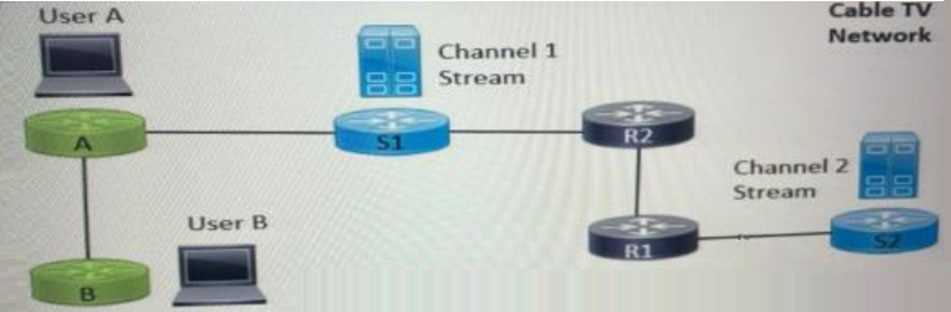
A network engineer must design a multicast solution based on:
* Many-to-many communications between the users and sources
* Support of up to 50 multicast sources
* Users that must register for steams
Which multicast solution must the engineer select?
It’s A for me. Bidirectional PIM (B) is mostly for one-to-many or many-to-one scenarios and doesn’t handle user registration the way ASM does. Source-Specific Multicast (C) is more for one-to-many with known sources, so it doesn’t fit many-to-many well. Multicast VPN (D) is focused on extending multicast over VPNs, which isn’t the main need here. Since we have many sources and users needing to register for streams, Any Source Multicast fits best.
I think option A makes the most sense, but from a different angle: ASM supports dynamic source discovery and allows receivers to register interest without knowing all sources upfront. Since there are up to 50 sources, SSM (C) would be tough because it needs pre-knowledge of sources. Bidirectional PIM (B) doesn’t really handle user registration well. So, A fits the many-to-many and user registration requirements better than the others here.
with a 100Mbps CIR. The ISP aggressively drops all traffic received over which is causing numerous
TCP retransmissions. The customer is not using any RTP applications but wants to maximize
bandwidth usage up to the CIR. Which QoS solution engineer choose?
D imo, queuing can help manage bursts better than policing which just drops.
Makes sense to smooth traffic before it hits ISP limits, so B.
A router running ISIS is showing high CPU and bandwidth utilization. An engineer discovers that the router is configured as L1/L2 and has L1 and L2 neighbors. Which step optimizes the design to address the issue?
This question is interesting, but I’d go with D here. Changing each interface to L1 or L2 individually lets you fine-tune where the router forms adjacencies and handles traffic, cutting CPU use without fully limiting the router’s capability. It’s more targeted than making the whole router just L1 or L2 like in C. Making the router strictly one level might work but could reduce flexibility in larger networks. So, D feels like a better balance between performance and functionality.
D Changing interfaces to either L1 or L2 can reduce the number of adjacencies and cut CPU usage, especially if the router doesn’t need to handle both levels everywhere. It’s more granular than just forcing the whole router to one level.
Option B makes sense since intermediate nodes focus on routing IP packets through the fabric rather than handling user-to-network mapping or gateway functions.
Anyone know if the intermediate node specifically handles routing or more like mapping functions here? The options kinda overlap for me.
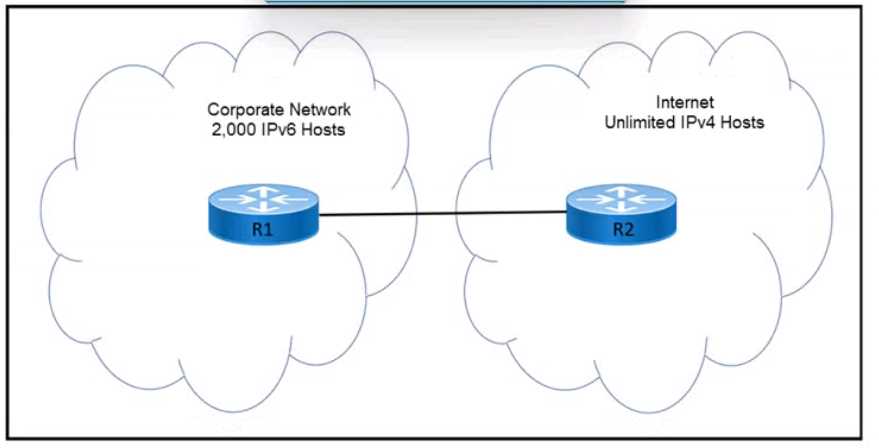
Refer to the exhibit. An engineer must design an address translation solution to provide Internet
connectivity for the corporate network. The design Is restricted to the 172.16.168.0/22 subnet.
Which solution must the engineer choose?
Not B, since stateless NAT64 needs a lot of IPv6 addresses for one-to-one mapping, which isn’t practical for a whole /22 subnet. Stateful NAT64 (A) handles that better with address sharing.
A, because stateful allows many-to-one mapping for private IPv4 to IPv6 translation.
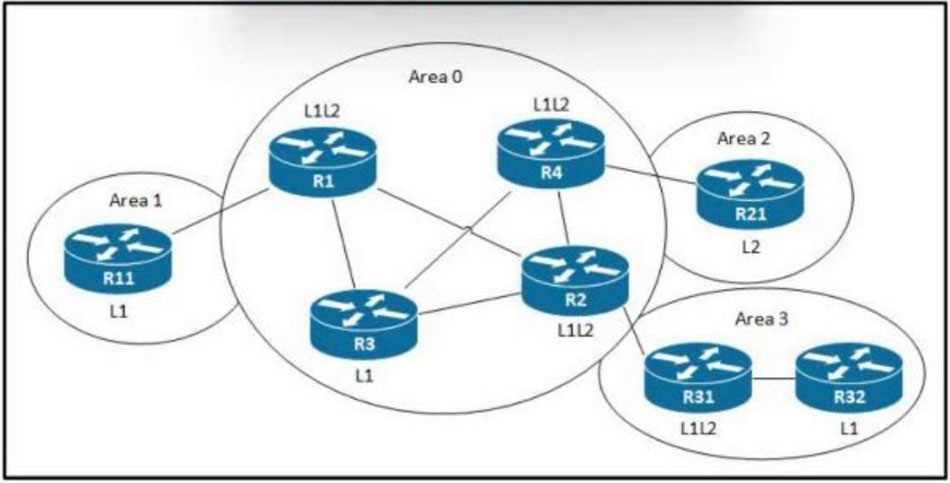
This one’s tricky, but I’m thinking C. Making Area 0 L2-only fits the OSPF design rules better since Area 0 should usually be the backbone with L2 routers managing inter-area traffic. That way, you avoid mixing L1 and L2 roles in the backbone which can mess up route propagation. Options A and B don’t seem to fix the core design flaw if Area 0 is hybrid, and D feels less impactful compared to restructuring the whole backbone area’s router roles.
B/D? Making R31 an L1 router (B) might clear up area border issues if it’s currently handling multiple areas confusingly. On the other hand, turning R11 into an L2 router (D) could help if it’s not properly relaying routes between areas yet. Without knowing their exact roles and configs, both seem plausible fixes for better inter-area routing. I’d drop A since making R3 L1L2 might not solve the core issue if it’s not on the backbone or area border, and C feels drastic if Area 0 already has mixed router types working.
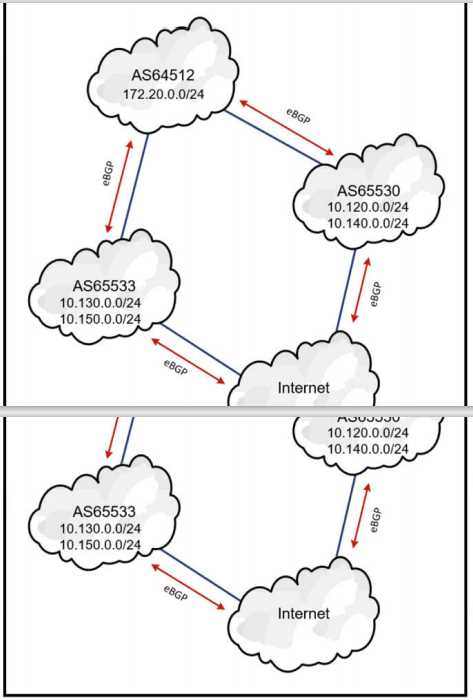
Refer to the exhibit. AS65533 and AS65530 are announcing a partial Internet routing table as well as
their IP subnets. An architect must create a design that ensures AS64512 become a transit AS. Which
filtering solution must the architect choose?
A imo, max-prefix filtering limits the number of routes an AS can advertise, which might help control what passes through AS64512 while still letting it be a transit. That fits better than no-advertise or no-export here.
It sounds like the goal is to let AS64512 act as a transit AS, so it should be able to advertise routes beyond its own AS. That rules out D (No Export), since that stops route propagation outside the AS. I'd pick C for next-hop modification to enable proper transit.
D imo. Priority queuing makes sense since SD-WAN Edge routers need to handle critical traffic fast, like voice or control signals. The other options are more about complex fairness or scheduling, but Edge devices often prioritize important packets immediately to reduce latency.
It’s C because the 1P-4Q-2T structure fits Cisco’s approach with multiple queues and shaping, unlike FIFO or simple priority which are too basic for SD-WAN Edge routers.
DRAG DROP Drag and drop the characteristics from the left onto the correct telemetry mode on the right. 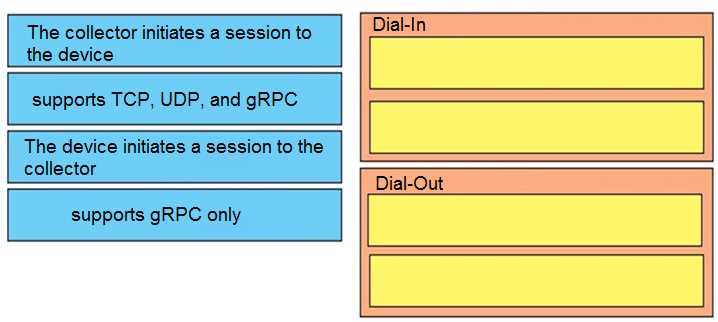
If the modes are real-time and batch, anything about continuous updates fits real-time, while anything mentioning storage or delay should go to batch. That split usually makes the most sense here.
I can’t see the image, but for drag and drop like this, usually one mode is about real-time data and the other about stored data. I’d toss anything mentioning delayed or recorded info into one pile, and live, instant metrics into the other. Sometimes they try to trick you by mixing terms that sound similar but belong to different modes-watch out for that. Hope this helps!
DRAG DROP Drag and drop the properties from the left onto the protocols they describe on the right. 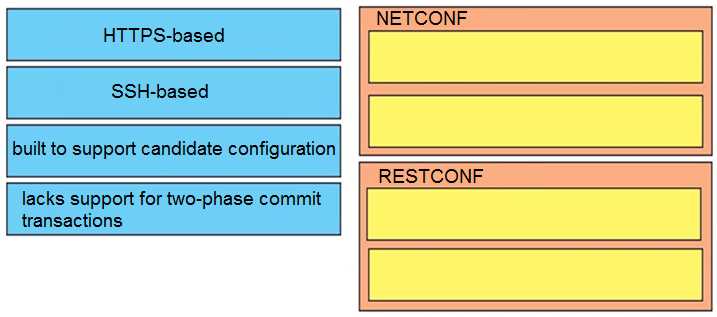
TCP handles flow control, so that property fits TCP, not UDP.
TCP’s known for reliability and ordering, so properties like guaranteed delivery fit there.
DRAG DROP An engineer must design an addressing plan for a small business using a single /24 network. Each department must have its own subnet. Drag and drop the subnets from the left onto the departments requirements that they fulfill on the right. Not all options are used. 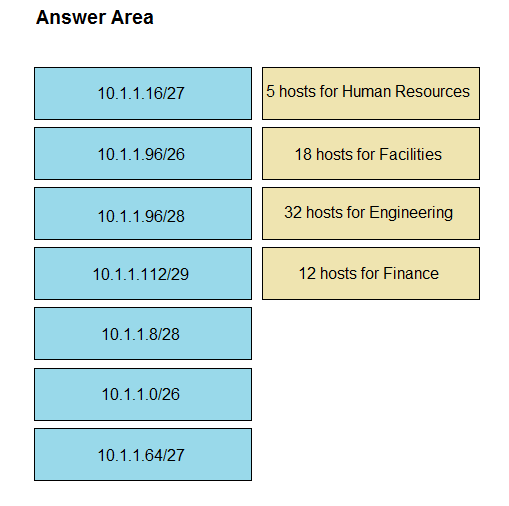
Another way to look at it is focusing on the number of hosts each subnet can support based on the subnet mask. Since it's a /24 network, we have 256 IPs total. Subnets with masks like /26 give 62 usable IPs, /27 gives 30, /28 gives 14, and so on. So smaller departments would fit better with /28 or smaller, while larger ones need /26 or /25. Matching these sizes to department size ensures efficient use of IPs without wasting them. This approach can help assign subnets even if exact host counts aren’t given, just by estimating department size roughly.
Matching subnet sizes to department needs avoids wasted IPs or shortages.