Free Cisco 300-420 Actual Exam Questions - Question 9 Discussion
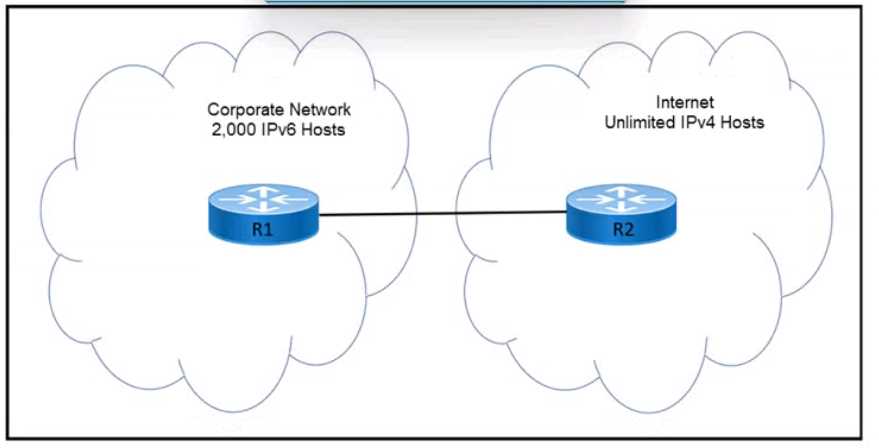
Refer to the exhibit. An engineer must design an address translation solution to provide Internet
connectivity for the corporate network. The design Is restricted to the 172.16.168.0/22 subnet.
Which solution must the engineer choose?
Not B, since stateless NAT64 needs a lot of IPv6 addresses for one-to-one mapping, which isn’t practical for a whole /22 subnet. Stateful NAT64 (A) handles that better with address sharing.
A, because stateful allows many-to-one mapping for private IPv4 to IPv6 translation.
B. Stateless NAT64 is simpler but requires a one-to-one mapping between IPv4 and IPv6, which might not scale well for a /22 subnet. Still, it could work if the design expects direct mappings without sharing addresses.
It’s A because stateful NAT64 is best for translating private IPv4 to IPv6 internet access.
Not D, because NAT66 is for IPv6-to-IPv6 translation and the subnet given is IPv4. The question needs IPv4 to IPv6, so options A or B make more sense.
Option A makes sense because NAT64 is designed for IPv4 to IPv6 translation, which fits the need to connect a private IPv4 subnet like 172.16.168.0/22 to the IPv6 internet. Between stateful and stateless, stateful NAT64 is better when multiple IPv4 hosts share a limited number of IPv6 addresses, which is typical in corporate networks.
Options C and D can be ruled out since NAT66 deals with IPv6-to-IPv6 translation, and here we start from an IPv4 subnet. Also, stateless NAT64 (B) requires a one-to-one mapping that’s less practical for private networks with many hosts.
It’s A since stateful NAT64 fits IPv4 private to IPv6 internet translation better.
It’s A because NAT64 handles IPv4 to IPv6 translation and 172.16.x.x is private IPv4.
This question doesn’t say if the goal is to translate between IPv4 and IPv6 or just within IPv6. Also, it doesn’t clarify if the translation must be stateful or stateless based on traffic flow needs. Since 172.16.168.0/22 is a private IPv4 subnet, I’m guessing there’s IPv4 involved, but the options mention NAT64 and NAT66, which handle different address families. Could someone confirm if the design is for IPv4-to-IPv6 (NAT64) or IPv6-only (NAT66)? That would help narrow down the right technique here.