Free Cisco 300-420 Actual Exam Questions - Question 15 Discussion
DRAG DROP An engineer must design an addressing plan for a small business using a single /24 network. Each department must have its own subnet. Drag and drop the subnets from the left onto the departments requirements that they fulfill on the right. Not all options are used. 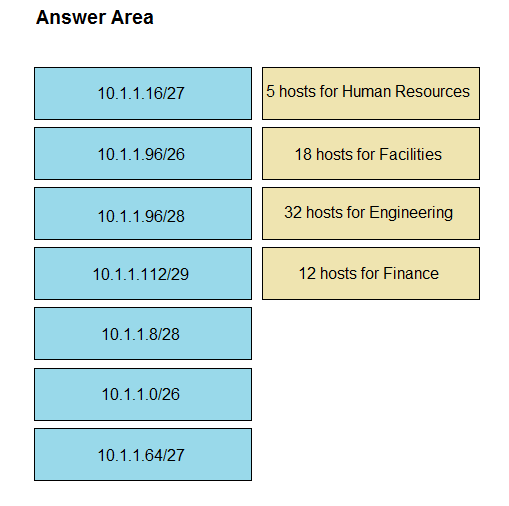
Another way to look at it is focusing on the number of hosts each subnet can support based on the subnet mask. Since it's a /24 network, we have 256 IPs total. Subnets with masks like /26 give 62 usable IPs, /27 gives 30, /28 gives 14, and so on. So smaller departments would fit better with /28 or smaller, while larger ones need /26 or /25. Matching these sizes to department size ensures efficient use of IPs without wasting them. This approach can help assign subnets even if exact host counts aren’t given, just by estimating department size roughly.
Matching subnet sizes to department needs avoids wasted IPs or shortages.
Some subnets are clearly too large or small for certain departments, so elimination helps.
I think the best way is to divide the /24 into smaller subnets that fit each department's size. Usually, departments need different numbers of hosts, so picking subnets with appropriate sizes matters most. For example, a subnet with 64 hosts might suit a bigger team, while one with 16 or 8 hosts fits smaller ones better. It all depends on the number of devices in each department.