Free VMware 3V0-32.23 Actual Exam Questions - Question 2 Discussion
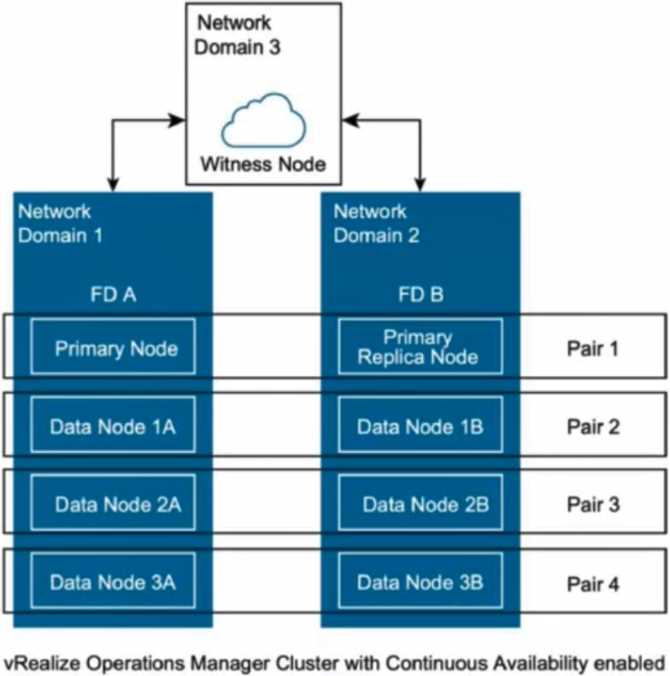
The architect has included Continuous Availability as part of the design.
Which scenarios does this design protect against. (Choose three.)
It’s E, because losing a whole network domain is a major failure that continuous availability aims to prevent.
Option A makes sense since the design should handle losing Data Node 1A and 3A without service impact—they’re in separate domains. Option C is another solid pick because the loss of both Primary and Primary Replica Nodes is typically covered by Continuous Availability to avoid single points of failure. For the third, I’d go with E because losing a whole network domain seems like what Continuous Availability aims to protect against, especially if nodes are distributed to handle that kind of failure. The other options mostly involve losing two nodes within the same domain, which is less likely t
Probably B too, since losing nodes across different domains like 1A and 2B fits the pattern of resilience designed here, unlike losing two nodes in the same domain which might not be fully covered.
Maybe D, A, and C. Continuous Availability usually protects against losing nodes spread across failure domains, so losing two nodes in the same domain (like 1A and 1B) should be covered. Losing Data Node 1A and 3A seems safe too, as they’re in different domains. The primary and primary replica node loss also fits since that’s critical. I’m not convinced about E – losing a whole network domain might be bigger than what this design covers, which looks more about node-level redundancy rather than entire domains.
Option A makes sense since losing Data Node 1A and 3A fits the pattern of protected failures. Option D also seems valid because losing two nodes within the same domain appears to be covered.
I think B makes sense to include since it covers loss across two different data nodes in separate domains, matching the Continuous Availability goal. C also fits because protecting the Primary Node and its replica is crucial. And for the third, E seems valid as losing a full network domain is exactly what these setups try to handle. So I’m putting B, C, and E together.
A/C/E? Losing Data Node 1A and 3A looks covered, plus the Primary Node and its replica for sure. The design also hints at handling a full network domain loss, so E fits too.
Option A seems right since losing Data Node 1A and 3A feels covered here. Also, maybe C with Primary Node losses? Not super sure on the others yet.