Free VMware 3V0-32.23 Actual Exam Questions
Dumps Box (DumpsBox) offers up-to-date practice exam questions for 3V0-32.23 certification exam which are developed and validated by VMware subject domain experts certified in VMware 3V0-32.23 . These practice questions are update regularly as we keep an eye on any recent changes in 3V0-32.23 syllabus, and when there is update our team quickly adjusts the questions. This commitment to providing the best quality exam prep material to certification aspirants is what makes DumpsBox.com the best certification exam prep website. On top of that, our strong, yet strictly moderated, community based feedback keeps the content clean and current. Each question has helpful community discussion that provides it extra perspective and introduces helpful resources for better exam preparation. This also saves students from other outdated practice questions or illicit exam dumps that can have adverse affects on career. Browse through our VMware 3V0-32.23 exam questions and pass your exam on first try.
VMware Aria Automation design to address changes in requirements.
The new requirements state:
The solution must continue to operate in the event of a single node failure.

The corporate encryption standard requires all solutions to encrypt data in transit using revocable

certificates.
Which two design decision should the architect make to meet the new requirements? (Choose two.)
I’d drop options C and D because self-signed certs don’t meet the corporate standard for revocable ones, and using a DNS CNAME alone doesn’t guarantee node failure tolerance. Between E and A, an integrated load balancer might limit scalability or resilience compared to an external one, so A feels more robust for HA. The CA-signed certs (B) are pretty much a must for real-world encryption standards since they can be revoked if compromised. Anyone think integrated load balancers could still meet the single-node failure requirement reliably?
A/B for sure. Three nodes with an external load balancer cover the high availability bit, and CA-signed certs fit the revocable encryption requirement way better than self-signed ones.
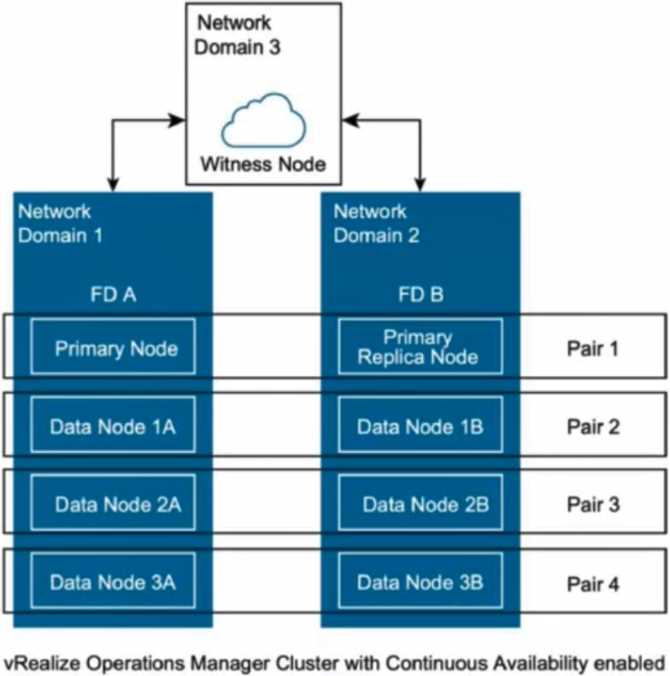
The architect has included Continuous Availability as part of the design.
Which scenarios does this design protect against. (Choose three.)
It’s E, because losing a whole network domain is a major failure that continuous availability aims to prevent.
Option A makes sense since the design should handle losing Data Node 1A and 3A without service impact—they’re in separate domains. Option C is another solid pick because the loss of both Primary and Primary Replica Nodes is typically covered by Continuous Availability to avoid single points of failure. For the third, I’d go with E because losing a whole network domain seems like what Continuous Availability aims to protect against, especially if nodes are distributed to handle that kind of failure. The other options mostly involve losing two nodes within the same domain, which is less likely t
owner is concerned that a lot of time might be needed to troubleshoot failures of these integrations.
Which Cloud Management component could be included in the solution to assist troubleshooting
efforts?
It’s D for sure since logs are the go-to for troubleshooting any kind of failure, especially with custom integrations. The other options focus more on performance or lifecycle management rather than detailed error diagnostics. Logs give the raw data needed to pinpoint where things go wrong, which you don’t get from just metrics or high-level dashboards. So for quick and thorough troubleshooting, Aria Operations for Logs fits best.
It’s D, logs give the most direct insight into what’s failing in integrations.
to automate and govern a VMware Software Defined Data Center.
Given the information from the service owner, which two statements would be considered business
requirements? (Choose two.)
Probably D and B. D is definitely a key business goal since faster time to market directly affects revenue and competitiveness. B relates to enforcing security and compliance, which usually stems from business policies or regulatory requirements, not just IT preferences. A feels more like an infrastructure-level requirement focused on uptime, which is crucial but typically classified under technical or operational needs rather than pure business demands. So, B and D seem to capture the broader business objectives better here.
Maybe A and D make more sense since redundancy impacts business uptime directly, not just tech reliability. D is definitely about business agility, so those two stand out as business requirements.
E imo, Automation for Secure Clouds fits better with lifecycle deployment than Logs or Networks. So A, B, and E feels like the right combo here.
C I think C is less likely because Networks is usually managed separately, not deployed through Aria Suite Lifecycle. Sticking with A, B, and E seems better since they fit the lifecycle deployment scope more clearly.
and looking to integrate with Aria Automation to meet the following conditions:
Multi-Tenancy in Aria Automation
Automated SaltStack Minion agent installation via Cloud Templates resource type
What two aspects does the architect need to include? (Choose two.)
Maybe D and E. Multi-tenancy is definitely a must, so D fits. Also, having proper admin credentials and root access (E) seems essential to make sure everything runs smoothly and securely.
Multi-tenancy is key here, so D makes sense; A fits with automated agent install.
following:
Three data centers in three geographical locations.
Each site has 1,000 logging sources that send events to VMware Aria Operations for Logs.
The customer has the following requirements:
Minimize the resources footprint in the management cluster where VMware Aria Operations for Logs
will be deployed.
VMware Aria Operations for Logs must be highly available with no single points of failure.
Logs collected from any data center must be protected against site failure.
Which three design decisions would the architect choose to achieve the requirements? (Choose
three.)
C forwarding logs between data centers protects against site failure. D is needed to avoid loops from that forwarding. E centralizes logs to one site, minimizing resources and ensuring HA without multiple big clusters.
It’s C because forwarding logs between sites ensures no data loss if one site fails.
following details:
The cluster has 3-nodes with 2 event forwarders sending logs to this cluster.
The VMware Aria Operations for Logs cluster is part of the disaster recovery protection process.
What should be the proper sequence of steps in the Disaster Recovery protection run-book for
recovering VMware Aria Operations for Logs cluster?
B definitely, master first to regain control then workers can come up anytime.
D imo, better to follow a strict order for workers to avoid sync issues.
DRAG DROP Drag and drop each design characteristic from the left into the box corresponding to the correct definition on the right. 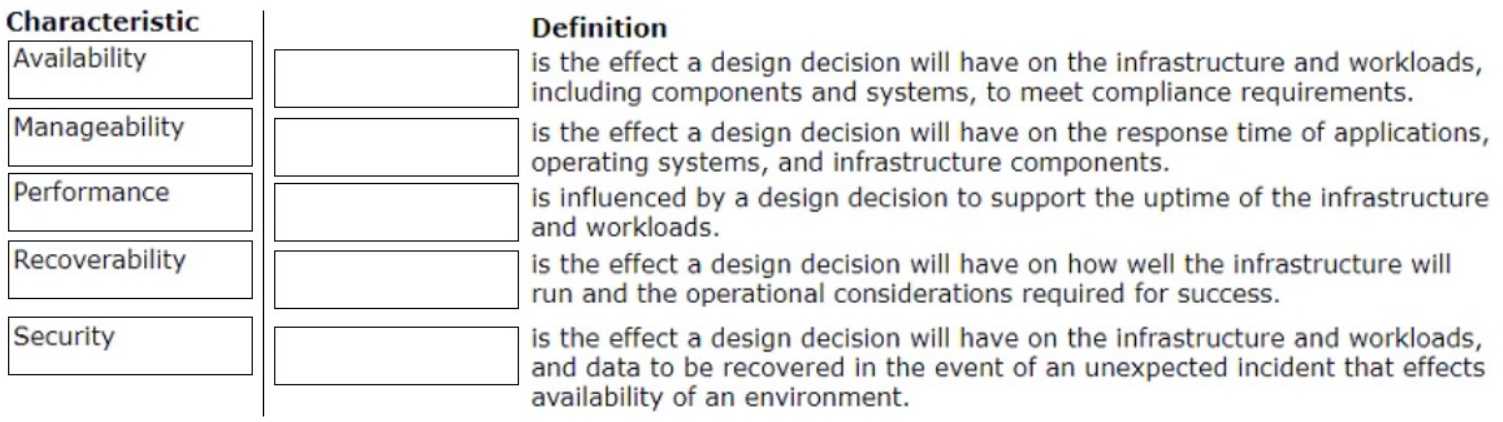
I’d say availability fits the one about uptime since it deals with how often the system is accessible, while resilience matches the ability to bounce back quickly after issues.
Fault tolerance fits best with keeping operations running despite hardware or software failures.
DRAG DROP Drag and drop each Design Quality from the left into the box corresponding to the correct requirement on the right. 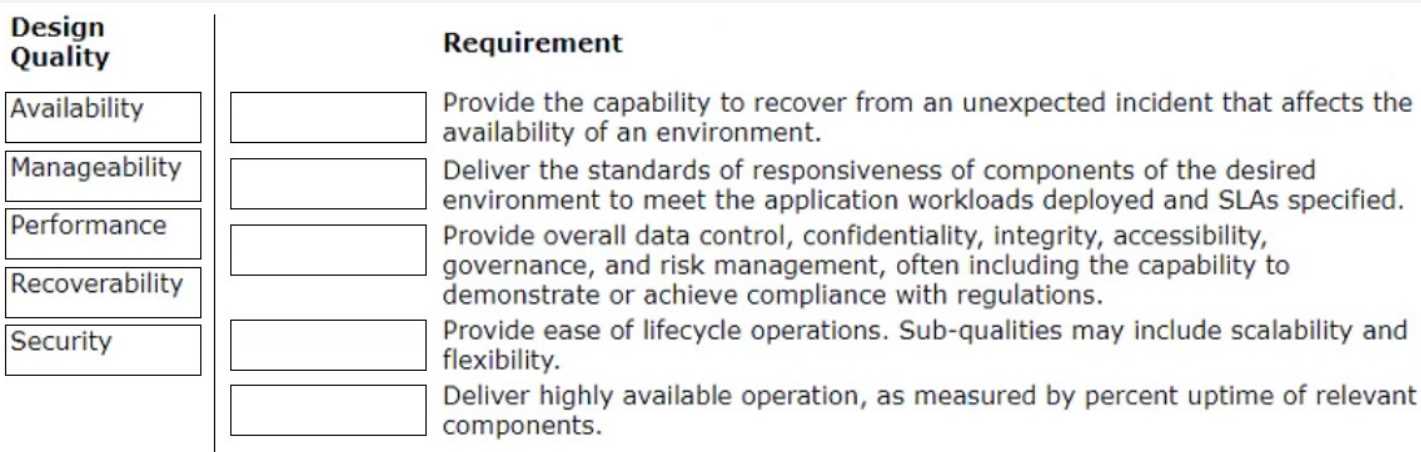
Flexibility fits better under adaptability than maintainability here.
I matched based on what improves system longevity, so maintainability went with flexibility.
DRAG DROP Match the design phase to the appropriate function. Drag and drop each term from the left into the box corresponding to the correct definition on the right. 
B looks right for Initiation, setting up initial goals and scope clearly.
Looks like A best fits Closing, since it’s about wrapping up and final reviews.
constraints, and recommendations were gathered:
Enable Continuous Availability
Monitor two physical locations
The sizing guide recommends deploying 5 analytics nodes
What are two design considerations for the analytics node deployment? (Choose two.)
C/E makes sense since the question mentions two physical locations—witness instances help avoid split-brain in multi-site setups, and fault domains separate failures by location. Also, the sizing guide says 5 nodes, so adding a sixth node (A) isn’t really supported here. High Availability (B) is important but usually implied when witnesses and fault domains are used, so not the direct design considerations. Extra Large Nodes (D) aren’t necessarily mandated either.
Maybe B and E, since HA and fault domains are crucial for multi-site setups.
The customer has the following requirements:
VMware Aria Operations for Logs cluster responds to multiple Virtual IP Addresses (VIPs)
Each event message received from a VIP is associated with a tag
Which two design decisions would the architect make to achieve the requirements? (Choose two.)
A/E? I think having interfaces on the same subnet as VIPs (E) is necessary for proper network routing, and dynamic tags (A) would let you tag events flexibly per VIP. Static tags might be too rigid here.
A/D? Dynamic tags cover changing VIPs and static tags lock in consistent labels, both needed for tagging per VIP. The subnet stuff feels less relevant since the main point is tagging events from VIPs.
infrastructure from its company’s cloud architect.
Which Cloud Management product should the architect recommend to accomplish this?
B imo, it’s the most comprehensive for overall compliance without narrowing to just logs or network.
It’s B because regulatory compliance reviews usually need a holistic view across the entire infrastructure, not just logs. While logs (A) are crucial, they only show part of the story. VMware Aria Operations covers performance, capacity, and compliance metrics broadly, which helps ensure all aspects meet regulations. The network and application-specific options (C and D) don’t provide the full compliance picture needed here. Overall, B offers a more complete compliance assessment for private cloud environments beyond just digging through logs.
combinations of products are supported? (Choose two.)
D can be dropped since it mixes two Operations products, not Automation and Operations.
I’m ruling out D since combining two versions of Operations doesn’t fit the mixed product scenario well. Also, C seems tricky because Automation SaaS might not sync smoothly with on-prem Operations. What about A and E?