Free The Open Group OGEA-101 Actual Exam Questions
Dumps Box (DumpsBox) offers up-to-date practice exam questions for OGEA-101 certification exam which are developed and validated by The Open Group subject domain experts certified in The Open Group OGEA-101 . These practice questions are update regularly as we keep an eye on any recent changes in OGEA-101 syllabus, and when there is update our team quickly adjusts the questions. This commitment to providing the best quality exam prep material to certification aspirants is what makes DumpsBox.com the best certification exam prep website. On top of that, our strong, yet strictly moderated, community based feedback keeps the content clean and current. Each question has helpful community discussion that provides it extra perspective and introduces helpful resources for better exam preparation. This also saves students from other outdated practice questions or illicit exam dumps that can have adverse affects on career. Browse through our The Open Group OGEA-101 exam questions and pass your exam on first try.
1 Partitions are used to simplify the management of the Enterprise Architecture
2 Partitions are equivalent to architecture levels
3 Partitions enable different teams to work on different element of the architecture at the same
time.
4 Partitions reflect the organization's structure
I think option B fits best here because partitions are definitely about simplifying management and allowing multiple teams to work simultaneously. Saying partitions equal architecture levels (options with 2) feels off since levels usually refer to hierarchy or detail depth, not division for collaboration or management. Plus, reflecting org structure might happen sometimes but isn't a must-have for partitions. So, 1 and 3 seem like the most solid statements to me.
Option B makes sense since partitions simplify management and support teamwork, unlike levels.
enterprise architecture?
It’s D, since Enterprise Continuum mainly helps organize and classify assets, not gather requirements.
Maybe D makes the most sense here because the Enterprise Continuum is all about organizing and categorizing assets. It helps keep track of different architecture styles and solutions, so you don’t start from zero every time. The other options seem more about requirements or coordination, which aren’t the main focus of the Continuum itself.
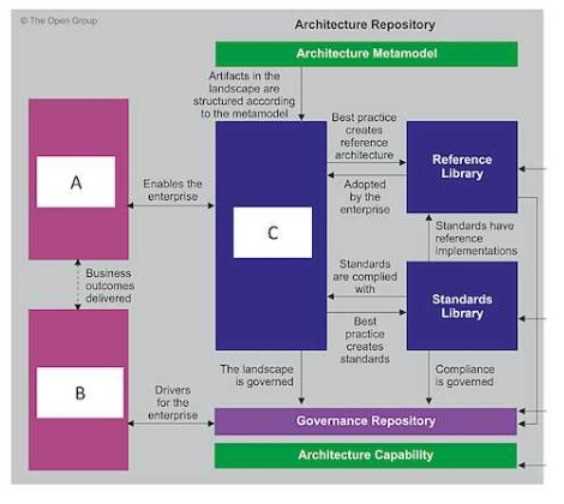
What are the items labelled A B and C?
It’s B for me. The middle label clearly says repository, so it makes sense that it aligns with Architecture Requirements Repository in option B. Also, the first label looks like a broad landscape view, which fits Architecture Landscape better than a solution landscape. The last label being Solutions Landscape matches how these layers stack up in TOGAF, with architecture on top, requirements in the middle, and solutions at the bottom. That order just feels more logical here.
D imo, because the first label looks like a repository, which fits better with option D starting with Architecture Requirements Repository. The last label also suggests a landscape view, matching option D’s end item.
appropriate Architecture Governance?
Makes sense to rule out A since Implementation Strategy focuses more on the how-to of execution, not governance handoff. The Transition Plan (C) seems right for ensuring governance is part of that phase shift. C
I get why B looks good, but I think D fits better here. A Migration Plan usually covers moving from the current state to the future state, including how governance frameworks adapt through the transition. It’s broader than just a handoff and ensures governance stays aligned as everything shifts. So, D seems like the more complete fit for ensuring smooth governance during implementation, not just setting up governance or mapping steps like B or C suggest.
The Preliminary Phase is mainly about setting up the architecture capability, so picking B makes sense since tools are part of that foundation, not about finalizing approvals or roadmaps yet. B
C imo, since getting approval for the Statement of Architecture Work is key early on to kick things off officially. Tool selection (B) might come later once the scope and work are agreed.
for carrying out the principle?
D, since requirements are what need to be done, fitting implications better than rationale.
A/D? A covers the reason behind the principle which often includes requirements, but D points to what happens next, like steps or conditions needed. Both could fit depending on interpretation.
breadth of an Architecture Project, and the contents of the EA Repository-?
Maybe D makes sense since strategy, portfolio, project, and solution delivery line up with different planning stages and outcomes in architecture projects, covering both scope and timelines clearly.
I’m sticking with B because it clearly breaks down architecture into manageable parts—from segment to enterprise level—which matches how projects scale and get documented in the EA Repository. The other options feel either too vague or off-topic, especially C which sounds more like buzzwords than defined purposes. B covers both the present capabilities and future enterprise goals, fitting the planning horizon angle well.
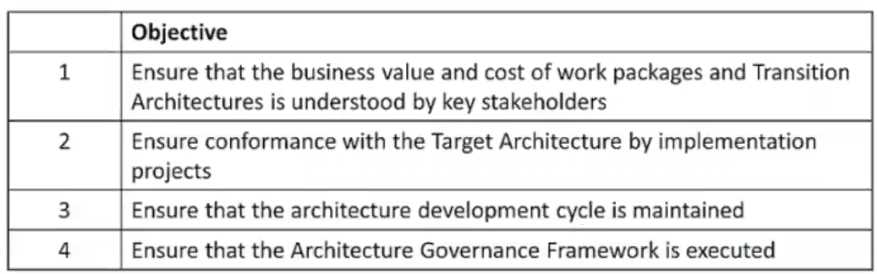
Which phase does each objective match?
Isn't phase 3 usually about development, so H fits better than G?
Not D, phase 2 is clearly planning which fits G better than H.
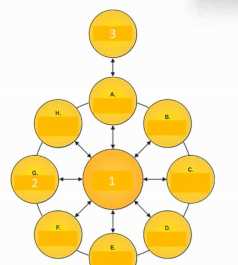
Consider the illustration of an architecture development cycle.
Select the correct phase names corresponding to the labels 1, 2 and 3?
Guessing A here, since Continuous Improvement often kicks off the cycle, followed by Migration Planning and then Architecture Vision setting the overall direction. The sequence looks logical to me.
Probably B. The order seems to match Requirements Management first, then Implementation Governance, and finally Preliminary for setting up the framework.
Option A makes sense since architecture principles help forecast impact from changes, not just set control rules or reflect culture. It’s about anticipating what happens when deploying the architecture.
It’s C because principles reflect culture and values guiding architecture choices.
cycle.
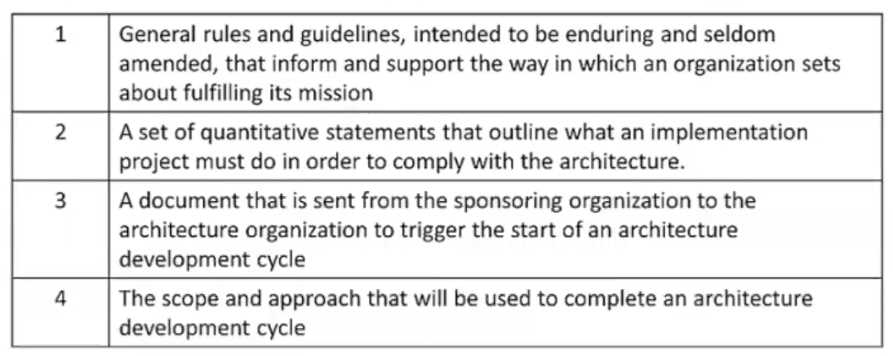
Which deliverables match these descriptions?
D/C? I think D fits because the Request usually kicks off the cycle, then the Statement lays out the work, Principles guide it, and Requirements come last. C mixes up that order a bit.
D makes sense too since the Request for Architecture Work usually starts the process, followed by Statement of Architecture Work, then Principles guiding the work, and finally the detailed Requirements Specification.
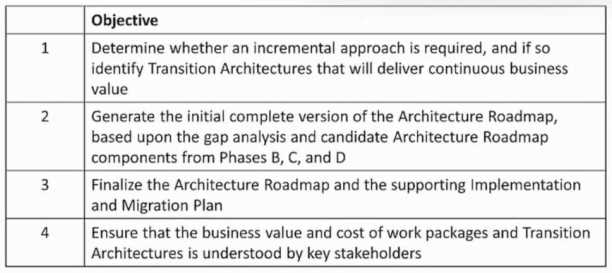
Which phase does each objective match?
Option D makes sense since phases 1 and 2 look like they’re about establishing requirements and direction, which fits E. Then phases 3 and 4 are more about design and deployment, which aligns better with F. The others repeat letters in a way that doesn’t seem to match the flow of ADM phases. Also, E typically comes before F in the ADM cycle, so having 1 and 2 as E and then moving to F for 3 and 4 feels more logical.
This one’s tricky but I think D fits best because 1 and 2 match E, and 3 and 4 to F. A and C mix up repeated letters which feels off here. D it is.
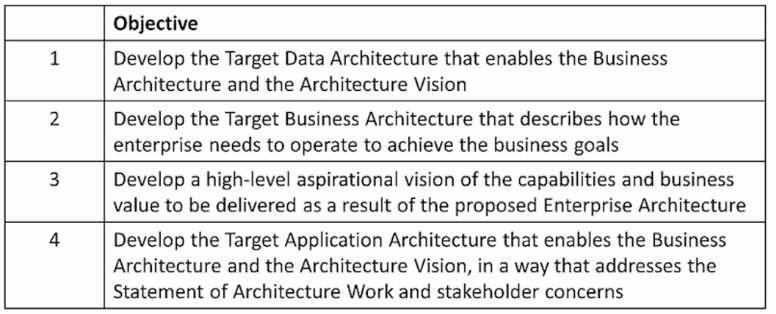
Which phase does each objective match?
This one seems tricky, but I’m going with A. The way objective 1 fits with phase C and how 2 matches phase B makes sense if you think about the sequence of setting architecture vision and then developing business architecture. The other options jumble up phases in a less logical order. The phrasing in the image leans towards the classic ADM flow where early phases set scope and vision, which aligns with A’s mapping better than the others.
C. The order seems the best fit when you match the core focus of each objective with the typical ADM phase goals. For example, 1B aligns with the preliminary phase’s focus on establishing context, and 3A fits well with the design phase’s goal of creating the architecture. The others fall into place logically, especially compared to the other options which mix up phase objectives more obviously.
A/B? I think A fits because the phase is about keeping an eye on the governance framework continuously, but B also makes sense since you need to ensure the architecture actually matches the plan during implementation.
Guessing B since ensuring conformance sounds like a core governance task during implementation.
It’s C because managing requirements happens continuously across all ADM phases, not just in one or centered somewhere specific. That ongoing process fits the idea of constant updates and checks.
D - Requirements and stakeholders are key to architecture success.