Free Salesforce Plat-Dev-210 Actual Exam Questions s - Question 2 Discussion
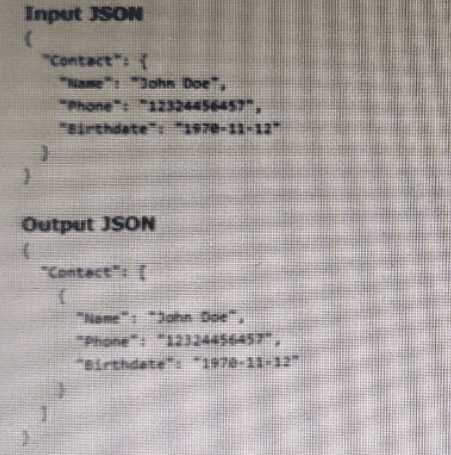
Given the input JSON shown above, what are two ways a developer could configure a DATA Raptor
transform to achieve the expected Output JSON? Choose 2 answers
Maybe B and C make the most sense. B targets the array directly with List(Contact), and C explicitly sets the output as a list, which fits the JSON array needed.
B imo, setting input path as List(Contact) directly targets the array, and C tbh makes sense by marking output as a list, so both handle arrays neatly without extra formulas.
Maybe A and C, since using a formula list and setting output as list both handle arrays well.
C seems right since setting output as list matches the JSON array format needed.
Maybe D and A could also work here. A suggests using a formula to explicitly create a list from the Contact field, which might be a clever way to ensure the data is treated as an array before transformation. D’s output path List(Contact) looks odd, but if the tool supports that syntax, it could direct the transform to output a list named Contact correctly. B and C seem solid, but I wouldn't discount A and D without testing, since they approach the problem from a different angle—adding a formula or tweaking output paths to shape the JSON as needed.
B imo, input path grabs the array correctly; C feels right with output as List.
I’m thinking options B and D could also be right. B sets the input path correctly with List(Contact), which grabs the array, and D tweaks output with List(Contact), which might help format the output as needed. If the Data Raptor is sensitive to the input/output path naming and expects explicit array handling, these two look plausible. Has anyone tested whether using List() syntax in input or output paths changes how it parses nested arrays? That might be key here.
It’s B and C. B works by targeting the right input path with List(Contact), and C sets both input and output as Contact while specifying the output as a List, which matches the JSON structure needed.
A and C. Option A works because using a formula like LIST(Contact) creates the array explicitly, which you can then map in the transform. C also makes sense since setting both input and output paths to Contact and marking the output as a List tells Data Raptor to treat that node as an array. B and D seem off because B’s input path as List(Contact) doesn’t match typical JSON path syntax, and D’s output path as List(Contact) might not be recognized properly without a formula or explicit list designation.
C imo, setting input and output paths both as Contact with output data type as List makes sense here. D also looks good, outputting as List(Contact) fits the goal.