Free Salesforce Plat-Dev-210 Actual Exam Questions s
Dumps Box (DumpsBox) offers up-to-date practice exam questions for Plat-Dev-210 certification exam which are developed and validated by Salesforce subject domain experts certified in Salesforce Plat-Dev-210 s . These practice questions are update regularly as we keep an eye on any recent changes in Plat-Dev-210 syllabus, and when there is update our team quickly adjusts the questions. This commitment to providing the best quality exam prep material to certification aspirants is what makes DumpsBox.com the best certification exam prep website. On top of that, our strong, yet strictly moderated, community based feedback keeps the content clean and current. Each question has helpful community discussion that provides it extra perspective and introduces helpful resources for better exam preparation. This also saves students from other outdated practice questions or illicit exam dumps that can have adverse affects on career. Browse through our Salesforce Plat-Dev-210 s exam questions and pass your exam on first try.
service expects the field value to be an integer. However, the DataRaptor is sending it as a string.
Which action can the developer take to fix this?
I think just setting the output type to Integer (A) might not truly convert the data, it could still send it as a string. Using TOINTEGER in a formula (D) forces actual conversion, so D sounds more reliable here.
If setting output type (A) just labels it, then formula (D) ensures actual conversion. D
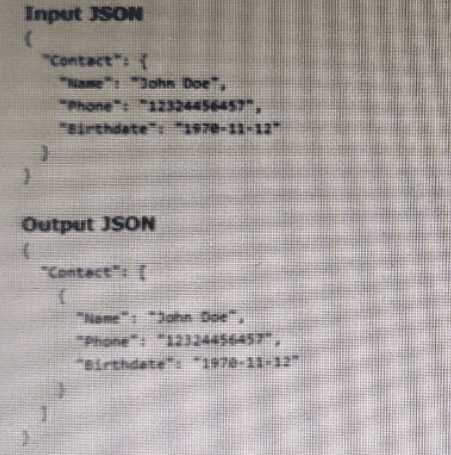
Given the input JSON shown above, what are two ways a developer could configure a DATA Raptor
transform to achieve the expected Output JSON? Choose 2 answers
Maybe B and C make the most sense. B targets the array directly with List(Contact), and C explicitly sets the output as a list, which fits the JSON array needed.
B imo, setting input path as List(Contact) directly targets the array, and C tbh makes sense by marking output as a list, so both handle arrays neatly without extra formulas.
Salesforce data is populated:
Which two errors could cause this behavior?
Choose 2 answers
Choose 2 answers
B, D. If the DataRaptor Extract isn’t active, it won’t pull any data. Also, a typo in the Input Parameters filter would stop the correct record from being fetched, causing no data to show.
It’s A and D because no Id or wrong filter means no data query.
information along with actions to close the case and update the case, and it will be styled using the
Community's theme.
What must the developer do to configure the FlexCard for deployment in a community?
It’s C since Target property sounds like it directs the card specifically to community pages.
It’s A for me. Setting the Deployment property to "Community" is key because it tells the FlexCard to adapt to the community environment, which includes applying community-specific styling and permissions. Just adding the API name or tweaking visibility won’t ensure the card inherits the community’s theme or behaves correctly in that context. Without setting Deployment properly, you might get default styling that doesn’t match the community look and feel. So, A covers both styling and the right deployment setup more comprehensively than the others.
OmniScript. The output of the function needs to be displayed to the user immediately in the current
step.
Based on best practice, which element should the developer use this function in?
D imo, the Set Values element (A) isn’t really meant for calculations; it’s more about assigning fixed values or setting variables, not doing live counts. The Range element (C) doesn’t handle functions directly—it’s more about defining data sets. The Formula element (B) is built for instant calculations and displaying those results right away, which matches the requirement perfectly. So B makes the most sense here, especially since the count needs to update immediately as users type.
It’s B because Formula elements recalc instantly as users input data, which fits showing COUNTIF results right away. Set Values is more for assigning static data, not real-time calculations.
What is the merge code syntax for passing a Date node from an element named SetValues in the
URL?
C/D? I’m between C and D as well. C’s %SetValues.Date% matches how I’ve seen variables merged in Integration Procedures, especially for simple node access. D’s colon syntax looks unusual to me, feels more like older or different contexts. Since the question is about a Date node specifically, dot notation (as in C) seems cleaner and clearer. Also, the percent signs are usually right for merge codes here. So I’m leaning more towards C because it fits the typical IP style I've worked with.
I think B fits the typical merge syntax for simple node values here. B
How should the developer configure this?
It’s D. Using a formula with the Filter function offers more control over what gets returned, so you can specify exactly which single result you want. The Limit property or filters might just cut off results arbitrarily, but a formula lets you set conditions to pick one meaningful record. This way, you avoid accidentally grabbing the wrong one if multiple entries qualify.
Maybe B makes the most sense since it limits results right where the extract is defined, avoiding any extra steps later on. A depends on action settings which might not always apply.
aggregation step?
D vs C? Aggregation needs flagged outputs, so D over just a calc step.
Makes sense that only outputs flagged to be included in the final results can be aggregated, so D fits better here than just any calculation step. D
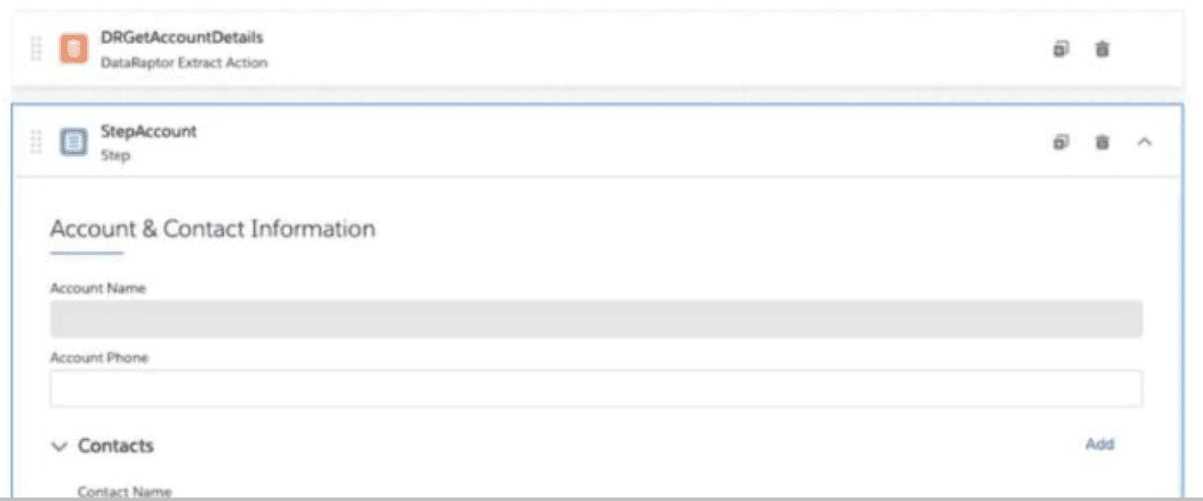
Omniscript structure shown?
BlkContacts is a Repeat Block.
It’s B because it shows each contact as a separate object directly inside BlkContacts, which fits how repeat blocks usually expect their data structure without extra nesting.
C seems better because it shows a straightforward array under BlkContacts without extra nesting, which repeat blocks usually require to render each item correctly. D might be too nested for some versions.
Account.
What type of mapping does a DataRaptor Load use to create the new contact and then add it as the
new Primary Contact?
Option B also fits since Linked Mapping covers creation plus linking in one step.
Maybe B, since Linked Mapping handles both creation and linking seamlessly.
data is updated in Salesforce. A Data Mapper Load saves the dat
a. What error could cause this behavior?
Choose 2 answers
Makes sense that B and D fit since read-only blocks updates and a misspelled ContextId stops correct record targeting. B,
Maybe A and D since wrong JSON paths or misspelled ContextId can block updates.
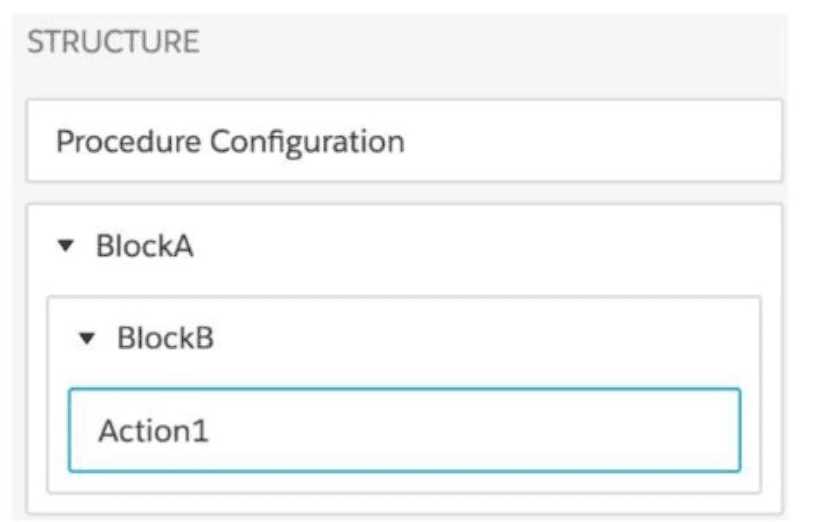
In this Integration Procedure structure, which Send JSON Path should be used to send the output of
the Action1 element to a Remote Action?
D imo, the order in option D seems flipped since JSON paths usually go from top-level block to nested elements. So starting with Action1 then going backwards feels off. Also, the dot notation is standard for JSON paths, which makes me put B and C aside since they use colons. Between A and D, A has the order right—outer block to inner action. But if we had to pick another just to test the waters, D's formatting is right but reversed order makes less sense in this context. So I’d rule it out as a valid path to send output properly.
A/B? I’m leaning toward A because dot notation is the usual way JSON paths are referenced, and the order seems right from outer BlockA to inner Action1. B uses colons, which might be valid in newer versions but feels less common for these paths. The nested structure suggests the path should go from BlockA to BlockB then Action1, matching A’s order. D looks reversed, and C is also reversed and uses colons, which I think is less likely here without explicit version context. So A feels safest based on standard JSON path conventions.
named FetchCart and a Response Action named ResponseCart.
In Preview, what JSON node shows the data sent to the Response Action?
D imo, since ResponseCart should directly show what’s passed to the Response Action, not just a summary node.
It’s B for me because the Response node usually represents the final output after all processing is done. Since ResponseCart is the last step, the data it sends should appear under Response in preview. ResponseCartDebug might show debug info, but if you want the actual JSON node with the data passed on, Response is where it’s at. That’s how I read it anyway.
postal code to a child FlexCard.
When configuration text elements in the child FlexCard, what syntax should a developer use to refer
to the contact’s postal code?
Option D seems right since child FlexCards usually access passed-in data through {Params}, not directly from parent or records. The other options don’t fit how data is typically passed down.
Makes sense to me, the child gets data via params, so D.
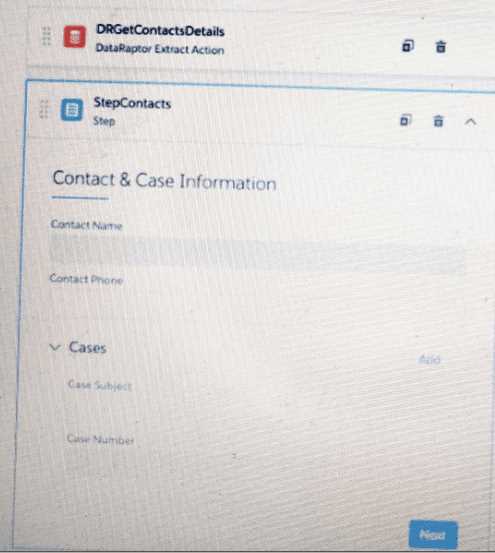
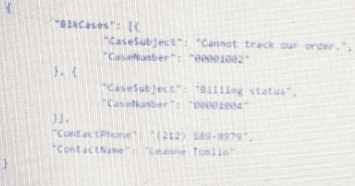
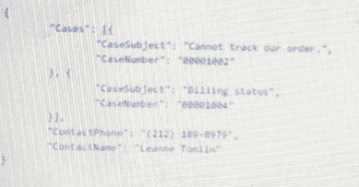
values correctly shown? BlkCases is a Repeat Block, and the names of the elements are the same as
the label names without spaces.
A)
B)

C)
D)

D imo since it properly treats BlkCases as an array of case objects with all the right fields, matching the repeat block setup exactly. The other options either miss that or mix up field names.
A vs D? The key is that BlkCases has to be a repeat block, so it should be an array of case objects. Option A clearly shows BlkCases as an array with multiple objects inside, each having the right keys matching the labels. D tries something similar but its syntax looks off for a standard repeat block—it's more nested or differently structured. So I’d go with A since it matches the repeat block definition more cleanly.