Free Microsoft Dynamics MB-800 Actual Exam Questions - Question 1 Discussion
You are setting up a new company for a customer.
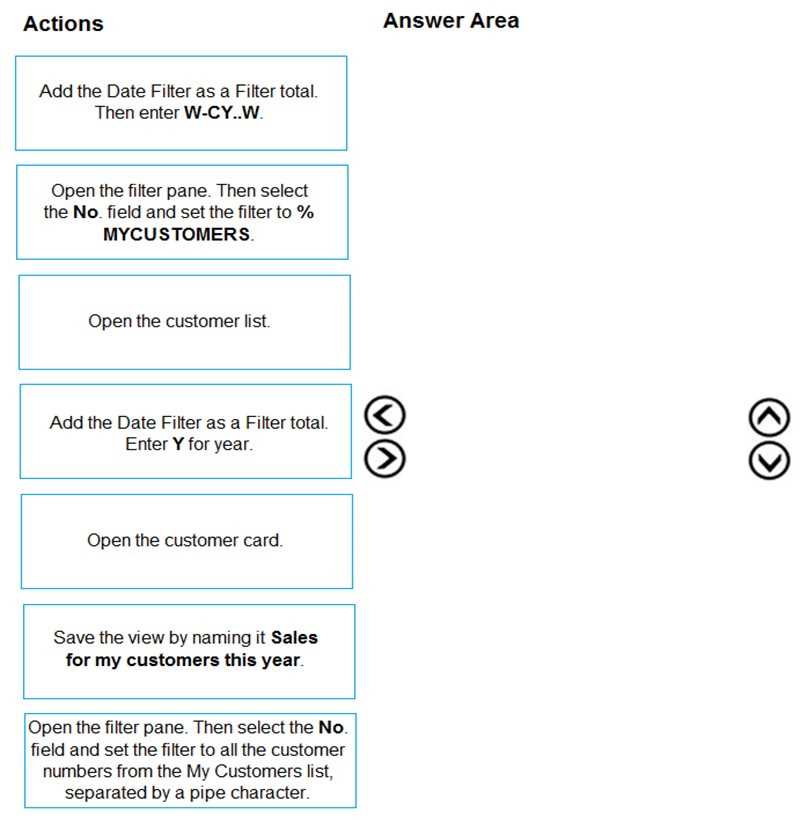
The customer wants you to filter the view to show all customers in the My Customers list and
calculate the year-to-date sales.
You need to apply the filter.
Which four actions should you perform in sequence? To answer, move the appropriate entities from
the list of actions to the answer area and arrange them in the correct order.
NOTE: More than one order of answer choices is correct. You will receive credit for any of the correct
orders you select.
I think the key is to first apply the filter that narrows down to "My Customers" so you’re not dealing with unnecessary data. Then you should set the date filter for year-to-date sales to target the right timeframe, which lets your calculation be accurate. After both filters are set, you can safely add the calculated column or measure for YTD sales. Doing it in this order makes sure your calculation doesn’t include extra data or dates outside the range. So, filter customers first, then filter dates, then calculate.
I’d start by adding the filter for “My Customers” to make sure you’re only looking at that group right away. Next, set the date filter specifically for this year to get the year-to-date data before doing any calculations. Once those filters are in place, add the total sales field and then apply the sum aggregation so you get the YTD sales total. That way, you’re working with the right subset and timeframe before pulling numbers. It seems cleaner than trying to calculate before filtering properly.
I’d go with starting by selecting or filtering the “My Customers” segment first, since you want only those customers in the view. Then, apply the date range filter for the year-to-date period to limit sales data to this year. After that, add the sales field to the view and finally apply a sum or aggregation to calculate the total YTD sales. This order makes sense because filtering customers first reduces data volume early, then time filtering narrows it further before you do calculations.
I’d say start by selecting the filter for “My Customers” to get the right subset, then apply the date filter for year-to-date so you’re only looking at this year’s sales. After that, add the calculation for total sales within that filtered data. The last step would be to apply or save these settings so they stick. Doing it this way ensures you only calculate sales on the correct group and timeframe, avoiding unnecessary calculations.
I think a clear way to do this is to first apply the filter for “My Customers” to narrow down the list, then set the date filter to capture the year-to-date range. After that, you’d add the sales field and apply an aggregate function to calculate total sales for that period. Finally, you’d apply or save the view so it reflects the filtered sales data. So basically: filter customers, set date range, calculate sales, then finalize the view. This sequence ensures you only sum sales relevant to those specific customers and dates.
First filter by “My Customers,” then apply YTD sales calculation.
Start by selecting the “My Customers” filter to narrow the list, then apply the date range for year-to-date, next calculate the sales sum, and finally save or apply the view for results.
I think the main steps are setting the filter on “My Customers” first to narrow down the data, then applying the calculation for year-to-date sales. The sequence probably starts with selecting the right field to filter, applying the filter, then choosing the calculation type, and finally setting the date range to YTD. Anything outside those steps seems unnecessary for this specific task. It’s about focusing on the customer view first, then making sure the sales figure is summed up correctly for the year so far.
I’d start by applying the filter for “My Customers” first, then move on to setting the calculation for year-to-date sales. Skipping any unrelated steps helps keep it straightforward.
I’d skip whatever action doesn’t relate to filtering or calculating YTD sales-sounds like one option might be a red herring. The key steps should involve setting the filter on “My Customers” and then applying the calculation.