Free Microsoft Dynamics MB-310 Actual Exam Questions - Question 2 Discussion
You are implementing a Dynamics 365 for Finance and Operations General ledger module for a client
that has multiple legal entities.
The client has the following requirements:
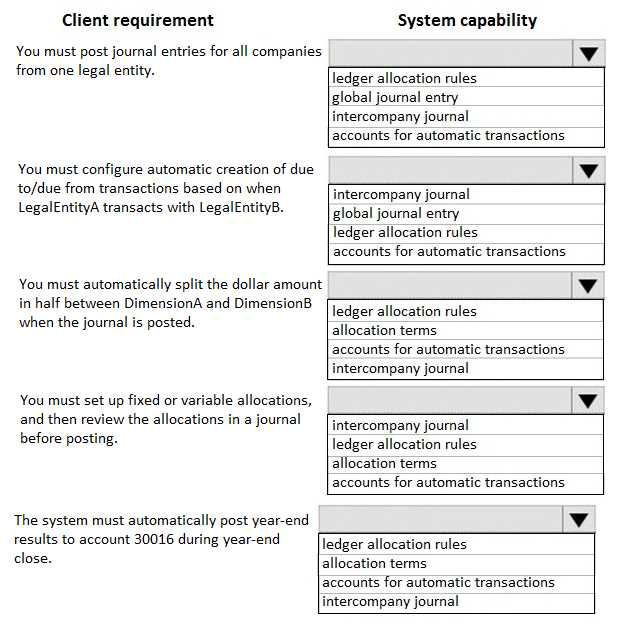
• Post journal entries for all companies from one legal entity.
• Configure automatic creation of due to/due from transactions based on when LegalEntityA
transacts with LegalEntityB.
• Automatically split the dollar amount in half between DimensionA and DimensionB when the
journal is posted.
• Set up fixed or variable allocations, and then review the allocations in a journal before posting,
• Automatically post year-end results to account 30016 during year-end close.
You need to configure the system.
Which system capability should you configure? To answer, select the appropriate configuration in the
answer area.
B handles intercompany transactions, so that covers the due to/due from part.
I’d say B is definitely for the automatic due to/due from transactions since that’s intercompany posting. For the half split between dimensions, C looks like the right setup for allocation rules.
For posting from one entity to others, A fits better than B for cross-company journal entries.
I agree with picking B for the intercompany transactions since that’s exactly what those setups handle—automatic due to/due from entries between legal entities. For splitting amounts between DimensionA and DimensionB, C seems right because it’s about dimension allocation on posting. The automatic posting to account 30016 during year-end close sounds like a fixed allocation or closing entry, so E fits there. Overall, the key is matching each requirement to its dedicated feature: intercompany for cross-entity postings, dimension allocation for splitting amounts, and allocation journals for year-
B fits intercompany entries, while C matches dimension splitting on posting.
I think B for intercompany accounting makes sense for the due to/due from transactions since that’s designed exactly for handling transactions between legal entities. For splitting amounts between dimensions, that sounds like allocation rules, so D fits that part well. The automatic posting of year-end results to an account is usually handled by year-end close settings, which would be E. The key here is matching each requirement to the right module feature rather than one setting covering everything.
B, C, A, D, E