Free Microsoft Data Engineering DP-700 Actual Exam Questions - Question 11 Discussion
HOTSPOT You have a Fabric warehouse named DW1 that contains four staging tables named ProductCategory, ProductSubcategory, Product, and SalesOrder. ProductCategory, ProductSubcategory, and Product are used often in analytical queries. You need to implement a star schema for DW1. The solution must minimize development effort. Which design approach should you use? To answer, select the appropriate options in the answer area. NOTE: Each correct selection is worth one point. 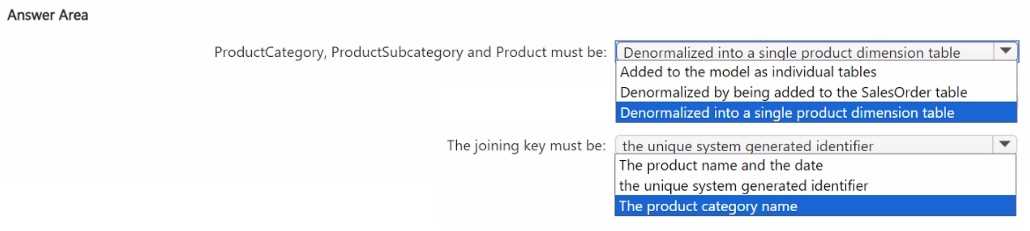
I’m thinking option D makes sense to combine ProductCategory and ProductSubcategory into a single dimension since those are closely related hierarchies. It cuts down on the number of joins and fits the star schema approach. For the fact table, A is the obvious choice since SalesOrder contains transactional data with measures. This way, you keep the design simple and efficient without extra development work. The other options don’t really group the dimension tables well or miss the clear fact table candidate.
I see why A for SalesOrder as the fact table works since it has the measures. For dimensions, D is good because it combines those related tables into one, cutting down on joins and complexity.
I agree with choosing A for the fact table since SalesOrder holds the metrics. For dimensions, D is smart—it merges categories and products, so fewer tables to manage and join. That fits star schema style well.
I’m thinking option A for the fact table makes sense since SalesOrder is the transactional data, so it should be the fact. For dimensions, D looks good because it combines ProductCategory, ProductSubcategory, and Product into one denormalized dimension. This reduces joins and aligns with a star schema pattern. It also cuts down development effort by avoiding building multiple dimension tables. Although denormalizing might cause some update headaches, since the question prioritizes minimizing dev work, this approach fits best.
Yeah, D and A make the schema straightforward and cut down query complexity.
D and A fit best; denormalized dims speed queries, Product as fact centralizes sales data.
Option D and A seem right; denormalizing dims cuts joins, Product as fact fits star schema.
I think D and A make sense here. Keeping ProductCategory denormalized (D) reduces joins, and making Product the fact table (A) fits star schema logic by placing sales info at the center. Keeps it simple.
Go star schema; keep ProductCategory and ProductSubcategory denormalized for simplicity.
this one’s tricky, anyone else stuck between snowflake and star schema?