Free Microsoft Azure AZ-900 Actual Exam Questions - Question 5 Discussion
HOTSPOT For each of the following statements, select Yes if the statement is true. Otherwise, select No. NOTE: Each correct selection is worth one point. 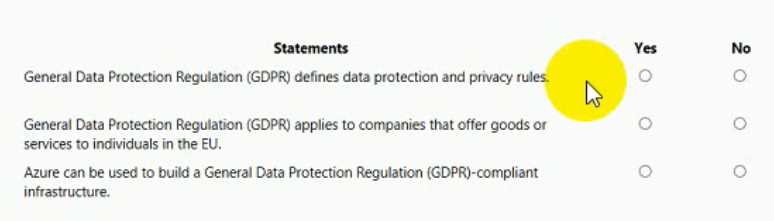
Yeah, B and D fit since billing and compliance don’t cross tenants.
I agree that B and D seem solid since billing and compliance are tied to subscriptions. For A, it says something about management groups across tenants, which doesn’t sound right because management groups are within a single tenant. C mentions subscriptions spanning multiple tenants, but I thought subscriptions belong to one tenant only. So, I’d say no on A and C based on those points. It feels like the question tests knowing how Azure structures tenants and subscriptions, not mixing them across boundaries.
I think B and D are definitely yes because billing is tied to a subscription and compliance applies at that level. A is tricky since subscriptions are under one tenant, so no for that. C sounds off too.
I’m going with yes on D because compliance boundaries are definitely tied to subscriptions, making it easier to enforce policies per subscription. Also, B makes sense since billing is generally done at the subscription level, so that’s a yes too. A looks off since not all require reserved capacity upfront, and C is tricky because while you can manage multiple subscriptions under one tenant, I don’t think each subscription is strictly tied to a single tenant in every case—so I’d say no there.
I’d say C is a yes because you can manage multiple subscriptions under one Azure AD tenant, which helps with organization and access control. A doesn’t fit since upfront reserved capacity isn’t a must for all subscriptions.
I think A is a no because not all subscriptions require reserved capacity upfront, especially with pay-as-you-go options. C sounds off too since you can usually have multiple subscriptions under one tenant. B and D seem solid yes choices.
I think B and D stand out because they’re related to billing and compliance policies Azure enforces. A talks about reserving capacity upfront, which isn't always true for all subscriptions, and C about subscription changes is too general without more context. So, ruling those out makes sense to me.
I’d say B and D are definitely yes since they align with Azure’s billing transparency and compliance. A and C don’t really fit the typical subscription terms, so no for those.
Looks like B and D should be yes, the others no. B and D fit the billing and compliance rules here.