Free Microsoft Azure AZ-700 Actual Exam Questions - Question 9 Discussion
machines shown in the following table.
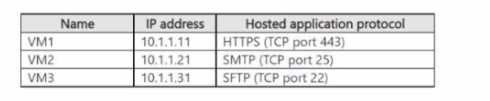
All the virtual machines are connected to VNet1.
You need to ensure that the applications hosted on the virtual machines can be accessed from the
internet. The solution must ensure that the virtual machines share a single public IP address
What should you use?
It’s C because the public load balancer allows multiple VMs to share one public IP for inbound internet traffic, unlike NAT gateway or internal load balancer which don’t expose VMs publicly.
Option C works since it lets multiple VMs share one public IP for inbound traffic.
Maybe D. If these are web apps that need SSL offloading or path-based routing, Application Gateway fits better than just a public load balancer serving raw traffic.
C imo. The key is sharing one public IP for inbound internet access, which a public load balancer does. NAT gateway and internal load balancer don’t fit the inbound internet requirement here.
B imo, an internal load balancer won’t expose VMs to the internet at all, so it’s out. The NAT gateway is mostly for outbound traffic, so that leaves the public load balancer or Application Gateway.
I’m thinking A might be off since NAT gateway usually handles outbound traffic from VMs, not inbound. B is internal, so no internet access. Between C and D, if the question just wants basic public access via one IP without fancy app-layer stuff, C fits better. But the question doesn’t mention HTTP or SSL specifically, so Application Gateway (D) might be overkill. Does anyone else think the key is just sharing a single public IP for inbound access, making the public load balancer the simplest fit?
C/D? A public load balancer (C) definitely fits since it can distribute traffic from one public IP to multiple VMs, which solves the single IP part. But if the apps are web-based and need layer 7 routing features like SSL offloading, Application Gateway (D) might be better. The question doesn’t say they need those advanced features though, so I’d lean more towards C for a straightforward setup. NAT gateway (A) is out because it’s for outbound, and internal load balancer (B) doesn’t have a public IP, so those don’t fit here.
C, since it handles inbound traffic to multiple VMs using one public IP.
Guessing C. The question wants all VMs accessible from the internet via one IP, and a public load balancer fits that use case better than Application Gateway or NAT gateway.
Probably C. A public load balancer is designed to handle inbound internet traffic and can distribute requests across multiple VMs using one public IP. NAT gateway mainly manages outbound connectivity, so it wouldn't let the internet initiate connections to the VMs. Application Gateway is more for web apps needing layer 7 features, but the question doesn't specify that. Internal load balancer doesn’t expose services to the internet, so it’s out too. So sharing a single public IP for inbound access points solidly to option C.
Maybe C. A public load balancer can distribute inbound traffic from one public IP to multiple VMs, which fits the need to share a single IP for internet access. NAT gateway is mostly for outbound traffic, so likely not right.
A imo, NAT gateway handles outbound but not inbound access, so not suitable.
C, it’s designed for inbound traffic sharing one public IP across VMs.
C imo, public load balancer is straightforward for sharing one public IP inbound.
Actually, a NAT gateway (A) is mostly for managing outbound connections, so it wouldn’t help with inbound traffic from the internet. Between B, C, and D, an internal load balancer (B) doesn’t provide public IP access since it’s internal only. That leaves either a public load balancer (C) or Application Gateway (D). The question doesn’t specify web app features like SSL offloading, so C makes the most sense to share one public IP across multiple VMs for general inbound traffic.
A/C? NAT gateway is mainly for outbound traffic, not inbound access. Between public load balancer and Application Gateway, load balancer fits better if you just need to share one IP for general app access, not specifically web apps.
C/D? A public load balancer makes sense for sharing a single public IP, but the Application Gateway also handles web traffic well. Not sure if NAT gateway fits here.