Free Microsoft Azure AZ-104 Actual Exam Questions - Question 15 Discussion
DRAG DROP - You have an Azure subscription that contains the resources shown in the following table. 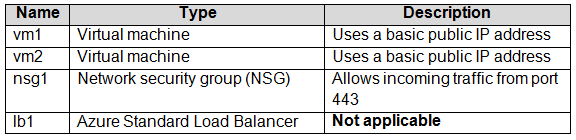 You need to load balance HTTPS connections to vm1 and vm2 by using lb1. Which three actions should you perform in sequence? To answer, move the appropriate actions from the list of actions to the answer area and arrange them in the correct order. Select and Place: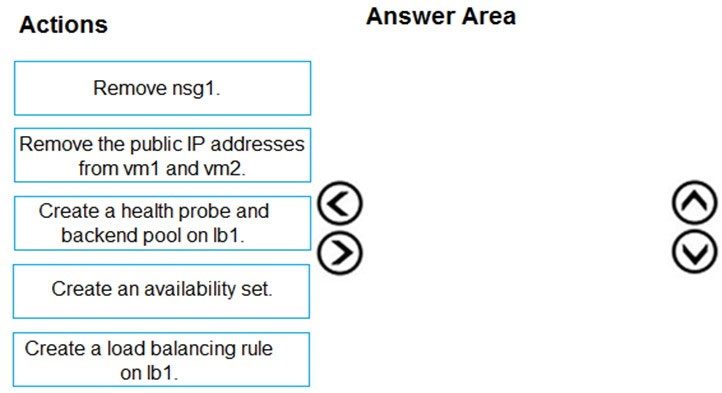
G first to set up health checks, then C for frontend IP, and finally D for load balancing rule.
I'd start with creating the health probe (G) to monitor VM health, then assign the frontend IP (C) so lb1 has an endpoint, and finally create the load balancing rule (D) to route HTTPS traffic properly.
I’d swap the order a bit here. First, definitely create the health probe (G) so you know the LB can check if vm1 and vm2 are up on the right port. Then assign the frontend IP (C) because lb1 needs an IP to listen on. Last, configure the load balancing rule (D) to tie it all together for HTTPS traffic. Without the probe, the rule won’t work properly since it won’t know VM health. This sequence ensures proper setup from checking VM status to handling incoming traffic on lb1.
I’d start with C to assign the frontend IP, then G for the health probe, and finally D to set
Starting with assigning the frontend IP (C) makes sense because lb1 needs to have an IP for incoming traffic. Then setting up the health probe (G) ensures lb1 checks VM availability before creating the load balancing rule (D).
I think starting with the frontend IP (C) makes sense because the load balancer needs an IP address to route traffic. Then setting up the health probe (G) is important so the LB knows which VMs are available before you create the load balancing rule. Finally, adding the load balancing rule (D) ties everything together to actually distribute HTTPS traffic between vm1 and vm2. The order C, G, D feels logical to me because without the IP and probe, the rule wouldn’t function properly.
I’d go with configuring the frontend IP first (C) since the load balancer needs an IP to listen on. Then setting up the health probe (G) so lb1 knows which VMs are healthy before distributing traffic. Finally, create the load balancing rule (D) to tie it all together for HTTPS traffic. The sequence feels right because you need the IP and health check in place before defining the rule.
C, G, D