Free Juniper JN0-105 Actual Exam Questions
Dumps Box (DumpsBox) offers up-to-date practice exam questions for JN0-105 certification exam which are developed and validated by JUNIPER subject domain experts certified in Juniper JN0-105 . These practice questions are update regularly as we keep an eye on any recent changes in JN0-105 syllabus, and when there is update our team quickly adjusts the questions. This commitment to providing the best quality exam prep material to certification aspirants is what makes DumpsBox.com the best certification exam prep website. On top of that, our strong, yet strictly moderated, community based feedback keeps the content clean and current. Each question has helpful community discussion that provides it extra perspective and introduces helpful resources for better exam preparation. This also saves students from other outdated practice questions or illicit exam dumps that can have adverse affects on career. Browse through our Juniper JN0-105 exam questions and pass your exam on first try.
(Choose two.)
D imo, 'configure' is the classic command for config mode, plus 'edit' works too.
A imo, since quit and exit clearly don’t enter config mode.
C/D? UDP is known for being connectionless, so D fits well. It also doesn’t do handshakes or retransmissions, which means it’s best effort — no guarantees packets arrive or in order, so C works too. A and B are pretty clearly wrong since UDP isn’t more reliable or slower than TCP, it usually has less overhead and can be faster.
It’s definitely D and C. UDP skips the handshake and just sends packets out, so it’s connectionless, and there’s no guarantee they arrive, which matches best effort. A and B are clearly off.
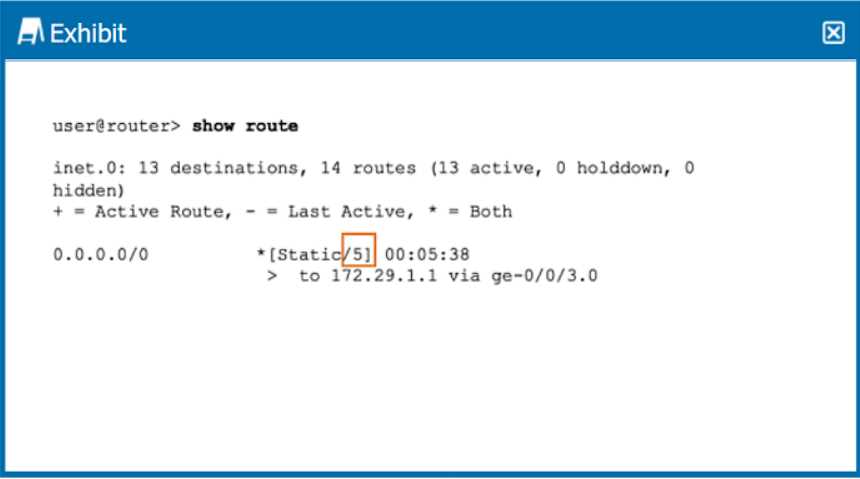
Referring the exhibit, what does the highlighted number indicate?
Option C could make sense if this is OSPF since cost is a common metric there and often set to integers like 5. Preference usually isn’t shown in the route table as just a number like that, and hop count would be more specific to RIP. Without protocol info, metric or cost is the safest guess since those terms are more generally applicable across different routing protocols. The exhibit looks like a routing table, and that number probably represents how “expensive” the route is, not just the preference or simple hop count.
A/C? The number could be a cost if this is OSPF since preference is usually lower, and hop count seems less likely if metric or cost are options. The exhibit lacks protocol info, so just guessing.
Option C makes the most sense since NTP is specifically designed for time synchronization, unlike SNMP or RIP which handle other network functions. D is just a distractor.
C imo, since SNMP is for monitoring and RIP is for routing, only NTP fits time sync.
It’s A, works the same in most Unix-like terminals for moving to line start.
Maybe A, since Ctrl+a is a classic shortcut in a lot of command lines for jumping to the start. Ctrl+k usually deals with deleting text, so it seems less likely for moving the cursor.
A/B? I’m considering if there’s a scenario where a user could have multiple login classes for different roles or environments, but from what I recall, it’s usually a single login class per user to keep things consistent. Assigning more than one might cause conflicts in resource limits or environment settings. So A or B could make sense if they’re counting predefined classes, but D still feels like the safest bet given the typical design. Without OS specifics, it’s tricky, but I doubt it’s more than one per user account.
I agree with the choice of D. From what I know, login classes are designed to set environment and resource limits per user session, so assigning more than one would conflict. It’s more about a single, distinct profile for each user, so having multiple login classes wouldn’t make sense practically.
B/C? Switches can cause loops if spanning-tree isn’t running, so B makes sense. And they always flood broadcasts to all ports except the source, so C fits too. A and D don’t really match how switches work.
C/D? D is definitely wrong because switches do learn MAC addresses to build their tables. A is tricky—each switch port creates its own collision domain, not one single domain. So A can be eliminated. That leaves B and C, and even without explicitly saying spanning-tree is disabled, B still holds since loops are a known risk in Layer 2 switches without loop prevention. So I’d go with B and C.
B imo is a must since both direct and local routes have the same preference of 0, which is the lowest possible. For the other, I’d go with C because OSPF internal and AS external routes typically don’t share the same preference — internal usually has a better (lower) preference than external routes. That rules out A and D for me as static routes usually have a better preference than direct, and EBGP definitely beats IBGP in preference order.
B/D? I think B is definitely true, but D seems off since EBGP usually has a better route preference than IBGP. So I’d say B plus maybe A for static vs direct routes.
this device for the current date and time on the US West coast. You have set the time zone to
America/Los_Angeies. however the time and date did not change.
In this scenario, which two additional actions would satisfy this requirement? (Choose two.)
Maybe A and B? The typo definitely messes things up, but even with the right timezone, you still gotta set time manually or pull it from an NTP server to actually update it.
A/B imo, gotta fix the typo first then set time or sync with NTP.
Option B and D, as Ethernet frames only use MAC addresses for source and destination.
Probably B and D since Ethernet frames only carry MAC addresses in the header.
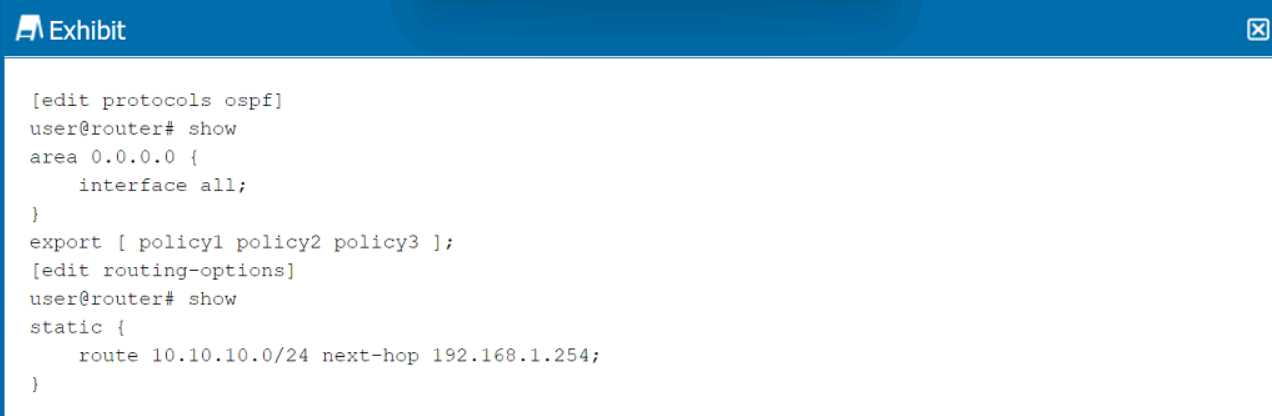
Referring to the exhibit, OSPF has three export policies that match different static route prefixes. The
10.10.10.0/24 static route does not match any terms in the policyl routing policy.
What happens next in this scenario?
D, since no match in policyl means immediate rejection there, no fallback.
Not sure if the policies are chained or separate here. If they’re separate, maybe the route gets checked against all three policies instead of being rejected immediately by policyl? That could change things.
[edit system archival] user@router# show configuration {
transfer-on-commit; archive-sites {
"scp://[email protected] : /archive" password ## SECRET-DATA
"ftp://[email protected]:/archive" password "$9..."; ## SECRET-DATA
.
Referring to the exhibit, where are the configuration backup files stored?
Maybe D makes sense because Junos usually tries primary first and only switches if it fails. The config shows two archive sites but no indication they run at the same time, so B seems unlikely. Also, no mention of round-robin behavior, so A probably isn’t right. C feels too vague since Junos typically follows a set order. So, assuming fallback is default seems safest here.
D The config hints at a primary and fallback setup since it lists two sites without saying they’re simultaneous. So, if SCP fails, it probably tries FTP next.
in the configuration, but no output is shown.
Which statement is correct in this scenario?
Could it be that the command just shows interface diffs, so A might also fit?
It’s B, since no output means candidate and active configs match exactly.
Maybe C and D, since CoS helps control congestion and prioritize important traffic.
Option C makes sense since class of service helps deal with congestion, and option D fits because it lets you give priority to latency-sensitive stuff. A and B feel a bit too absolute or broad.
A and C because transport deals with ports, not MAC addresses.
Probably A and C, since MAC addresses belong to the data link layer.