Free Google Professional-Machine-Learning-Engineer Actual Exam Questions - Question 4 Discussion
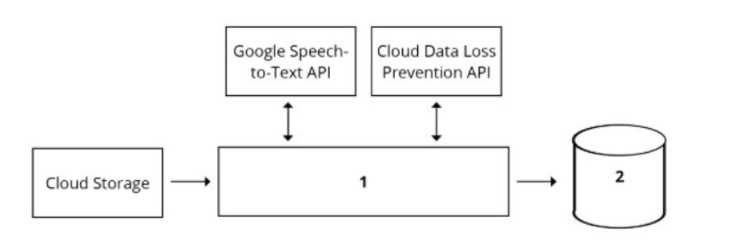
in each call. The call center receives over one million calls daily, and data is stored in Cloud Storage.
The data collected must not leave the region in which the call originated, and no Personally
Identifiable Information (Pll) can be stored or analyzed. The data science team has a third-party tool
for visualization and access which requires a SQL ANSI-2011 compliant interface. You need to select
components for data processing and for analytics. How should the data pipeline be designed?
Good point on Cloud SQL handling regional data and ANSI-2011 compliance. I’d say C fits best since Pub/Sub or Datastore won’t provide the SQL interface needed, and Cloud Functions might struggle with scaling to that volume. C it is.
Maybe C since Dataflow can scrub PII well and Cloud SQL keeps data regional.
C Dataflow is great for processing and anonymizing data fast, plus Cloud SQL supports ANSI-2011 and regional instances—better for keeping data local compared to BigQuery's multi-region setups.
D imo, Cloud Functions can handle quick PII filtering, Cloud SQL fits regional and ANSI needs.
Option C makes sense too. Dataflow is solid for processing and scrubbing PII before storing, and Cloud SQL still supports ANSI-2011 SQL with regional instances available. Cloud SQL could be easier to control data residency since you can spin up instances strictly in the needed region, while BigQuery's multi-region handling might risk crossing boundaries unintentionally. Plus, Cloud SQL handles structured query needs well for the data science team’s third-party tool. The main tradeoff is scalability at this volume, but with proper instance sizing, it should work fine.
C/D? Cloud SQL definitely supports ANSI-2011 SQL, which the third-party tool needs, and Cloud Functions can handle event-driven processing at scale without managing servers. But not sure if Cloud Functions alone can handle the volume or PII filtering as well as Dataflow. Meanwhile, Dataflow’s strong for ETL and regional compliance, but pairing it with Cloud SQL might limit scaling with a million calls daily. So it’s a trade-off between scalability (Dataflow + BigQuery) and strict SQL compliance (Cloud SQL).
Probably C here since Cloud SQL supports ANSI-2011 SQL and can keep data regional. Dataflow can handle the processing and filtering before loading into Cloud SQL, though scalability might be a concern.
Maybe A makes the most sense since Dataflow can do real-time processing and PII filtering before pushing data to BigQuery, which easily handles huge volumes and supports ANSI-2011 SQL for the visualization tool.
C/D? Cloud SQL supports ANSI-2011 SQL, which fits the third-party tool’s need, and processing with Cloud Functions or Dataflow can handle PII removal. But Cloud SQL might struggle with the scale of over a million calls daily, and Cloud Functions can be limited for streaming data. Pub/Sub and Datastore don’t fit well for SQL querying or large-scale analytics. So it’s more about balancing scale versus SQL compatibility here. BigQuery scales better than Cloud SQL, but if strict SQL ANSI-2011 compliance is needed, Cloud SQL options (C or D) might be considered despite scaling challenges.
Maybe A because Dataflow handles large-scale streaming well and can do preprocessing like PII removal before loading into BigQuery, which supports ANSI SQL and regional data residency. Cloud SQL won’t scale as well here.
It’s A because Dataflow can filter out PII in real-time and keep data regional, while BigQuery scales for huge datasets and offers full ANSI-2011 SQL support, unlike Cloud SQL or Datastore.
It’s A because BigQuery can easily handle massive datasets with ANSI SQL support and strict regional controls, while Dataflow manages huge streaming input better than Cloud SQL or Datastore.
A. Dataflow handles large-scale streaming well, and BigQuery supports ANSI SQL and regional data residency. Cloud SQL might struggle with the volume and doesn't guarantee regional data isolation as strictly.
A, but explanation is too vague here. Can someone clarify?