Free Google Professional Cloud Network Engineer Actual Exam Questions - Question 12 Discussion
asia-southeast1 region cannot communicate with compute resources on-premises. What should you
do?
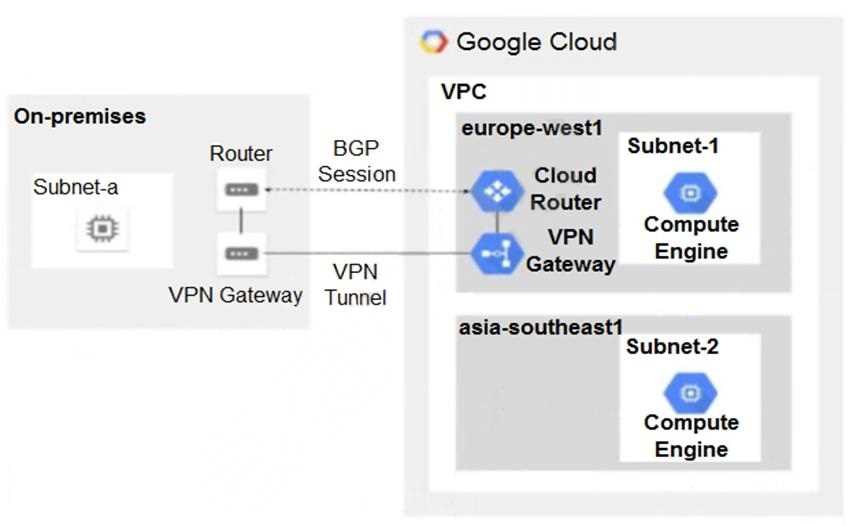
C, since regional routing blocks cross-region route sharing with on-premises.
Actually, D makes sense here too. Adding a second BGP session to the Cloud Router could help if the current session isn’t handling routes from asia-southeast1 properly, enabling proper route exchange with on-prem.
C. The regional mode restricts route sharing to within the region, so changing to Global lets routes from asia-southeast1 be advertised on-prem and vice versa, fixing the communication issue.
It’s A for me. If the routes from asia-southeast1 subnet aren’t showing up on-prem, maybe the Cloud Router isn’t advertising those routes properly. Custom route advertisement could solve that by explicitly sharing the subnet routes with on-prem. Changing to Global routing (option C) helps with route sharing across regions but won’t fix missing route advertisements to on-prem directly. Adding another BGP session (D) is only needed if you have multiple connections, which doesn’t seem to be indicated here. IP forwarding (B) isn’t relevant for basic routing between subnets and on-prem.
Probably C. If the routing mode is regional, it won’t share routes across regions, so switching to Global should fix communication between asia-southeast1 and on-prem resources.
It’s C—regional routing limits subnet visibility across regions, Global fixes that.
This one’s confusing because it looks like the subnet is regional but maybe routes aren’t propagating properly. I’d go with C, changing to Global routing mode might help connect different regions.