Free Databricks-Generative-AI-Engineer-Associate Actual Exam Questions - Question 2 Discussion
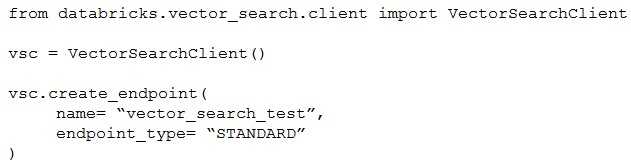
Assuming they intend to use Databricks managed embeddings with the default embedding model,
what should be the next logical function call?
B/C? You’d usually need to create or sync the index before querying it with similarity_search (D). Between B and C, create_delta_sync_index (B) sounds like it handles updating or syncing, which might be necessary if the index already exists and data is changing. create_direct_access_index (C) might be for initial setup. If this is the very first setup, then C could make sense; if updating or syncing, then B. So it really depends on whether the code snippet indicates an existing index or not.
D, since testing retrieval with similarity_search() comes after the index setup.
D/A? Assuming embeddings are ready and the vector store is set up, running similarity_search() (D) makes sense to test if retrieval works. But if the index hasn’t been created or synced yet, then calling create_delta_sync_index() (B) or create_direct_access_index() (C) would be necessary first. Since the question doesn’t clarify the index status, A (get_index()) could also be valid to check if an index exists before proceeding. Without that info, it’s between checking or testing the search next.
I think D fits best here. After setting up embeddings and the vector store, the natural move is to test it by running similarity_search(). Creating or syncing the index seems like earlier steps, and if that’s done, you want to see if the search actually retrieves relevant results. So D makes the most sense as the next call.
A imo, if the index was already created before, calling get_index() makes sense to retrieve and verify it before any searches or updates. It’s the safe next step after setup.
Maybe D here. If the vector store setup code is already done and it uses the default embedding model, the next step might be to actually run a similarity search to test if everything works. Creating the index (B or C) should’ve been done earlier in setup, so this feels like a test after setup rather than the setup itself. Plus, the question says "test setting up," which hints at trying out a search rather than creating an index again.
B/D? I get why B makes sense since you need the index created, but if the vector store already has an index from before, maybe the next step is to run similarity_search (D) to test it out. The question says “test setting up,” so possibly they want to check if it works after creating or confirming the index. But if the index isn’t created yet, then B is definitely needed first. Without more context on whether the index exists, both could be reasonable steps.
It’s B, you gotta build the index before searching, can’t skip that step.
B imo. Before you can run similarity searches, you need to create the index that organizes the vectors. The code snippet looks like it’s setting up the vector store but not yet building the index itself. So going straight to similarity_search (D) seems premature without an index in place. Creating the delta sync index (B) fits as the next step to prepare the data structure for efficient queries. You can’t really get or search an index if it doesn’t exist yet, so A and D don’t make much sense right after initial setup.
I think the next step should be D. vsc.similarity_search() since after setting up the vector store and embeddings, you'd want to perform a search to test if the vectors are working properly. Does that make sense?