Free Cisco CCNA 200-301 Actual Exam Questions - Question 12 Discussion
DRAG DROP Drag and drop the WLAN components from the left onto the component details on the right. 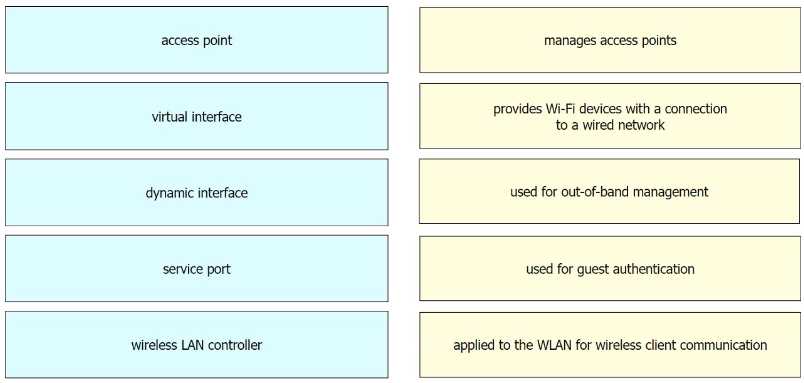
I’d say A is standalone AP because it’s focused on a single device, no extra links. C is the client since it’s separate, so that leaves B as just a regular AP, and D definitely managing the group.
I think B is the standalone AP because it’s just a single device without any links, which matches the idea of it working independently. D clearly shows connections to multiple APs, so that has to be the controller managing everything centrally. C being the client device makes sense since it’s separate from the APs and controller. That leaves A as the standalone AP label. This setup fits the connections shown and the typical roles in WLAN architecture.
B looks like it's just one AP without any connections, so standalone AP fits best. D clearly links multiple APs, so it has to be the controller managing them all.
Looks like B is the access point since it’s isolated, and D must be the controller because it connects multiple APs. C is definitely the client device, so A should be the standalone AP.
I’d say B is definitely a standalone AP since it’s shown as a single unit without any central connection lines. D looks like the controller managing multiple APs, so that fits the role better.
I’m thinking C is the client device here since the details talk about end-user access. That leaves A and D for AP and controller roles, with D clearly handling multiple APs, so it fits better for central management.
I agree with dropping B; it’s more of a controller function, not a single AP.
B can’t be right since the description talks about managing multiple APs, which fits D way better. Also, A’s more about standalone APs, so it doesn’t match the centralized control part.
I ruled out A because the description mentions centralized control, which doesn’t fit that option. C seems off since it’s more about the client’s role, not the infrastructure piece described. D matches better since it talks about managing multiple APs, which fits the component details given.
Skipping B, it’s a common trap since it looks right but doesn’t fit the details here.