Free Cisco CCNA 200-301 Actual Exam Questions - Question 11 Discussion
DRAG DROP Drag and drop the 802.11 wireless standards from the left onto the matching statements on the right 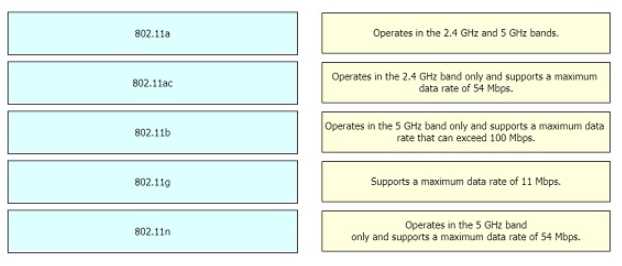
802.11n was the first with MIMO and dual-band, so it fits that statement best.
I think looking at the release timeline helps separate these more clearly. 802.11a and 802.11g came out earlier, so they match the older, slower descriptions. Then 802.11n introduced dual-band and MIMO, so it fits where those features are mentioned. 802.11ac is the newest one with the highest speeds and only works on 5 GHz, which helps put it in the last spot. Using a mix of frequency band, max speed, and MIMO support seems like a solid way to drag and drop these correctly without overcomplicating it.
I also used the max speed to differentiate, since 802.11ac has way higher throughput than 802.11a despite both being 5 GHz. So, matching 802.11ac with the highest speed statement made sense to me.
I focused mostly on the modulation type and the introduction of MIMO tech to sort these out. For instance, 802.11n was the first to really push MIMO and work across both 2.4 and 5 GHz, so I placed it where those features mattered. Also, noticing that 802.11ac improved max throughput significantly and used only 5 GHz helped me nail its spot without overthinking channel widths or year. This way, I avoided mixing up standards that share frequencies but differ in tech improvements, which seemed less error-prone than just comparing speeds or release dates alone.
I looked at the frequency bands and max throughput mainly. Since 802.11a and 802.11ac both use 5 GHz but have quite different speeds, that helped distinguish them quickly. Also, 802.11g is only 2.4 GHz with moderate speed, so it fits well with the lower-speed options. Ignoring channel width made it less confusing in my case, just focusing on whether it’s legacy or newer based on speed and band worked out fine.
I matched based on max speed and year released, that helped separate newer 802.11ac/n from older ones.
I went with frequency bands first to rule out standards that don’t use 5 GHz, then matched speeds. Seems simpler that way instead of juggling all features at once.
I’d say focus on max speed and frequency bands to match, ignoring extras like MIMO.
I think another way to confirm is by recalling which standards support 5 GHz bands. The newer ones like 802.11n and ac definitely do, fitting with the faster speeds and MIMO tech in B and D. The older ones, a and b, mostly stick to 2.4 GHz and slower max rates. So matching based on frequency band support could help reinforce the grouping—A and C align with 2.4 GHz legacy tech, while B and D align with more modern dual-band or 5 GHz capabilities. That frequency aspect seems like a solid secondary check to make sure we’re placing them right.
A and C are legacy standards, so they match older, slower statements.
I agree B and D fit well. Another way to look at it: A and C are older standards focused on lower speeds and 2.4 GHz band primarily, while B and D cover faster speeds and newer tech like MIMO. That helps narrow which goes where since the statements mention speed and frequency specifics.
B and D fit best.