Free Cisco CCNA 200-301 Actual Exam Questions - Question 1 Discussion
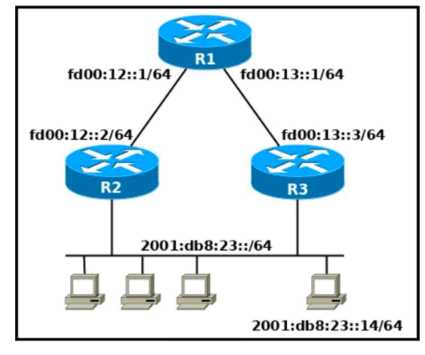
Refer to the exhibit. Which two commands, when configured on router R1. fulfill these
requirements? (Choose two.) ' Packets toward the entire network 2001:db8:23: :/64 must be
forwarded through router R2. ' Packets toward host 2001: db8:23::14 preferably must be forwarded
through R3.
E and B, because E covers the whole /64 and B targets the specific host.
This one’s pretty straightforward if you look at the prefixes. The entire /64 network 2001:db8:23::/64 needs to go to R2, so E fits perfectly for that. For the specific host 2001:db8:23::14, a /128 route makes sense to prefer R3, which is exactly what B does. The other options either use wrong masks or point to the wrong next-hop. So I’d choose E and B based on the prefix lengths and the next-hop logic.
E matches the requirement for routing the entire /64 network via R2, and B correctly sets a host route with /128 to R3, making it prefer that path for 2001:db8:23::14 specifically.
Makes sense to me that E covers the whole subnet to R2, and B pins the host route to R3 for preference. Using /128 in B ensures just that one host is routed differently from the broader network. So, E and B.
It’s E for sure to route the whole 2001:db8:23::/64 network via R2, since that covers the entire subnet as required. Then B fits for the host-specific route because it targets a single IP with /128 mask through R3, which matches the requirement of preferring R3 for that host. The others either have weird masks or point to the wrong next-hop. So E and B together make sense without overlap or confusion.
E imo for sending all packets to 2001:db8:23::/64 via R2, and B tbh makes sense for specifying the host 2001:db8:23::14 to go through R3. Options seem to fit those tasks best.