Free Cisco 400-007 Actual Exam Questions - Question 8 Discussion
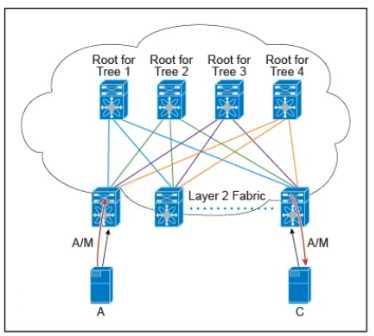
There are multiple trees in the Cisco FabricPath All switches in the Layer 2 fabric share the same view
of each tree. Which two concepts describe how the multicast traffic is load-balanced across this
topology? (Choose two )
It’s definitely not B since all trees won’t be equally used at all times—traffic depends on group membership and sources. Also, C seems off because leaf nodes don’t assign (S.G) to the same tree everywhere; the fabric does hashing to spread groups across different trees. So, A is good because each (S.G) sticks to one tree to maintain order, and E fits since overall multicast traffic balances over all trees for efficiency.
I’m with A and E here. Each (S.G) group sticks to one tree for packet order, so no load-balancing on that level, but overall multicast traffic still spreads across all trees.
A/D? I think A is right because each (S.G) keeps to a single tree to avoid duplication or out-of-order packets. D also makes sense since the overall multicast traffic gets spread across all trees, improving link utilization. B and E seem too broad or vague, and C feels off because not every leaf assigns the same tree consistently—it’s more about consistent assignment per (S.G), not per leaf node. So A and D fit the load balancing and traffic consistency better here.
A/E? Since each (S.G) stays on one tree to keep order, A makes sense. But overall multicast load does spread across all trees, so E fits too. C feels too specific and less likely.
A/E? Since each (S.G) group sticks to one tree to avoid out-of-order issues, A fits. But overall multicast load spreads across trees, so E also makes sense here.
E imo, because FabricPath generally spreads multicast traffic over all trees to balance load. A doesn’t fit since (S.G) traffic usually sticks to one tree, not ignored for load-balancing.
C imo, since each leaf picks one tree for specific (S.G), ensuring consistent path.
C imo, since each leaf picks one tree for specific (S.G), matching A’s idea too.
A imo, since one (S.G) group sticks to a single tree, so no per-flow load balancing. E also fits because overall multicast traffic uses multiple trees, spreading the load across the fabric.
B imo, because traffic rates won’t be equal on all trees; some links carry more load. Also, D makes sense since specific (S.G) traffic benefits from better link utilization by using particular trees.
This feels like A and E too. A because each (S.G) stream sticks to one tree, and E since overall multicast traffic is balanced across multiple trees. C sounds too strict about leaf node assignments.
A/E? A makes sense because individual (S.G) flows don’t get split, while E fits since multicast traffic as a whole is balanced across multiple trees for efficiency. C seems too rigid.
It’s A and E. Since a specific (S.G) isn’t load-balanced itself, but multicast traffic as a whole is spread across trees, that fits these options best. C is close but not fully accurate about assignment consistency.
Option C makes sense since each leaf picks a tree for the (S.G) to avoid loops, and option E fits because overall multicast traffic does get spread across multiple trees for load balancing.
This one’s tricky but I’m going with C and E. Each leaf picks a tree for a specific (S.G), so that flow stays consistent per leaf, which fits C. But overall, multicast traffic spreads across different trees, so it balances load network-wide, which makes E fit too. D seems off since it implies a single (S.G) spreads across trees, but the consistency per leaf rules that out.
C/E? Each leaf picks a tree for (S.G), so it’s consistent per leaf, but overall traffic spreads across trees for better balancing.
E and D imo