Free Cisco 350-801 Actual Exam Questions
Dumps Box (DumpsBox) offers up-to-date practice exam questions for 350-801 certification exam which are developed and validated by Cisco subject domain experts certified in Cisco 350-801 . These practice questions are update regularly as we keep an eye on any recent changes in 350-801 syllabus, and when there is update our team quickly adjusts the questions. This commitment to providing the best quality exam prep material to certification aspirants is what makes DumpsBox.com the best certification exam prep website. On top of that, our strong, yet strictly moderated, community based feedback keeps the content clean and current. Each question has helpful community discussion that provides it extra perspective and introduces helpful resources for better exam preparation. This also saves students from other outdated practice questions or illicit exam dumps that can have adverse affects on career. Browse through our Cisco 350-801 exam questions and pass your exam on first try.
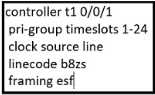
Refer to the exhibit. An administrator must replace the T1 card with an E1 card. What is the correct
configuration if the administrator was asked to configure 12 time slots?
C/D? The question’s about configuring 12 time slots on an E1 card replacing a T1. E1 has 32 time slots, but only 30 are for voice, so the config must reflect that difference. Options showing configs with the right timeslots allocated (like 12 out of 30) make more sense. A and B might be T1-focused or use wrong slot counts. D looks like it matches E1 and the needed 12 channels better, but C could be close if it shows correct timeslot usage. Gotta pick the one that correctly maps the 12 timeslots on an E1 interface.
It’s B for me. Translation patterns do more than just match numbers; once matched, they send the call to a specific destination, which is their main job. C talks about CDR updates, but that’s more of a side effect rather than a defining characteristic. A is off because translation patterns primarily work with the called number, not the calling party number. D is definitely wrong since translation patterns usually require partitions to control access. So, B fits best as it highlights the key behavior after matching a translation pattern.
internal IVR of the help desk. IT support has been given Cisco UCM traces and below is the snippet of
the SDP of the INVITE packet.
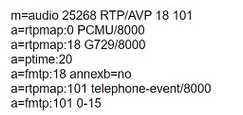
How is this issue resolved?
B/D? The issue looks like a DTMF signaling problem, so either KPML or RFC 2833 makes sense. Since KPML is less common for IVR DTMF, D could be the safer bet here.
D imo, the inability to select IVR options usually means missing RFC 2833 DTMF settings.
P-187
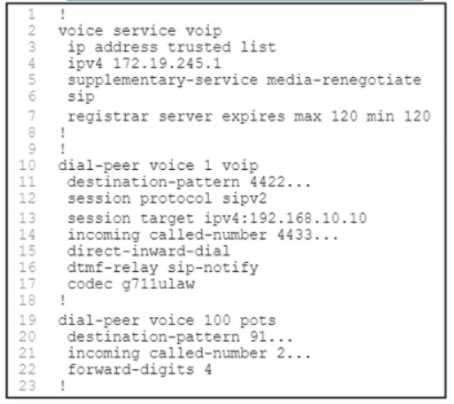
Refer to the exhibit. An engineer must implement toll fraud prevention on a Cisco UCM cluster. Only the SIP protocol
must be allowed for connections passing through Cisco Unified Border Element. What must be configured?
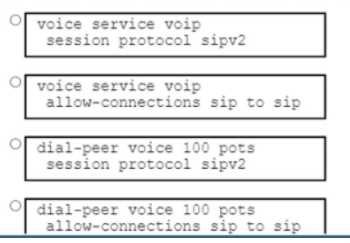
This one looks like D since configuring an inbound SIP ACL on the CUBE directly restricts protocols, matching the requirement to allow only SIP. It’s more precise than route groups here. D
It’s B for me too. Using standard local route groups is the straightforward way to keep the same route pattern but send calls out through the local gateway at each site. That way, the system automatically picks the right gateway based on the device’s location without messing with CSS or transforms. Options A and D seem more complex than needed here, and C isn’t about routing patterns—it’s about gateway permissions, which doesn’t solve the main issue.
this forwarded call? (Choose two.)
A, C. Using a Forced Authorization Code (A) adds a barrier for international forwarding, and restricting Call Forward All CSS (C) directly limits international numbers in forwarded calls. Both tackle the problem from different angles.
Makes sense to block international patterns at the SIP trunk level, so B is solid. Plus, setting Call Forward All CSS to restrict international calls (C) directly targets forwarded calls, so I’d go with B and C.
UCM?
A vs C? Normalization usually means changing called number format before routing.
B. Toll fraud restriction in the IOS router offers a direct way to block unauthorized calls at the network edge, which is more effective than just route patterns inside UCM.
rate of 20 ms, and endpoint B supports packetization rate of 30 ms for G.711ulaw. Which two media
resources are allocated to normalize packetization rates through transrating? (Choose two.)
Maybe D makes more sense here since the question mentions the inactive custom panel on the MX800 itself. The In-Room Control Editor on the device’s web page should be where you tweak or remove those custom control panels directly. The CUCM phone config page usually handles general settings but not detailed custom panel stuff. So, if the panel’s not working and shows empty, the web editor on the MX800 is probably where to clean it up.
D imo, the In-Room Control Editor is designed exactly for custom panels on MX800.
configuration snippet configures the ISDN E1 PRI for this task?
E imo, since UPDATE can modify session parameters including DTMF settings, and C because PRACK ensures reliability of provisional responses that might carry DTMF negotiation info. NOTIFY feels less direct here.
It’s definitely not A or B since REGISTER and SUBSCRIBE don’t deal directly with session negotiation or media. Between C, D, and E, I think D can be ruled out because NOTIFY is mostly about event notifications rather than negotiating media parameters like DTMF. So C and E feel like the best fit—they’re both involved in session updates and provisional responses which are critical when troubleshooting DTMF negotiation in SIP INVITE flows.
error message "Cannot find your services automatically. Click advanced settings to set up manually "
Which action should the engineer take first?
Not B, since wrong credentials usually give a different error. The message points to service discovery issues, so checking the SRV record with option C makes more sense first.
D imo, the Unified Border Element handles secure traversal better for remote access, and pairing it with UCM and Video Communication Server fits the need without the Expressway complexity.
number of route patterns that are needed. Which route pattern enables the administrator to match
variable-length numbers?
It’s C, the exclamation mark lets you cover all number lengths after 9.011.
Maybe C. The exclamation mark (!) in Cisco route patterns is used to match variable-length digits, so it helps cover various international number lengths without needing multiple patterns. The asterisk (*) matches zero or more digits but can cause issues if the number length isn’t controlled well. The at sign (@) is for patterns defined by a dial plan, which isn’t as flexible here. The 9.011 part just strips the prefix but doesn’t handle variable length by itself. So for minimizing route patterns with various international numbers, 9.011! seems best.

Refer to the exhibit. Given this "debug isdn q921" output, what is the problem with the PRI?
Maybe D again. The question asks for letting video endpoints negotiate without interference, so it sounds like codec transparent on dial peers is exactly meant for that—passing the negotiation straight through. A and B don’t really fit since path-thru content sdp deals more with voice or signaling, and hardcoding codecs would restrict negotiation. C, transcoding, is the opposite of what you want if you’re trying to avoid interference. So D is the cleanest choice here.
This one seems straightforward since the goal is to let endpoints handle video negotiation themselves. D makes the most sense here-codec transparent on dial peers means CUBE won’t mess with codec handling. So, I’d go with D.
mailboxes must be configured when the Cisco Unity Connection server is configured. Which action
accomplishes this task?
I think syncing users via AXL (option C) is the way to go since it directly accesses Cisco UCM's user data, making mailbox configuration automatic during setup. AXL is usually used for this kind of integration. C
Maybe D fits best since syncing with Active Directory is a common way to manage users and their mailboxes in Unity Connection. It automates user creation instead of manual input. A and B are more about protocols and integration rather than user syncing, and C doesn’t directly handle mailbox setup—it’s about accessing UCM data but wouldn’t create voicemail boxes by itself. So, using AD sync seems like the more straightforward method here.
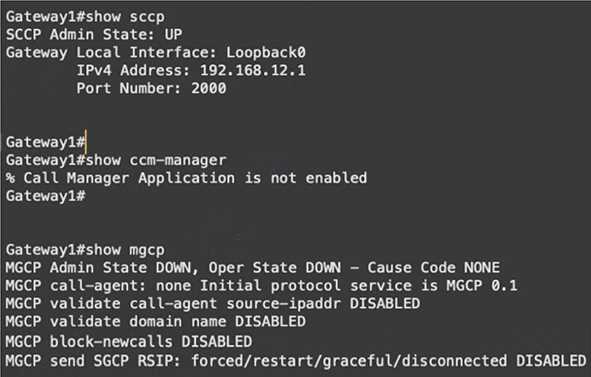
Refer to the exhibit. A collaboration engineer adds an analog gateway to a Cisco UCM cluster. The
engineer chooses MGCP over SCCP as the gateway protocol. Which two actions ensure that the
gateway registers? (Choose two.)
B/C? You need to enable MGCP with “mgcp” and tell the gateway to talk MGCP to the UCM with “ccm-manager mgcp.” D isn’t enough by itself to register.
I think C makes sense since the gateway needs to run MGCP mode. But what about D? Isn't "ccm-manager config" also required to get the gateway recognized by UCM?
It’s C for me. Balanced mode definitely handles both load balancing and failover automatically, which is a key feature. Active/standby gives you a hot standby ready to take over but doesn’t spread the user load across nodes. D’s incorrect because balanced mode does provide load balancing, not just failover. Also, active/standby isn’t just standby—it’s always on, so it can switch over instantly. This distinction fits how Cisco usually designs their HA setups for IM and Presence.
C/D? I’m stuck between C and D. C says balanced mode does both load balancing and failover, with active/standby just failover but no load balancing, which sounds right. But D seems plausible since it says balanced mode doesn’t do load balancing, only failover, which matches some setups where load balancing is done outside IM & Presence. The key difference is whether balanced mode actually shares the user load or not. I’m guessing Cisco’s docs lean towards balanced mode doing both, so maybe C is the better fit here.
and InformRequests) from several network devices in the Collaboration infrastructure for which it
has requested notifications?
Since traps and inform requests are sent to the manager, not from it, UDP162 (C) fits as the receiving port. UDP161 is for sending queries, so options A and B seem off. Could TCP be involved here at all?
Traps are usually sent over UDP and port 162 is the default for SNMP traps, so I’d go with C here. It fits the standard network management setup better than the others.
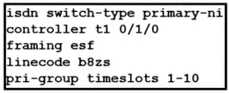
Refer to the exhibit. An engineer configures ISDN on a voice gateway. The provider confirms that the
PRI is configured with 10 channels the engineer ordered and is working from the provider side, but
the engineer cannot get a B-channel to carry voice. The rest of the configuration for the serial
interface and voice network is functioning correctly. Which actions must be taken to carry voice?
C. The pri-group timeslots probably should be 0-9 for the 10 channels since router interfaces typically start counting from zero. If the engineer used 1-10, that might be why no B-channel is active. It’s a common gotcha with PRI configs on Cisco gear. The other options don’t really fit because the controller card is usually active by default, it’s a T1 interface so E1 isn’t relevant here, and manually reversing channels isn’t standard practice. Adjusting the timeslot range to 0-9 should fix it.
The INVITE definitely kicks off the call, then 200 OK confirms User 2 answered, followed by ACK to finalize the setup. BYE should be last for User 2 disconnecting. This matches standard SIP flow.