Free Cisco 350-501 SPCOR Actual Exam Questions
Dumps Box (DumpsBox) offers up-to-date practice exam questions for SPCOR 350-501 certification exam which are developed and validated by Cisco subject domain experts certified in Cisco 350-501 SPCOR . These practice questions are update regularly as we keep an eye on any recent changes in SPCOR 350-501 syllabus, and when there is update our team quickly adjusts the questions. This commitment to providing the best quality exam prep material to certification aspirants is what makes DumpsBox.com the best certification exam prep website. On top of that, our strong, yet strictly moderated, community based feedback keeps the content clean and current. Each question has helpful community discussion that provides it extra perspective and introduces helpful resources for better exam preparation. This also saves students from other outdated practice questions or illicit exam dumps that can have adverse affects on career. Browse through our Cisco 350-501 SPCOR exam questions and pass your exam on first try.
Egress PE NAT is being used via a single centralized router to provide Internet access to L3VPN customers. Which description of the NAT operation is true?
B imo, since the NAT table has to keep track of which VRF the translation belongs to, even if not explicitly shown, it’s how the router handles multiple overlapping customers. That’s why A and D are off.
A - Different VRFs can share the same outside IP since NAT isolates them.
C and D can be ruled out since UDP and BGP don’t handle the control plane in this context. But could OTCP be a trick option? Not sure it’s ever used here.
This one’s definitely B. OMP is Cisco’s Overlay Management Protocol used for the control plane in SD-WAN, specifically between routers and vSmart controllers. A and D don’t fit here—OTCP isn’t related, and BGP isn’t the main control plane protocol in Cisco SD-WAN. C is just a transport type, not a control protocol. So B makes the most sense given how Cisco’s SD-WAN architecture works.
no packet loss issues when IGP and LDP protocols are not synchronized. Which configuring must the
engineer implement so that the IGP routing protocol will wait until LDP convergence is completed?
B/D? D suggests disabling synchronization, which seems the opposite of what's needed here. B fits best since it explicitly tells the IGP to wait for LDP convergence, avoiding packet loss.
I’m thinking about this a bit differently: option A talks about disabling CEF and enabling LDP, but wouldn’t disabling CEF cause forwarding issues or performance drops? That seems counterproductive. Option C handles LDP session protection, which is more about recovery rather than synchronization or waiting mechanisms. It’s really between B and D, but since D disables sync, it’s likely not what we want. So, if the goal is to have IGP wait for LDP, enabling synchronization as in B makes more sense. Still, anyone else see a use case for A here?
Refer to the exhibit: 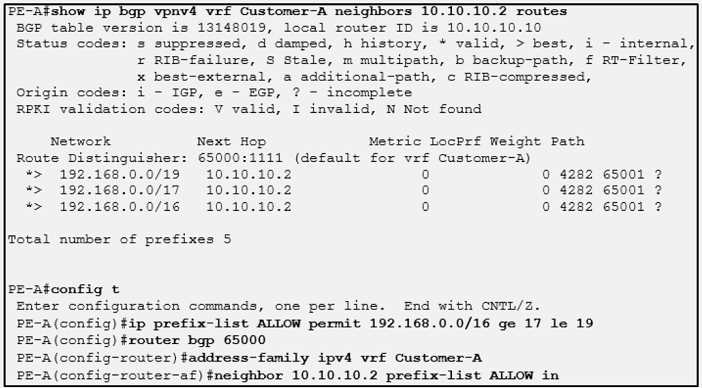 Which three outcomes occur if the prefix list is added to the neighbor? (Choose three)
B/D/F? Denying 192.168.0.0/17 and 192.168.0.0/16 makes sense to block bigger ranges, while permitting 192.168.0.0/19 fits allowing more specific smaller blocks like in F.
Maybe B, D, and F since denying /17 but also /16 seems consistent with prefix filters blocking larger blocks too.
Refer to the exhibit. 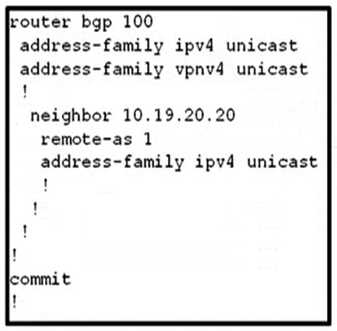 An engineer is trying to implement BGP configuration on a router Which configuration error prevents the ASBR from establishing a BGP neighborship to a directly connected BGP speaker?
B/C? The VPNv4 family (C) shouldn't really cause a session to fail unless there's some misconfiguration with route targets or something else. But having the IPv4 address family directly under neighbor config in IOS XR can indeed cause issues if the syntax isn't supported or needed, so B seems like a more straightforward reason for failure here. Also, D is out since TCP params are usually defaulted and A seems unrelated to the direct neighborship issue. So between B and C, B feels like the more plausible blocker for establishing the session.
Makes sense, the extra IPv4 family config under neighbor should be removed for eBGP on IOS XR B.
Refer to the exihibit. 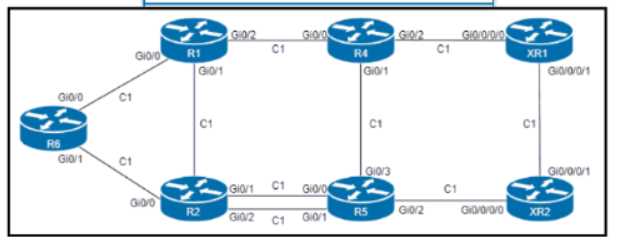 Refer to the exhibit. An engineer configured R6 as the headend LSR of an RSVP-TE LSP to router XR2, with the dynamic path signaled as R6-R2-R5-XR2. and set the OSPF cost of all links to 1. MPLS autotunnel backup Is enabled on all routers to protect the LSP. Which two NNHOP backup tunnels should the engineer use to complete the implementation? (Choose two.)
I think it should be A and B. B obviously backs up the R2-R5 link directly, which is crucial. A provides a valid alternate path from R6 that avoids the primary path and covers the backup for R6 well. C seems too long and passes through extra routers which might not be necessary or efficient for a backup tunnel here. D and E include parts of the primary path, so they don’t really qualify as backups. So A and B fit the criteria better as proper NNHOP backup tunnels.
B and C make sense since B protects the R2-R5 link, and C offers an alternate route to XR2.
Refer to the exhibit. 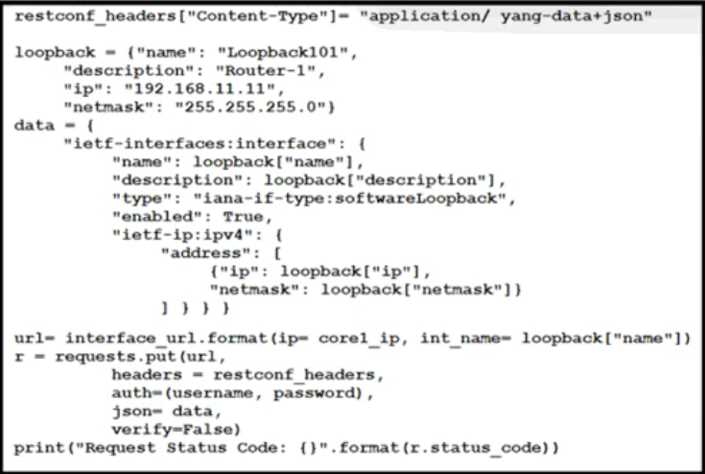 An engineer at a new ISP must configure many Cisco devices in the data center. To make the process more efficient, the engineer decides to automate the task with a REST API. Which action does this JSON script automate?
Maybe A. The JSON seems focused on setting an IP for loopback0 without mentioning creating or deleting interfaces, so it likely updates the existing loopback interface’s IP address.
A imo, the JSON only shows updating an existing loopback interface's IP, not creating or deleting any interfaces. The focus seems to be on configuring loopback rather than physical interfaces.
Refer to the exhibit. After a networking team configured this MPLS topology, the supervisor wants to view MPLS labels to verify the path that packets take from router R1 to router R7 The team already Issued an ICMP ping to verify connectivity between the devices. Which task must the team perform to allow the supervisor to view the label switch path? 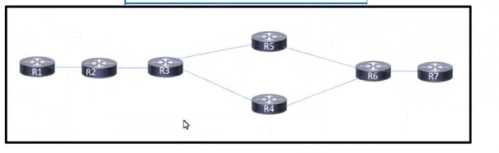
B imo, MPLS LDP is what actually assigns the labels, so without it, there wouldn’t be any labels to display. The team needs to make sure LDP is running to see the label info.
D imo, MPLS OAM is designed for monitoring and troubleshooting, so it makes sense that it can display the label info for each hop. The other choices are more about label distribution or setup, not viewing paths.
Which feature describes the adjacency SID?
Guessing C since adjacency SIDs are typically local to a node, not global.
It’s A because adjacency SIDs are specific to point-to-point links.
Refer to the exhibit. 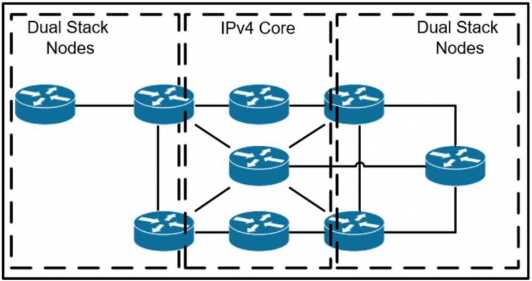 A network operator has two IPv4 and IPv6 dual-stacked network on each side of the IPv4 core network. The operator must be able to provide connectivity between them while using specific assigned IPv6 space provided from the company IP administrator team. Which technology should the network operator use to accomplish this goal?
A imo, since 6rd helps tunnel IPv6 over IPv4 preserving assigned IPv6 space.
Option B, NAT46 translates IPv6 to IPv4, matching the dual-stack to IPv4 core setup.
Refer to the exhibits: 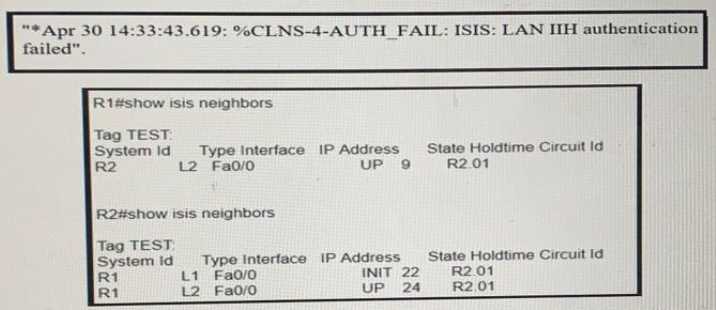 R1 and R2 are directly connected and IS-IS routing has been enabled between R1 and R2 R1 message periodically Based on this output, which statement is true?
Actually, I think D makes more sense here. The messages point out failures specifically for Level 2 PDUs only, and there’s no clear evidence of Level 1 authentication failing. If both levels were failing, we’d expect the log to mention Level 1 too, but it’s silent on that. So the issue seems isolated to Level 2 neighbors, not both or just Level 1. This fits better with the error output shown, where the authentication problem is only flagged for Level 2 PDUs.
Guessing A here because the message specifically points out Level 2 failing first and then Level 1. That sequence seems important and rules out B since it implies simultaneous failure for both levels. Also, C and D focus on one level only, so they don’t line up with the message showing a clear order of failures. The key detail is that Level 2 fails before Level 1, so A fits best with that observation.
Which statement describes the advantage of a Multi-Layer control plane?
A/D? I’m going with D here because multi-layer control planes often enable unified configuration across different vendor devices, which is a big deal for interoperability between Layer 1 and 3. A mentions Layer 0 to 3, but automatic provisioning of monitors feels more like a feature, not the main advantage. Managing multivendor environments seems more central to the benefit of multi-layer control planes than just traffic management across layers.
A/D? A seems like the most comprehensive since multi-layer control planes are about managing traffic across multiple layers, not just 1 or 3. D mentions multivendor capabilities between Layer 3 and 1 but leaves out Layer 0, which is important for optical layers. C is too narrow focusing only on Layer 0, and B is more about automation benefits in general, not specific to multi-layer control planes. So A feels like the best fit because it highlights end-to-end provisioning and traffic management across those layers.
DRAG DROP A network engineer is adding 10Gbps link to an existing 2X1Gbps LACP-based LAG to augment its capacity. Network standards require a bundle interface to be take out of service if one of its member links does down, and the new link must be added with minimal impact to the production network. Drag and drop the tasks that the engineer must perform from the left into the sequence on the right. Not all options are used. 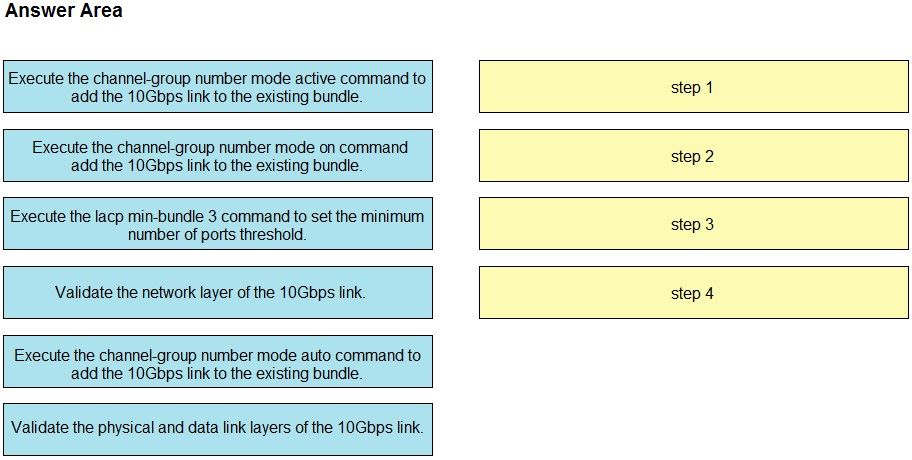
Make sure to disable the whole bundle before adding the new 10Gbps link to avoid network loops.
I think before disabling the bundle, you should definitely test the new 10Gbps link as a standalone interface to make sure it's stable and properly configured—that avoids surprises later. Then, shut down the bundle to prevent any traffic loss or flapping while adding the new link. Once it's added, bring the bundle back up with the new member included. Skipping the standalone check could cause bigger problems when you enable the bundle again. So testing first, then disabling, then adding, then enabling seems safest to me.
DRAG DROP Drag and drop the functions from the left onto the correct Path Computation Element Protocol roles on the right 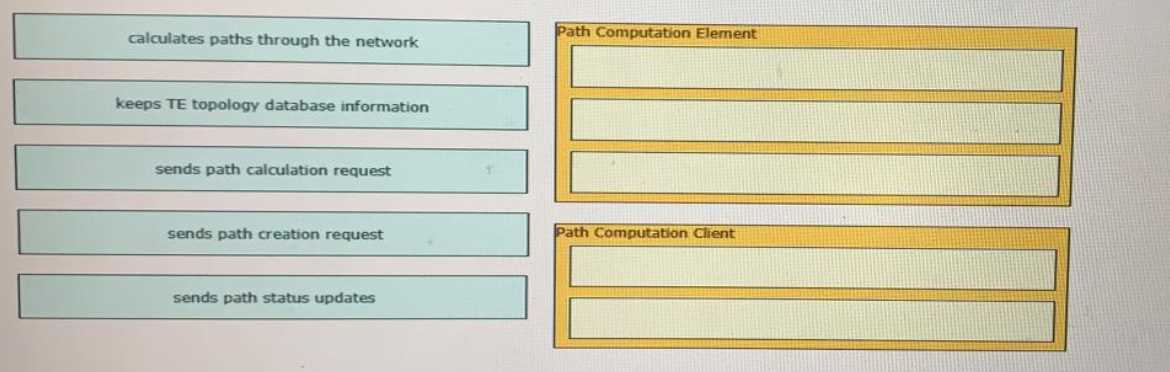
I can see why C is marked as Initiator since it deals with starting the path request. But looking closer, function A seems more about handling updates rather than just responding, so it might be more limited to Responder. B definitely fits Both because it involves message exchange between both roles. I’d say sticking C with Initiator, A with Responder, and B with Both makes the most sense based on what each function is responsible for in the protocol.
I think C makes the most sense as Initiator because it talks about setting up the initial path request. A fits Responder since it handles replies and updates. B seems like it covers both roles because it deals with message forwarding and error handling, which can happen on either side. So yeah, C for Initiator, A for Responder, and B as Both looks right to me too.
DRAG DROP Drag and drop the NAT64 descriptions from the left onto the correct NAT64 types on the right. 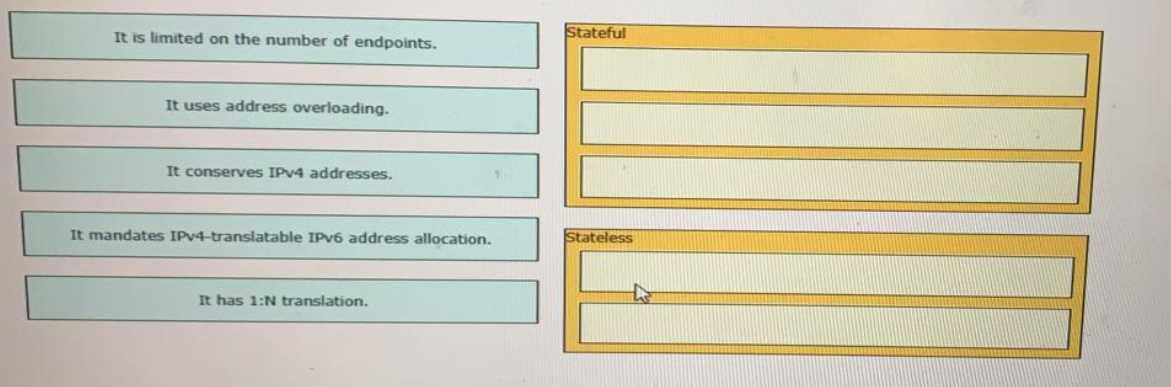
I’d rule out the stateless NAT64 for option C since it usually involves prefix translation without maintaining session state, which doesn’t quite fit the description given here.
C