Free Cisco CLCEI 300-820 Actual Exam Questions
Dumps Box (DumpsBox) offers up-to-date practice exam questions for CLCEI 300-820 certification exam which are developed and validated by Cisco subject domain experts certified in Cisco CLCEI 300-820 . These practice questions are update regularly as we keep an eye on any recent changes in CLCEI 300-820 syllabus, and when there is update our team quickly adjusts the questions. This commitment to providing the best quality exam prep material to certification aspirants is what makes DumpsBox.com the best certification exam prep website. On top of that, our strong, yet strictly moderated, community based feedback keeps the content clean and current. Each question has helpful community discussion that provides it extra perspective and introduces helpful resources for better exam preparation. This also saves students from other outdated practice questions or illicit exam dumps that can have adverse affects on career. Browse through our Cisco CLCEI 300-820 exam questions and pass your exam on first try.
It’s C, because NAT breaks direct IP reachability in SDP connection info.
C imo, NAT messes with IPs shown in SDP, making them unreachable outside the local network. The other options don’t really tie into NAT’s main problem with SIP SDP.
Probably D here. Cloud deployments usually have better infrastructure and less hardware delay, so they can be faster to set up and use than on-premises, especially if the on-premises system has limited resources. Plus, cloud updates and patches roll out quicker, improving performance overall.
Also, B is off because cloud services rarely come without additional costs. A is too broad and often depends more on how the system’s managed. C is about interoperability but that’s not strictly a benefit of cloud deployment alone—it can be true in other setups too.
A/B? Cost usually isn’t zero for cloud services, so B feels unlikely. A might be tempting, but “more secure” is vague and depends on setup. Interoperability in C still sounds more solid.
to pull directory photos from an internal server. What should be configured on the Expressway-C so
that MRA registered clients reach this server?
B imo, the HTTP allow list is key for Expressway-C to let those directory photo requests pass through. Certificates (D) are less relevant unless the server itself demands mutual TLS.
It’s B because without explicitly allowing the directory photo server on the HTTP allow list, Expressway-C won’t let those requests through, no matter the certs or zones.
anymore for an organization. There are several administrators and configuration changes could have
happened without anyone knowing. Internal communication seems to be working, but no external
system can register or call anywhere. Gathering symptoms, you also discover that no internal
systems can call out either.
What is TraversalZone missing that causes this issue?
Option B makes sense too, since pipes actually carry the media. Without that, even if signaling works, calls won’t complete properly between zones.
I thought about option A too, since a link connects zones logically. But if internal calls can’t go out, maybe the issue is more about how media flows rather than just the link. Could the problem be more with B or C?
on the internal network to the Internet?
A/D? I see A as handling media traversal which is critical when calls cross network boundaries, so it might be necessary alongside D. Both signaling and media need to be managed properly.
D sounds right since interworking handles SIP protocol issues for routing calls properly. D
separate firewalls on separate network segments?
It’s A. Using dual interfaces prevents any risk of traffic mixing across the firewalls, which could happen with just one interface even if VLANs are used. Keeps things clean and secure.
A, because two separate networks need distinct physical interfaces to avoid bridging.
diagnostic logs, an engineer found that the destination pattern is “[email protected]:5061”, and
the call was dropped with a 404 response code from Expressway-C. The search rule intended for this
call-in Expressway-C is configured for Alias Pattern Match, Pattern type “Suffix,” and Pattern
“example.com”. How must the configuration be changed to allow the call?
Makes sense that the port is the issue here, since the suffix match won’t recognize "example.com:5061" as just "example.com". So, I’d pick B to create a transform on Expressway-C to strip the port number before matching. That way, the call gets routed correctly without changing UCM settings or policies.
B for sure, Expressway-C can’t match suffix with port included.
Which dial plan settings can be used to set up different regulations according to the protocol (SIP or H.323) or the source of the query?
A imo, since presearch transforms can adjust digits based on source or protocol before routing.
B tbh, because search rules are designed to match patterns based on different criteria like protocol or source, so you can effectively set regulations according to those parameters. Call policy (C) seems more about permission and blocking rather than shaping call routing based on query source or protocol. Policy services (D) sound broader and less specific to dial plans. Presearch transforms (A) mainly deal with digit manipulation, but the question hints more towards applying different rules based on where the call comes from or which protocol it uses, which fits search rules better.
Remote Access solution?
It’s C because _collab-edge._tls is the standardized SRV record for MRA in public DNS, while D is more specific to Expressway internal setups, not always for the external DNS entry.
It’s D since _cisco-expwy._tls is also used for Cisco Expressway, which handles MRA traffic externally. C is common, but D fits well for external DNS SRV entries in many MRA setups too.
D/C? ICE definitely finds paths, but it uses STUN and TURN too, which relate to NAT traversal. SNMP doesn’t do this, so D still seems best, but the involvement of other protocols makes me double-check.
D imo, ICE works by gathering candidate addresses and checking connectivity, which is key for endpoints behind NATs to find usable paths. The others don’t handle path discovery, so they’re not really relevant here.
C imo, usually both CLI and GUI offer backup options for flexibility. If one was limited, it’d probably say so explicitly. So having both seems the safest bet here.
B/D? I think scheduling backups via CLI (B) makes sense since command line tools often handle tasks like that, but some GUIs offer scheduling too (D). Not sure if both are allowed though.
Yeah, I think A fits since Core can run on private certs, and E makes sense because Jabber’s flexible with cert types. D feels too strict about Edge always needing public certs. So A and E for me.
B imo, because phones generally don't need manual root cert uploads—they rely on built-in trust stores. And D makes sense since Expressway Edge usually requires a public CA cert to avoid trust issues from external clients. That combination fits common deployment practices better than some of the other options.
B, 4096 is overkill for most Cisco Expressway deployments, Cisco usually sticks with 2048.
Option B, because 2048 bits balance security and performance well for most Cisco setups.
323 communication? (Choose two)
B/D? B uses _sips_tcp which fits secure SIP over TCP, and D is the typical UDP SRV for H323 signaling. A is definitely off topic since _collab-edge isn’t standard for these protocols. C is valid but less common than D for H323, so D feels safer. E could work but usually _sips goes with TCP rather than UDP, so B is a better pick here if we want two distinct protocols covered well.
C, D; H323 usually uses _h323ls over TCP or UDP, and UDP is common for signaling.
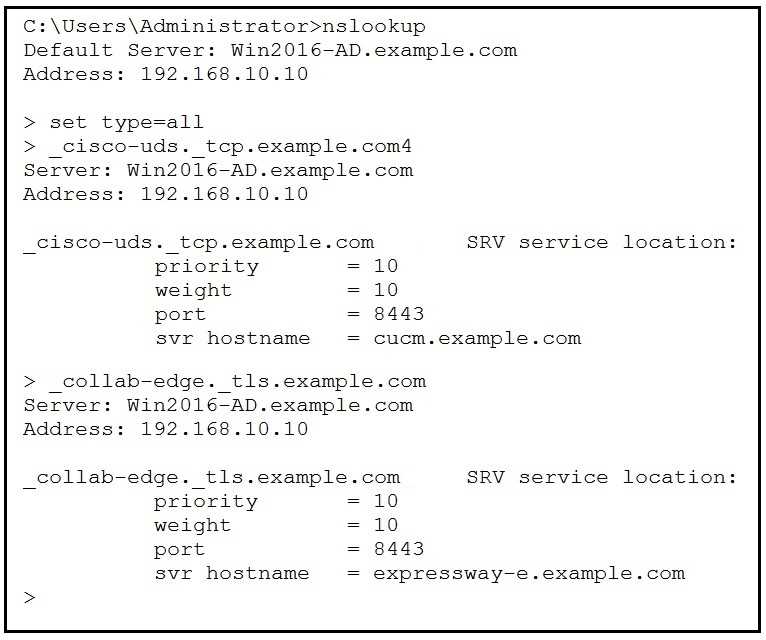
When a Jabber user attempts to connect from outside of the organization, the user enters the login
information as "[email protected]" and receives the error "Cannot find your services
Automatically". The engineer tries to resolve SRV records used by Jabber.
DNS A record "expressway-e.example.com" points to the Expressway-E IP and "cucm.example.com"
points to the Cisco Unified Communications Manager.
Which change resolves the DNS problem?
Changing the priority (D) won’t fix the root cause since the issue is about external DNS exposure. The main problem is the internal-only cisco-uds record showing up externally, so removing it (C) is cleaner.
Option C makes sense; cisco-uds SRV is internal and shouldn’t be on external DNS.