Free Cisco 300-815 Actual Exam Questions | CLACCM Actual Exam Questions - Question 8 Discussion
Refer to the exhibit. 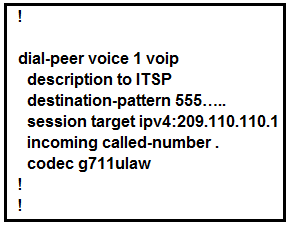 An engineer configures Cisco Unified Border Element to connect the enterprise VoIP network with a SIP telephony provider. Calls are not working in either direction. What must be configured in the dial peer 1 to fix the issue?
D imo, because without the incoming called number configured, the router can’t properly match inbound calls to the dial peer. That would definitely cause calls not to work both ways. The other options feel less likely since codec mismatches usually still allow signaling, and the session protocol looks fine already from the exhibit. So the missing piece is matching the incoming called number for the dial peer.
I’m thinking it’s D this time. If the incoming called number isn’t set correctly on dial peer 1, the router might not know to match inbound calls properly, which would break calls both ways. The other options seem more related to codec or protocol settings, but a missing or wrong incoming called number would definitely stop calls from routing. So, D.
B imo, codec mismatch often breaks calls both ways.
Good point about SIP versions; I think C is right since the session protocol must match. C
Maybe C fits here since dial peers need the right session protocol to match the provider, and if it's set wrong, calls won't go through at all. The exhibit might hint that SIPv2 is required.
It’s A because the answer-address directs where calls go, fixing routing issues for both ways.
Option C feels off since Cisco UBE uses SIP by default. Can someone confirm if the dial peer needs a specific session-protocol for this provider, or if the problem is actually with the called number or codec settings?