Free Cisco 300-415 Actual Exam Questions
Dumps Box (DumpsBox) offers up-to-date practice exam questions for 300-415 certification exam which are developed and validated by Cisco subject domain experts certified in Cisco 300-415 . These practice questions are update regularly as we keep an eye on any recent changes in 300-415 syllabus, and when there is update our team quickly adjusts the questions. This commitment to providing the best quality exam prep material to certification aspirants is what makes DumpsBox.com the best certification exam prep website. On top of that, our strong, yet strictly moderated, community based feedback keeps the content clean and current. Each question has helpful community discussion that provides it extra perspective and introduces helpful resources for better exam preparation. This also saves students from other outdated practice questions or illicit exam dumps that can have adverse affects on career. Browse through our Cisco 300-415 exam questions and pass your exam on first try.
Drag and drop the steps from the left Into the order on the right to delete a software image for a
WAN Edge router starting with Maintenance > Software Upgrade > Device list on vManage.
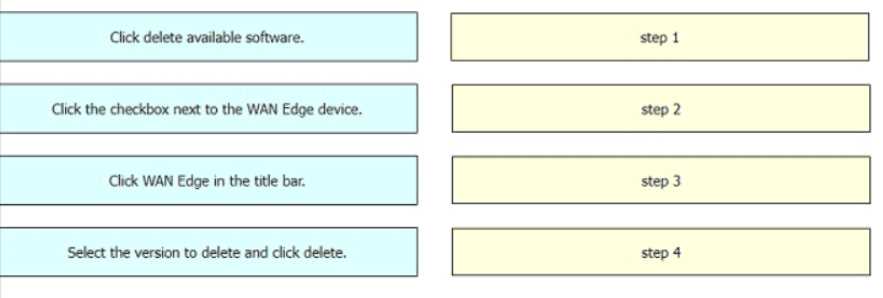
You can rule out any steps before Maintenance since question starts there. Also, deleting an image definitely needs the Software Images tab after selecting the device list, so the order should be Maintenance > Device list > Software Images > Delete > Confirm.
Definitely need Software Images tab after Device list, then confirm delete prompt last.
toward a network service such as a firewall or IPS?
C, since vSmart is responsible for policy distribution and can enforce traffic redirection rules.
Maybe B since WAN Edge enforces and redirects traffic directly at branches.
Edge design?
A)
B)
C)
D)
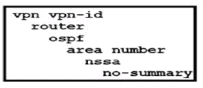
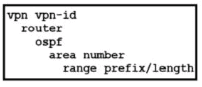
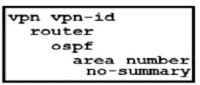
B/D? B raises the cost on the WAN interface itself, which directly impacts OSPF path preference by making that exit less attractive. D also looks similar but might be messing with routing preferences in a broader way, maybe more global than just interface cost. Since the question focuses on making one exit less preferred, the interface-specific cost tweak in B makes more sense here. The other options seem less targeted for this exact purpose.
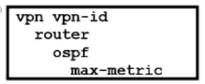
B/C? B changes the OSPF cost on the interface itself, which directly affects route preference. C looks close too but might be more about overall router priority, not just exit path preference.
updated and advanced signature-based antivirus with sandboxing and threat intelligence to stop
malicious attachments before they reach users and get executed. Which Cisco SD-WAN solution
meets the requirements?
C, since it covers sandboxing, exploit protection, and advanced antivirus together.
It’s C because it directly combines sandboxing with advanced antivirus and threat intel.
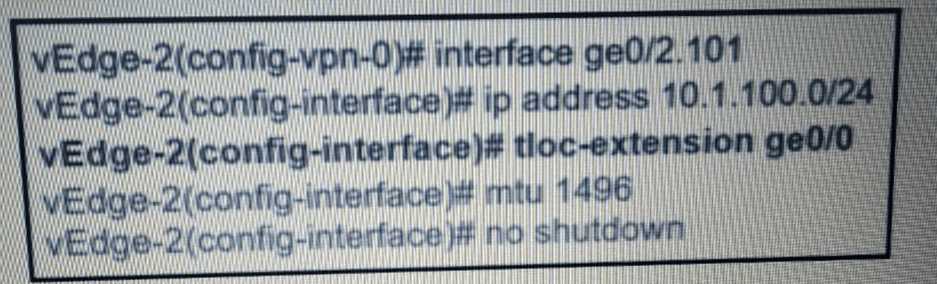
What binding is created using the tloc-extension command?
Isn’t tloc-extension specifically for transport to transport links? That points to D.
Maybe C. The tloc-extension typically pairs a service interface with a transport one, so D’s transport-to-transport binding doesn’t fit the usual pattern. That rules out options A and D for me.
• policy name: App-police
• police rate: 1000000
• burst: 1000000
• exceed: drop
Which configuration meets the requirements?
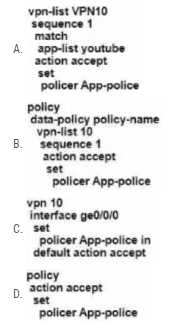
C/D? Option C matches the rate and burst closely, but D explicitly states drop on exceed, which is key here. The question wants "exceed: drop," so D might be safer.
Maybe D fits better here because it uses the exact police rate and burst values in bits per second, as required. Also, it clearly specifies the drop action for exceeding the rate, which matches the policy description. The other options seem to either have different burst sizes or don’t explicitly set the exceed action to drop. The naming also aligns perfectly with the policy name given.
single VPN be part of?
Makes sense that it’s C since zones are meant for clear traffic policies, and allowing one VPN in multiple zones would complicate things. So, sticking with one zone per VPN seems right. C
C. From what I remember, each VPN interface can only belong to a single zone because zones are designed to segment and control traffic cleanly. If a VPN was in multiple zones, it would mess up the firewall’s ability to enforce consistent policies. Makes sense to keep it simple with one zone per VPN for clarity and security.
Maybe A, since when OMP preferences tie, the TLOC preference acts as the next deciding factor, and I remember higher TLOC preference usually gets selected.
D imo, since the question only says OMP route preference values are equal, the next logical step would be comparing TLOC preferences. Lower TLOC preference value usually wins when OMP prefs tie, which matches option D. The origin type being connected or static feels like a later tie-breaker, so B and C might come after checking TLOC values. If TLOC prefs differ, that should be the decisive factor here.
does the network architect extend the in-house Cisco SD-WAN branch to cloud network into AWS?
Guessing C here since GRE tunnels are a straightforward tech for linking branches directly to AWS without extra virtual devices or routers. It keeps things simple and flexible.
D imo since installing a cloud router in the main data center centralizes connectivity.
server for 251 to 1000 devices in software version 20.4.x?
A imo, 4 vCPUs with 16 GB RAM fits better for 251-1000 devices.
I’m ruling out D and C since 2 vCPUs or 8 vCPUs feel off for that device range. Between A and B, maybe RAM matters more than CPU here, so does 16 GB seem like the must-have for stability?
approach to network monitoring and configuration?
No doubt about it, vManage handles all the monitoring and config, so C.
Guessing C again since vManage is known to provide a unified view for managing and monitoring the SD-WAN environment, unlike vSmart or vBond which focus on control and orchestration tasks.
B vs C, I’d pick B since IGMP v1/v2 are more widely supported.
B/D? The vSmart controller usually pushes routes, so options where WAN Edge routers originate routes (A and D) seem less likely. Between B and C, the IGMP version difference stands out. Since IGMP v3 support might not be standard everywhere, B’s mention of v1 or v2 feels safer for a general question. So I’m picking B mainly because it fits the common flow and IGMP versions better than the other options.
Which configuration defines the groups of interest before creation of the access list or route map? A) 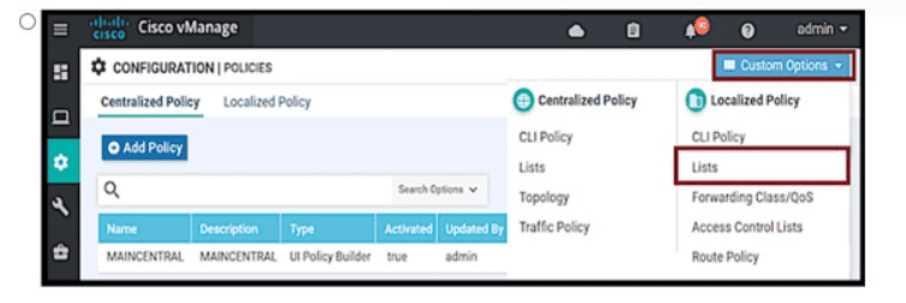 B)
B) 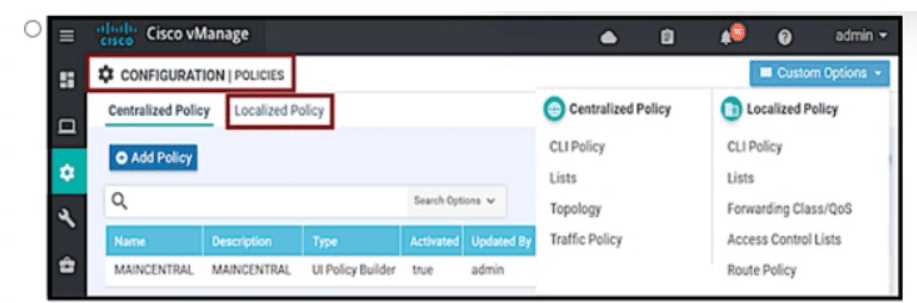 C)
C) 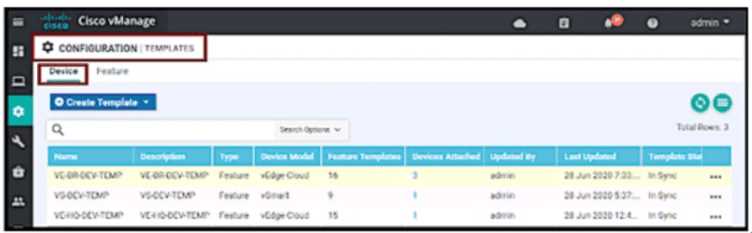 D)
D) 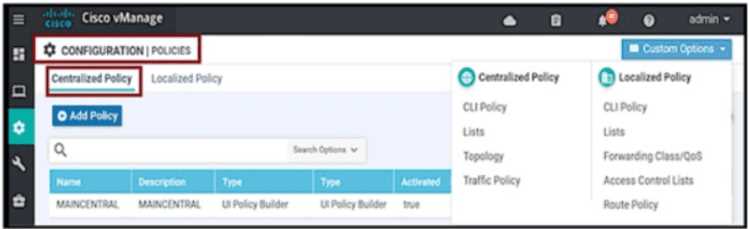
D feels right because it shows commands creating object groups directly, which is what you'd do before making ACLs or route maps. The others seem more like referencing or using groups already defined.
D imo, looks more like the actual definition of groups before any ACL or route map comes into play. B just seems like setting names or references, but D shows the config commands that create the groups from scratch. A and C look more like applying or modifying existing groups rather than defining them first. So D fits the “before creation” part better in my view.
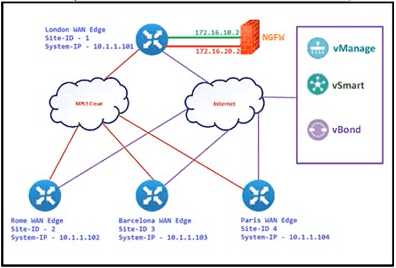
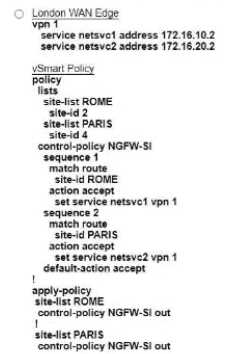
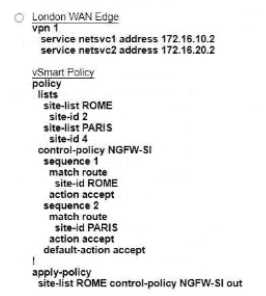
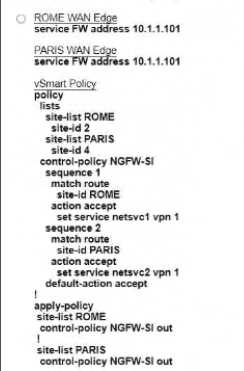
Refer to the exhibit. The Cisco SD-VYAN is deployed using the default topology. The engineer v/ants
to configure a service insertion policy such that all data traffic between Rome to Paris is forwarded
through the NGFW located in London. Which configuration fulfills this requirement, assuming that
the Sen/ice VPN ID is 1?
A)
B)
C)
D)
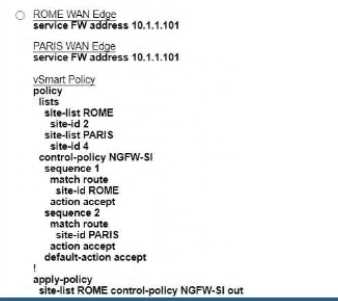
It’s B, because it clearly shows London NGFW tied to Service VPN 1 and matches Rome-Paris flow.
B vs D? B clearly specifies the service VPN ID 1 and sets the source and destination correctly for Rome to Paris, making sure traffic hits the NGFW in London. D looks close but I’m not sure if it fully ties the NGFW to Service VPN 1 as cleanly. Also, A and C don’t seem to specify the service VPN properly or miss linking the NGFW in London. So between B and D, B feels more aligned with the requirement to use Service VPN ID 1 explicitly.
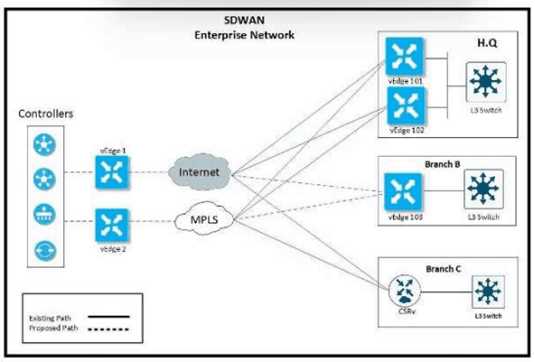
The network team must configure branch B WAN Edge device 103 to establish dynamic full-mesh
IPsec tunnels between all colors with branches over MPLS and Internet circuits. The branch ts
configured with:
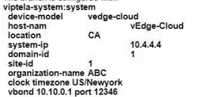
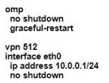
Which configuration meets the requirement?
A)
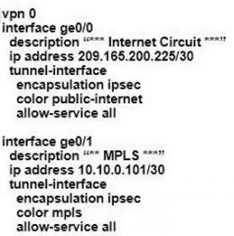
B)
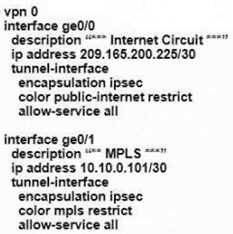
C)
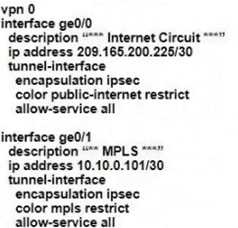
D)
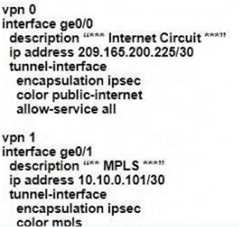
C imo, it looks cleaner with the proper peer definitions for all colors, while D seems a bit overcomplicated and might cause conflicts. Full mesh needs clear peers more than interface bindings.
B/C? Option B seems to list all the peers and interfaces needed for full mesh but doesn’t clearly show MPLS and Internet interface bindings like option D does. Option C looks incomplete with missing peer IPs, so it’s probably out. I’m not sure if just having all peers is enough without explicit interface bindings though — that might be critical if the question emphasizes transport paths.