Free AWS MLA-C01 Actual Exam Questions - Question 9 Discussion
HOTSPOT An ML engineer is working on an ML model to predict the prices of similarly sized homes. The model will base predictions on several features The ML engineer will use the following feature engineering techniques to estimate the prices of the homes: • Feature splitting • Logarithmic transformation • One-hot encoding • Standardized distribution Select the correct feature engineering techniques for the following list of features. Each feature engineering technique should be selected one time or not at all (Select three.) 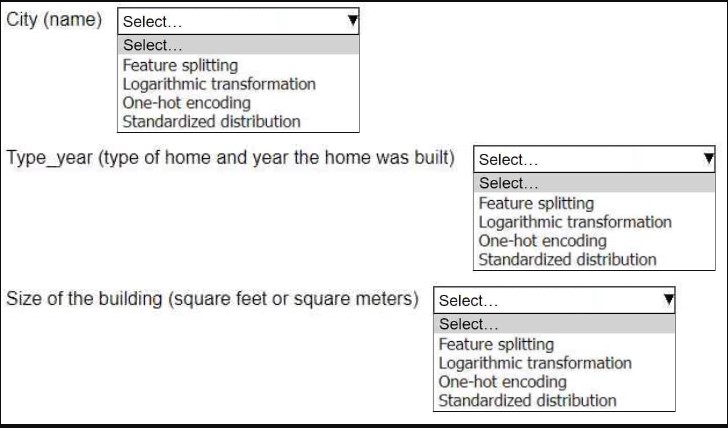
Feature splitting doesn’t seem necessary here since no combined features are mentioned. One-hot encoding fits well for categorical variables, and standardization is good for numeric features with a normal distribution.
I think feature splitting can be ruled out since there’s no mention of combined features like “city-state” or something that needs breaking apart. One-hot encoding is a no-brainer for categorical data like neighborhood or style of house, because numeric models don’t handle categories well. For numeric features, if they're roughly normal, standardization works best, but if the distribution is skewed (like price or area), applying a log transform helps normalize it before feeding into the model. So, the three techniques should be one-hot encoding, log transform, and standardization.
I agree with the points about one-hot encoding for categorical variables and standardization for features that look normally distributed. Even if the question doesn’t specify skewness explicitly, it’s pretty common to apply a log transform to price-related features since prices often have right-skewed distributions. Feature splitting doesn’t seem necessary unless there’s a combined feature like an address or date, which isn’t mentioned here. So I’d skip feature splitting and focus on the other three techniques where they clearly fit best.
If none of the features are combined, then feature splitting can be ruled out. One-hot encoding for categories and standardization for features that look normal make sense. Log transform is for skewed numerical data like price or area.
If there’s no combined feature like an address or date, feature splitting might not fit here. One-hot encoding works for categories, log transform for skewed numeric data, and standardization for features with normal-like distribution.
I think one-hot encoding is definitely for categorical features like neighborhood or type of house. Logarithmic transformation fits when you have skewed numeric features, maybe something like price or lot size. Standardized distribution would make sense for continuous numeric features to normalize them. Feature splitting seems less relevant unless you’re dealing with a combined feature like “year-built and renovation year” together. Since the question doesn’t mention combined features, I’d skip that one here. So basically B, C, and D seem like the best picks to me.
Feature splitting usually targets combined or complex features, so I’d skip it if none are given. One-hot encoding for categories, log transform for skewed numbers, and standardizing for continuous features sounds solid.
I agree with one-hot encoding for categorical features like neighborhood or style, and standardized distribution for numeric features such as square footage or age. Logarithmic transformation makes sense when the price or some numeric feature is heavily skewed, which often happens with prices. Feature splitting seems less relevant unless there's a combined feature that can be broken down, so it might not apply here. So the three techniques I'd pick are one-hot encoding, logarithmic transformation, and standardized distribution.
I think one-hot encoding fits categorical data, logarithmic transformation works for skewed numeric features like prices, and standardized distribution for continuous features. Not sure about feature splitting here.