Free AWS MLA-C01 Actual Exam Questions - Question 11 Discussion
HOTSPOT An ML engineer needs to use Amazon SageMaker Feature Store to create and manage features to train a model. Select and order the steps from the following list to create and use the features in Feature Store. Each step should be selected one time. (Select and order three.) • Access the store to build datasets for training. • Create a feature group. • Ingest the records. 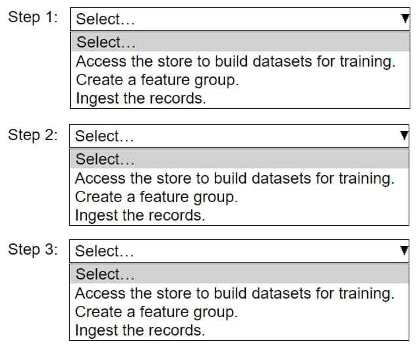
Starting with creating the feature group (B) is essential since it defines the schema. Then ingesting records (C) populates the store, and finally accessing the store (A) lets you build datasets for training.
Starting with creating the feature group sets up the schema and storage. Next, ingesting records fills it with data. Finally, accessing the store lets you build training datasets from those features.
Starting with creating the feature group makes sense since you need that structure first. Then ingesting records follows naturally because you need to populate the feature group before accessing for training data.
I agree the first step has to be creating the feature group since that defines the schema and data structure. Without it, you can't ingest records because there's nowhere to put them. Once data is ingested, the final step is definitely accessing the store to build datasets for training. So the order should be: create a feature group, ingest the records, then access the store. It’s pretty straightforward once you think about setting up before adding data and then using the data after.
Starting with creating a feature group makes sense because that sets up the structure. Then ingesting records fills the group with data, and finally accessing the store is for training dataset prep. The order seems straightforward: create, ingest, access.
You gotta create the feature group first to set up the schema, then ingest records into it. After that, you access the store to pull data for training. The order’s clear: create, ingest, access.
Start by creating a feature group, then ingest the records, and finally access the store to build datasets. Makes the most sense for organizing data flow.