Free AWS AIF-C01 Certified AI Practitioner Actual Exam Questions
Dumps Box (DumpsBox) offers up-to-date practice exam questions for AIF-C01 certification exam which are developed and validated by Amazon – AWS subject domain experts certified in AWS AIF-C01 Certified AI Practitioner . These practice questions are update regularly as we keep an eye on any recent changes in AIF-C01 syllabus, and when there is update our team quickly adjusts the questions. This commitment to providing the best quality exam prep material to certification aspirants is what makes DumpsBox.com the best certification exam prep website. On top of that, our strong, yet strictly moderated, community based feedback keeps the content clean and current. Each question has helpful community discussion that provides it extra perspective and introduces helpful resources for better exam preparation. This also saves students from other outdated practice questions or illicit exam dumps that can have adverse affects on career. Browse through our AWS AIF-C01 Certified AI Practitioner exam questions and pass your exam on first try.
demand. The company uses ML models to make these forecasts.
An AI practitioner is writing a report about the trained ML models to provide transparency and
explainability to company stakeholders.
What should the AI practitioner include in the report to meet the transparency and explainability
requirements?
B. PDPs really stand out because they visually break down how each feature influences the forecast, making it easier for non-technical stakeholders to grasp. Options A and C feel too technical or risky to share openly—code and raw data aren’t usually needed for transparency. D might show the training process but doesn’t explain the actual decisions the model is making, which is what matters most here.
B. Partial dependence plots give clear visuals about feature impacts, which is key for explainability. The other options either expose too much technical detail or don’t directly clarify how the model makes decisions.
identify and categorize the animals in the photos without manual human effort.
Which strategy meets these requirements?
A. Object detection is the best fit since it not only identifies animals but also categorizes them automatically without human input. The other choices don’t really match: anomaly detection looks for weird or rare items, named entity recognition works with text, and inpainting is about filling image gaps. Even if the question doesn’t mention needing exact locations, object detection still covers recognizing and labeling animals directly in images, which meets the requirement better than anything else here.
Not B, since anomaly detection is about spotting outliers, not sorting animals into categories. Object detection (A) fits best because it can find and label each animal automatically.
specific business criteri
a. The company wants to build and use an AI model responsibly to minimize bias that could
negatively affect some customers.
Which actions should the company take to meet these requirements? (Select TWO.)
It’s A and C for me too. Detecting data imbalances is key to spotting bias early, and evaluating the model’s behavior helps keep things transparent and fair for everyone.
C imo, transparency helps identify bias patterns missed initially.
Option A—tokens are the actual text chunks, not their numeric forms.
I'd toss out C and D right away since tokens aren't weights or prompts. Between A and B, tokens are definitely the text chunks before any math conversion, so B feels like a step later in the pipeline. Does that make sense?
a. The company uses an ML model to evaluate the security camera footage for potential thefts. The
company has discovered that the model disproportionately flags people who are members of a
specific ethnic group.
Which type of bias is affecting the model output?
B. If the model flags one ethnic group more often, it could mean the training data didn’t represent that group fairly. When certain groups are underrepresented or overlooked in the sample, the model struggles to generalize and ends up biased. This fits sampling bias because the problem comes from how the data was gathered, not from how features were measured or labeled. Without enough diversity in the training set, the model’s predictions will naturally skew against less represented groups.
C, since observer bias involves human labeling errors that could skew the model’s learning.
The company wants to know how much information can fit into one prompt.
Which consideration will inform the company's decision?
B/C? Context window (B) definitely limits prompt length, but batch size (C) is about how many inputs you process at once, not prompt size. So B feels more relevant here.
B/D? Context window (B) definitely sets the max input length, so it’s crucial for how much fits in a prompt. But model size (D) might also matter since bigger models often come with bigger context windows. Temperature (A) and batch size (C) don’t affect prompt length, so I’d rule those out. Still, knowing the exact context window probably depends on which LLM you pick—so model size could influence that indirectly.
Makes sense that it’s B since ongoing pre-training updates the model with fresh info, helping it adapt better. A and D don’t fit because complexity and inference speed usually aren’t affected by more training, and C is off because more training generally means more time, not less. So improving performance over time is the main benefit here — that’s option B.
D imo, optimizing inference time usually comes from model compression, not ongoing pre-training.
high accuracy and must minimize the risk of incorrect annotations.
Which solution will meet these requirements?
I’m thinking option C might not fit well because while Amazon Rekognition does image recognition, it doesn’t specifically focus on improving annotation accuracy or validation. Also, D with QuickSight seems off since it’s more about data visualization, not annotation or image processing. B talks about data augmentation, which helps expand datasets but doesn’t directly address minimizing incorrect annotations. So really, the question boils down to solutions that ensure annotation accuracy rather than just processing or expanding data. Would you agree the focus is more on quality control than on
A, because human review reduces annotation errors better than automated options.
model (LLM) from Amazon Bedrock for intent detection. The company wants to use few-shot
learning to improve intent detection accuracy.
Which additional data does the company need to meet these requirements?
C/D? Since the goal is intent detection, you'd want user messages paired with their correct intents (C). D seems less relevant because intents leading to responses don’t directly train detection. So C feels more direct.
C/D? Since the goal is intent detection, pairing user messages with intents (C) seems crucial, but having intents linked to responses (D) might help guide the model on expected outcomes too.
in the past 12 months.
Which AWS solution should the company use to automate the generation of graphs?
It’s C because QuickSight is built to handle automated visualizations and reporting, unlike the others which aren’t focused on graph generation. D’s more for chatbot interactions, not creating graphs.
This one’s pretty straightforward since the question’s about automating graph generation for sales data. Amazon QuickSight (C) is designed exactly for this kind of visual analytics and reporting, so it fits best. The other options either don’t exist or serve different purposes, so C makes the most sense here.
well on the training dataset. When the company deployed the model to production, the model's
performance decreased significantly.
What should the company do to mitigate this problem?
This looks like a classic overfitting issue, so C makes the most sense to me.
It’s C because more diverse training data usually helps the model generalize better.
wants to decrease the number of actions call center employees need to take to respond to customer
questions.
Which business objective should the company use to evaluate the effect of the LLM chatbot?
I’m thinking it’s B too because if calls get shorter, employees probably have fewer follow-up tasks, which matches the goal of reducing their actions. B
It’s B because average call duration directly reflects how much time employees spend handling queries, so reducing it shows the chatbot’s effectiveness in cutting down their workload.
The generated content sounds plausible and factual but is incorrect.
Which problem is the LLM having?
B imo. Hallucination fits better because the model is generating info that sounds legit but isn’t actually true. Overfitting (C) usually means memorizing training data too closely, which would cause different problems like poor generalization, not making stuff up. Data leakage (A) would be about the model accidentally training on test data, which isn’t hinted at here. Underfitting (D) means the model hasn’t learned enough patterns, leading to poor performance overall, but not necessarily plausible-sounding false facts. So hallucination is the classic issue where the LLM invents wrong details w
Not C, overfitting usually means the model just memorized training data and doesn’t generalize well, but here the errors are made up content, so B makes more sense as it’s about generating false info.
HOTSPOT A company wants to build an ML application. Select and order the correct steps from the following list to develop a well-architected ML workload. Each step should be selected one time. (Select and order FOUR.) • Deploy model • Develop model • Monitor model • Define business goal and frame ML problem 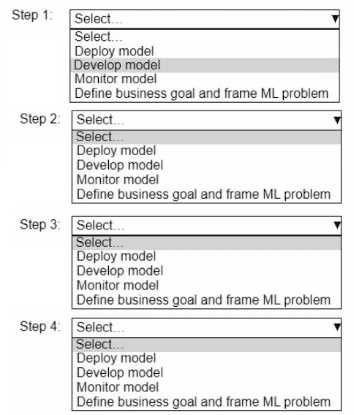
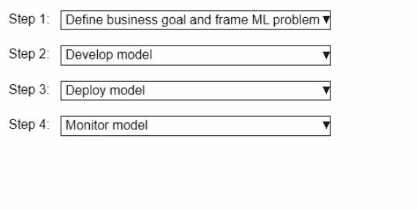
Definitely agree with starting by defining the business goal (D) because without that, the whole process lacks direction. Then developing the model (B) makes sense as the next step since you need something to deploy. Deployment (A) logically follows to actually use the model. Monitoring (C) comes last to keep an eye on how it's performing in real-world conditions and catch any drift or issues. Skipping around or mixing these steps would mess up the workflow and likely cause problems in production.
Starting with defining the business goal (D) sets the direction. Then developing (B) follows naturally, deployment (A) puts it in use, and monitoring (C) checks performance after deployment. Makes logical workflow sense.
deploy the model to make predictions without managing servers or infrastructure.
Which solution meets these requirements?
Maybe D, since SageMaker handles everything serverless, unlike EC2 or EKS.
Managing servers is the key here, so both A and B are out since they require server management. C doesn’t really deploy models, it’s more for content delivery. D fits best as it’s fully managed with no infra to handle.