Free VMware 2V0-21.23 (PSE) Actual Exam Questions
Dumps Box (DumpsBox) offers up-to-date practice exam questions for 2v0-21.23 certification exam which are developed and validated by VMware|VMware > VMware Certified Professional subject domain experts certified in VMware 2V0-21.23 (PSE) . These practice questions are update regularly as we keep an eye on any recent changes in 2v0-21.23 syllabus, and when there is update our team quickly adjusts the questions. This commitment to providing the best quality exam prep material to certification aspirants is what makes DumpsBox.com the best certification exam prep website. On top of that, our strong, yet strictly moderated, community based feedback keeps the content clean and current. Each question has helpful community discussion that provides it extra perspective and introduces helpful resources for better exam preparation. This also saves students from other outdated practice questions or illicit exam dumps that can have adverse affects on career. Browse through our VMware 2V0-21.23 (PSE) exam questions and pass your exam on first try.
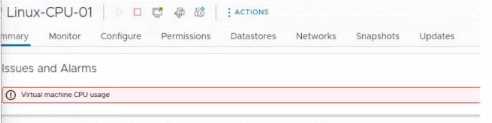
After removing an ESXi host from a cluster for maintenance, a number of virtual machines have
encountered the warning seen in the exhibit. After re-adding the ESXi, the issue is resolved. Which
step should the administrator take to move the triggered alarm to its normal state?
•
The cluster contains two virtual machines (VMs) named app01 and app02.
•
The cluster contains six hosts named esx11 through esx16.
•
The app01 and app02 VMs run software that is licensed to run only on esx11, esx12, or
esx13.
•
vSphere Distributed Resource Scheduler (DRS) is configured
Which set of steps must the administrator perform to ensure that the licensing requirements are met
for app01 and app02?
machine. When looking in vCenter, the administrator can see that there are already users and groups
assigned permissions on the virtual machine as follows:
•
The group VMJJsers has the Virtual Machine Power User role.
•
The group VM_Viewers has the Read Only role.
The administrator confirms that the user requesting the additional access is currently one of five
members of the VM_Viewers group
Which two steps should the administrator take to grant this user the additional access required
without impacting the user access of others? (Choose two.)
machines (VMs). The administrator wants to ensure that VMs run on separate hosts without
interfering with normal maintenance operations.
How should the administrator configure Distributed Resource Scheduler (DRS)?
upgrade. Which interface should the administrator use to complete the restore?
cluster to support the need for additional capacity.
The vSphere cluster currently has four identically configured ESXi hosts (esxOT esx02. esx03 and
esx04) that utilize Intel Skylake-based CPUs. The two new hosts (esx05 and esx06) are configured
identically in terms of memory and storage to the existing hosts: but utilize Intel Ice Lake-based
CPUs.
The administrator must ensure that:
•
Any virtual machine migrates to any of the six ESXi hosts running in the cluster.
•
There is no virtual machine downtime during the process of adding the new hosts.
Which step should the administrator take to meet these requirements?
Standard Switches? (Choose three.)
• Virtual machines (VMs) are running Production and Test workloads
• vSphere Distributed Resource Scheduler (DRS) is enabled
• There are no resource pools in the cluster
Performance monitoring data shows that the Production workload VMs are not receiving their fully
allocated memory when the vSphere cluster is fully utilized.
A combination of which two steps could the administrator perform to ensure that the Production
VMs are always guaranteed the full allocation of memory? (Choose two.)
no additional configuration changes. When attempting to log into the vSphere Host Client using the
Fully Qualified Domain Name (FQDN) of the host, the administrator receives the following error
message:
‘’server Not Found –we can’t connect to the server at esxit101.corp.local.’’
• Host FQDN: esxi 101. Corp. local
• Management VLAN ID: 10
• DHCP: No
• Management IP Address: 172.16.10.101/24
• Management IP Gateway: 172.16.10.1
• Corporate DNS Servers: 172.16.10.5, 172.16.10.6
• DNS Domain: corp.local
Which three high level tasks should the administrator complete, at a minimum, in order to
successfully log into the
the vSphsrs Host Client using the FQDN for the exxi101 and complete the configuration (Choose
three.)
cluster runs workload virtual machines (VMs) that are incompatible with vSphere vMotion, and
therefore cannot be live migrated between hosts during the installation of the patches.
Which configuration in vSphere Lifecycle Manager will allow the administrator to reduce the
downtime associated with the patching operation without migrating the VMs?
top of a physical server to a software-defined data center (SDDC) in a remote secure location.
The following constraints apply:
• The remote secure location has no network connectivity to the outside world.
• The business owner is not concerned if all changes in the application make it to the SDDC in the
secure location.
• The application's data is hosted in a database with a high number of transactions.
What could the administrator do to create an image of the guest OS and application that can be
moved to this remote data center?
monitor the VM performance for a recurrence of the issue.
Which two tools can the administrator use? (Choose two.)
is configured for supporting live virtual machine (VM) migrations.
Which configuration change should the administrator make to isolate live VM migration traffic from
other network traffic?
connectivity states.
Which trigger can be used to quickly identify the issue and alert the administrator so that the issue
can be resolved?
software-defined data center solution.
Which VMware solution should the administrator recommend?