Free The Open Group OGEA-103 Actual Exam Questions
Dumps Box (DumpsBox) offers up-to-date practice exam questions for OGEA-103 certification exam which are developed and validated by The Open Group subject domain experts certified in The Open Group OGEA-103 . These practice questions are update regularly as we keep an eye on any recent changes in OGEA-103 syllabus, and when there is update our team quickly adjusts the questions. This commitment to providing the best quality exam prep material to certification aspirants is what makes DumpsBox.com the best certification exam prep website. On top of that, our strong, yet strictly moderated, community based feedback keeps the content clean and current. Each question has helpful community discussion that provides it extra perspective and introduces helpful resources for better exam preparation. This also saves students from other outdated practice questions or illicit exam dumps that can have adverse affects on career. Browse through our The Open Group OGEA-103 exam questions and pass your exam on first try.
not undergone any formal review and approval process are called______ Documents which have
been reviewed and approved are called ______
Probably A since "finalized" implies completion after a formal process.
B tbh. The word "approved" fits better with the second blank since it's more formal than just "finalized." "Draft" definitely works for the first one, so B sounds like the best match without overcomplicating things. A is close but "finalized" doesn't necessarily mean approved, just completed.
not undergone any formal review and approval process are_______________.
I’d say A, since ‘draft’ is the clearest marker for unfinished docs.
A Calling them ‘draft’ fits usual document workflow terms; it clearly signals they’re not finalized or reviewed yet. B and D seem off since ‘invalid’ or ‘Version 0.1’ aren’t standard for this status.
You are working as an Enterprise Architect within an Enterprise Architecture (EA) team at a large
government agency. The agency has multiple divisions.
The agency has a well-established EA practice and follows the TOGAF standard as its method for
architecture development. Along with the EA program, the agency also uses various management
frameworks, including business planning, project/portfolio management, and operations
management. The EA program is sponsored by the Chief Information Officer (CIO), who has actively
promoted architecting with agility within the EA department as her preferred approach for projects.
The government has mandated that the agency prepare themselves for an Artificial Intelligence (AI)-
first world, which they have called their “AI-first” plan. As a result, the agency is looking to determine
the impact and role that AI will play moving forward. The CIO has approved a Request for
Architecture Work to look at how AI can be used for services across the agency. She has noted that
digital platforms will be a priority for investment in order to scale the AI applications planned. Using
AI to automate tasks and make things run smoother is seen as a big advantage. Process automation
and improved efficiency from manual, repetitive activities have been identified as the key benefits of
applying generative AI to their agency’s business. This will include back-office automation, for
example, for help center agents who receive hundreds of email inquiries. This should also improve
services for citizens by making them more efficient and personalized, tailored to each individual’s
needs.
Many of the agency leaders are worried about relying too much on AI. Some leaders think their
employees will need to learn new skills. Some employees are worried they might lose their jobs to
AI. Other leaders worry about security and cyber resilience in the digital platforms needed for AI to
be successful.
The leader of the Enterprise Architecture team has asked for your suggestions on how to address the
concerns, and how to manage the risks of a new architecture for the AI-first project.
Based on the TOGAF standard, which of the following is the best answer?
C - captures stakeholder concerns clearly in key TOGAF deliverables, not just communication.
I think option C nails it since it focuses on deep stakeholder analysis and capturing concerns in the Architecture Vision and Requirements Specification, which aligns well with TOGAF’s approach. C
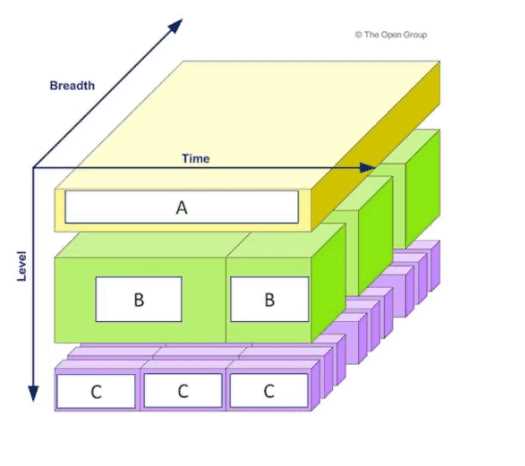
What are the items labelled A, B and C?
It’s A for me. The terms Strategy, Tactic, and Operational Architecture make sense as a hierarchy in architectural planning, moving from high-level goals to specific implementations. The diagram’s layout looks like it’s emphasizing levels of architectural focus rather than just capabilities or segments. Options C and D seem more about capability layers or enterprise segments, which don’t quite fit the naming in the image. B doesn’t really align with those labels either since Architecture Vision and Development are more process-oriented than classification layers.
D. The diagram talks about different architecture levels within the enterprise context. Strategic, segment, and capability architectures align with how organizations break down their architecture scope in layers. The other options don’t capture this hierarchy as cleanly, especially since A and B focus more on strategy and tactics or vision and development, which feels less about the structure shown here.
the Architecture Board?
D doesn’t seem right, it’s more about tracking decisions, not storing agreed requirements.
C
the recommended criteria of_______________
I’m thinking it’s not A or C because consistency and stability don’t really capture the idea of covering every possible situation. Between B and D, robustness usually means strong enough to handle challenges, but completeness sounds more about covering all cases, which fits “every situation perceived” better. Could the key be that the principles don’t just handle situations well but actually include all of them in scope? Wonder if the original text distinguishes that clearly.
B imo, since robustness implies handling all possible conditions well.
breadth of an Architecture Project, and the contents of the EA Repository-?
B, because it covers key architecture levels directly related to EA planning.
I agree with B because it clearly outlines architecture scopes that align with typical EA planning layers. Options A and C don’t really match standard architecture planning purposes. B seems the best fit here.
Consider the illustration showing an architecture development cycle Which description matches the
phase of the ADM labeled as item 2?
A/C? I feel like C might be off because managing requirements is usually continuous and doesn’t fit a single phase label like item 2. Between A and D, A feels more about the nuts and bolts of getting the architecture ready to be rolled out, which seems like what a development cycle needs early on. D sounds more like a later checkpoint or review step. So, item 2 being about implementation planning (A) looks like a better match here.
B imo, because managing change procedures usually come right after defining the architecture.
1. Each contracted party is required to act responsibly to the organization and its stakeholders.
2. All decisions taken, processes used, and their implementation will not be allowed to create unfair
advantage to any one particular party.
3. Digital Transformation and operations will be more effective and efficient.
4. Strategic decision-making by C-Level executives and business leaders will be more effective.
Which statements highlight the value and necessity for Architecture Governance to be adopted
within organizations?
A, since governance is about responsibility and fairness, which 1 and 2 cover.
A, because 1 and 2 focus on rules and fairness that governance ensures.
C, it’s an ongoing process in every phase, not just one or the center focus.
This one feels like D to me. Requirements Management isn’t just about capturing or processing changes; it’s more about keeping both requirements and stakeholder engagement central to the whole ADM process. That continuous focus makes sense instead of just being a step or phase-specific task.
You are the Chief Enterprise Architect at a large food service company specializing in sales to trade
and
wholesale, for example, restaurants and other food retailers.
One of your company's competitors has launched a revolutionary product range and is running a very
aggressive marketing campaign. Your company's resellers are successively announcing that they are
not
interested in your company's products and will sell your competitor's.
The CEO has stated there must be significant change to address the situation. He has made it clear
that
new markets must be found for the company's products, and that the business needs to pivot, and
address the retail market as well as the existing wholesale market.
A consideration is the company's ability and willingness to change its business model, and if it is a
temporary or permanent change. An additional risk factor is one of culture. The company has been
used to a stable business with a reasonably well known and settled client base - all with its own local
understandings and practices.
The CEO is the sponsor of the EA program within the company. You have been engaged with the
sales,
logistics, production, and marketing teams, enabling the architecture activity to start. An
Architecture Vision, Architecture Principles, and Requirements have all been agreed. As you move
forward to develop a possible Target Architecture you have identified that some of the key
stakeholders' preferences are incompatible. The incompatibilities are focused primarily on time-to-
market, cost savings, and the need to bring out a fully featured product range, but there are
additional factors.
Refer to the scenario
You have been asked how you will address the incompatibilities between key stakeholder
preferences.
Based on the TOGAF standard which of the following is the best answer?
A/C? I think A goes further with developing alternatives collaboratively, which feels more hands-on. C is solid too but seems a bit more formal and less about co-creating solutions with stakeholders.
A imo, because it clearly involves working directly with stakeholders to create alternatives and then jointly deciding the best path forward. It’s more collaborative than just relying on criteria or focusing on department heads only.
other principles?
Actually, D seems more about consequences of applying the principle, not relationships. The B section, Rationale, is a better fit since it explains why the principle exists, often referencing other principles.
Option D makes sense since implications would cover how principles connect or affect each other.
You are working as an Enterprise Architect within an Enterprise Architecture (EA) team at an electric
vehicle manufacturer. The company produces electric cars and battery systems. The goal of the
company is to build the best technology and software platform for electric vehicles.
The company has decided to introduce a major change to its vehicle design over a five-year period.
This will be a cross-functional effort between hardware and software teams, delivering significant
new features in the vehicles they manufacture. It is planned to be developed in phases.
An architecture to support strategy has been completed with a roadmap for a set of projects.
The EA team has inherited the architecture for the hardware and software automotive platform used
by current vehicles, some of which can be carried over to the new vehicle design. The EA team has
started to define which parts of the architecture to carry forward.
The presentation and access to different variations of data that the company plans to offer through
its vehicles creates an architecture challenge. The application portfolio and supportinginfrastructure
must connect with multiple cloud services and data repositories in different countries to be able to
handle large-scale data.
Enough of the Business Architecture has been defined, so that work can commence on the
Information Systems and Technology Architectures. These architectures need to be defined to
support the primary business services that the company plans to provide. These services will manage
and process the data created by vehicles, paving the way for self-driving vehicles in the future.
The company uses the TOGAF Standard as the basis for its Enterprise Architecture framework.
The EA team reports to the Chief Technical Officer (CTO), who is the sponsor of the EA program.
The CTO requires that the EA team follow the purpose-based EA Capability model as described in:
The TOGAF Series Guide: A Practitioners’ Approach to Developing Enterprise Architecture Following
the TOGAF® ADM.
Refer to the scenario:
You have been asked how to decide and organize the work to deliver the requested architectures.
Based on the TOGAF standard, which of the following is the best answer?
C imo, because relying on the superior architecture to identify dependencies and risks is key for coordinated project planning. It’s more comprehensive than just updating stakeholders like in A or jumping into roadmaps prematurely like in B.
I think B is worth considering because it talks about reviewing the Architecture Vision and creating the Architecture Roadmap early in the process, which aligns with TOGAF’s emphasis on clear planning before starting work. It also includes estimating costs and getting approval from the Architecture Board, which feels like an important governance step. Unlike A and C, it focuses more on formal steps to move from vision to execution rather than just iterating or relying heavily on the superior architecture. That structured approach could be crucial in a complex, phased project like this.
contain a list of the applications in use within the enterprise?
It’s C for me too. The Architecture Landscape is designed to show what’s currently in use across the enterprise, including applications. The Reference Library is more about guidelines and templates, so it wouldn’t have an actual app list. And the Governance Log focuses on decisions and approvals, not inventories. The Metamodel just defines how info is structured; it’s not a storage of actual data like app lists. So the Landscape fits best as it provides a snapshot of the enterprise’s current architecture, including apps.
D imo, Governance Log might track app usage changes or approvals over time.
will address the gaps?
C imo. Phases B, C, and D are where you define and develop the architecture, so it makes sense that you’d identify gaps and start associating them with specific work efforts early on. Assigning detailed work packages feels a bit later, but linking gaps to potential solutions starts here before moving into planning in Phase F. That initial connection between gaps and work packages is critical before you formalize everything in migration planning.
B imo. Phase F is where you actually plan the migration and assign those work packages to fix gaps. Phase E is more about managing changes after that.